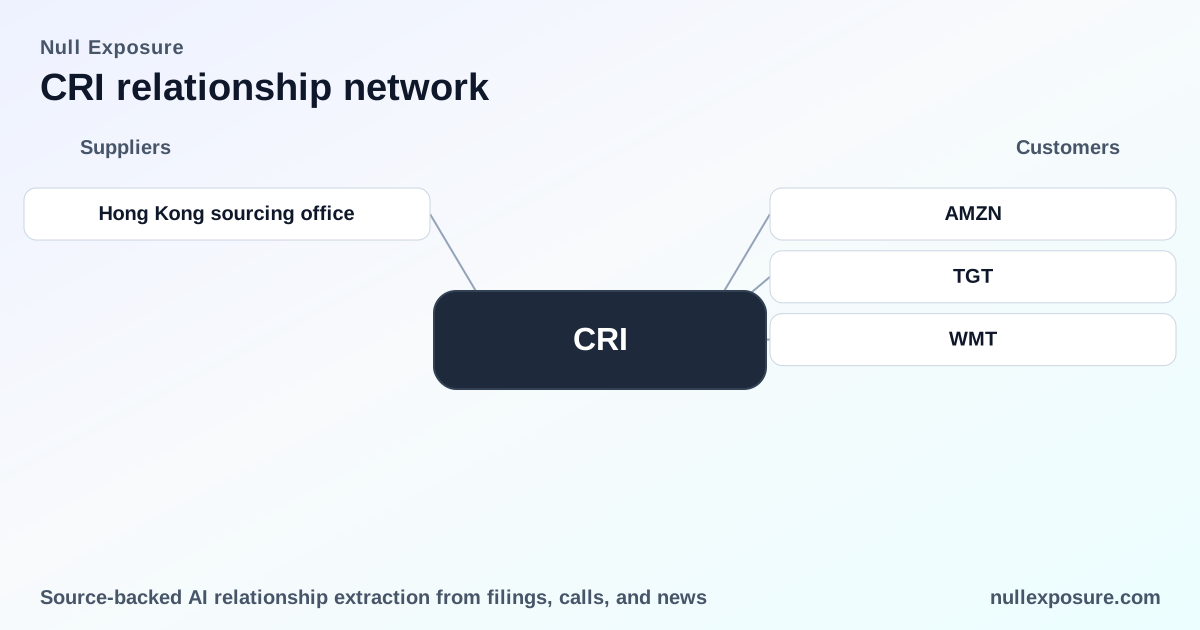
Carter's (CRI) — Retail partnerships that define distribution, margin and concentration
Carter’s monetizes through a blended retail-wholesale model: it designs and markets children’s apparel, sells directly through its own stores and eCommerce sites, and distributes branded product to large national retailers under wholesale agreements and brand exclusives. Revenue derives from three segments — U.S. Retail, U.S. Wholesale and International — and the company’s go-to-market depends on deep placement with a handful of major retail partners that both drive volume and compress margin volatility. For active investors and operators, understanding those customer relationships is the primary lens on sales durability, working capital exposure, and pricing power.
Explore a service that tracks partner concentration and counterparty risk at scale: https://nullexposure.com/
Executive summary: what the customer map implies for valuation and risk
Carter’s is a branded consumer goods firm with high customer concentration in wholesale channels and a large North American footprint. The two largest wholesale accounts represented 10.9% and 10.1% of consolidated net sales in fiscal 2024, signaling material counterparty risk if buying behaviors shift. The company sells via long-standing contractual arrangements to major retail chains and sources product through global manufacturers, which makes its operating model dependent on retail distribution, inventory management, and promotional dynamics rather than on bespoke manufacturing relationships.
Key operating characteristics:
- Contracting posture: Predominantly wholesale distribution agreements and retail placement contracts, with brand exclusives for specific retail partners.
- Concentration: Material — top two wholesale customers combined exceed 20% of sales in FY2024.
- Criticality: Retail partners are critical channels for national distribution and seasonal sell-through.
- Maturity: Established, repeat relationships with major national retailers and a stable brand portfolio.
How Carter’s uses branded exclusives and platform partners
Carter’s allocates brands strategically across retail channels to capture multiple customer segments and maximize shelf space and online reach. This is a deliberate distribution design: some Carter’s-owned labels are exclusive to specific retailers, while others are distributed broadly to mass platforms to boost scale and reduce inventory risk on Carter’s own stores.
Channel-level relationship review (each relationship in the results)
Amazon.com (AMZN)
Carter’s distributes its Simple Joys brand through Amazon, positioning the label for broad online reach and convenience-driven shoppers; this channel supports eCommerce scale and complements Carter’s own web sales. According to Carter's investor release dated February 23, 2026 (Business Wire via FinancialContent), Simple Joys is available on Amazon.com (FY2026).
Source: Carter’s press release, Feb 23, 2026 (Business Wire / FinancialContent).
Target (TGT)
Carter’s places its Just One You brand at Target, leveraging Target’s curated family assortment and national store footprint to target value-oriented and middle-market customers. Carter’s press release on February 23, 2026 states that Just One You is available at Target (FY2026).
Source: Carter’s press release, Feb 23, 2026 (Business Wire / FinancialContent).
TGT (duplicate entry)
The dataset includes a separate entry for TGT reflecting the same relationship: Carter’s associates the Just One You brand with Target as a dedicated retail placement, reinforcing Target’s role as a strategic wholesale partner for Carter’s mid-tier label distribution (FY2026).
Source: Carter’s press release, Feb 23, 2026 (Business Wire / FinancialContent).
Walmart (WMT)
Carter’s distributes the Child of Mine brand exclusively through Walmart, using that exclusive to secure broad mass-market presence and predictable high-volume placements across Walmart’s physical and online channels. Carter’s Feb 23, 2026 press release identifies Child of Mine as available exclusively at Walmart (FY2026).
Source: Carter’s press release, Feb 23, 2026 (Business Wire / FinancialContent).
WMT (duplicate entry from a different article)
A separate CityBiz item on Carter’s strategic distribution also notes that the company distributes products through major retail partners including Walmart, Target, and Amazon, corroborating the retailer list and emphasizing Carter’s multi-channel wholesale strategy (May 2026). This duplicate record confirms Walmart’s centrality to Carter’s mass-market distribution approach.
Source: CityBiz news article, May 4, 2026.
What these relationships imply for cash flow, inventory and negotiating leverage
- Revenue stability but concentrated exposure. Exclusive placements (Child of Mine at Walmart; Just One You at Target) create predictable volume streams but increase single-buyer dependence; the FY2024 disclosure that two wholesale customers represented 10.9% and 10.1% of net sales is the quantitative anchor for that risk.
- Margin trade-offs. Placement with mass retailers drives scale and inventory velocity but compresses gross margins due to promotional allowances, chargebacks, and cooperative advertising—line items the company discloses as part of net sales adjustments.
- Working capital sensitivity. Large retail partners impose ordering cadence and return/chargeback mechanics that increase receivable and inventory complexity relative to pure direct-to-consumer models.
Constraints and company-level signals (how Carter’s operates beyond named partners)
Carter’s governance and filings provide clear signals about operating constraints and the practical limits of its model:
- Large-enterprise counterparties dominate wholesale relationships; the company lists Costco, JCPenney, Kohl’s, Macy’s, Sam’s Club, and others as wholesale customers, indicating a buyer base composed of major national retailers (company filing language).
- Geographic concentration is North America-first. The U.S. Retail and U.S. Wholesale segments are the revenue core; international sales skew toward Canada, though Carter’s reports wholesale licensees in over 90 countries outside North America.
- Materiality is present at the company level. The two largest wholesale customers together represent roughly one-fifth of sales, a fact reported for fiscal 2024 and indicative of concentration risk under stress scenarios.
- Relationship posture is active and mature. Carter’s reports ongoing sales to wholesale customers and continues to structure brand exclusives with national retailers, indicating operational maturity rather than nascent channel testing.
Investment implications and risk checklist
- Positive: Strong brand recognition, diversified brand architecture across retail tiers, and scale via mass retail partners support predictable gross revenue and stable inventory turnover.
- Negative: Concentration among a few large wholesale accounts exposes Carter’s to ordering shifts, promotional pressure, or category re-merchandising by those retailers; working capital and margin volatility are the main execution risks.
For a deeper read on how partner concentration impacts revenue risk and receivables dynamics, review our platform’s partner-level exposures and counterparty trend tracking. https://nullexposure.com/
Bottom line
Carter’s commercial strategy is distribution-first: the company extracts margin and scale by assigning brands to distinct retail channels, securing exclusives with national buyers while maintaining direct retail. That structure produces stable top-line channels but material counterparty concentration, which investors must weigh against brand strength and operating execution when modeling downside scenarios.