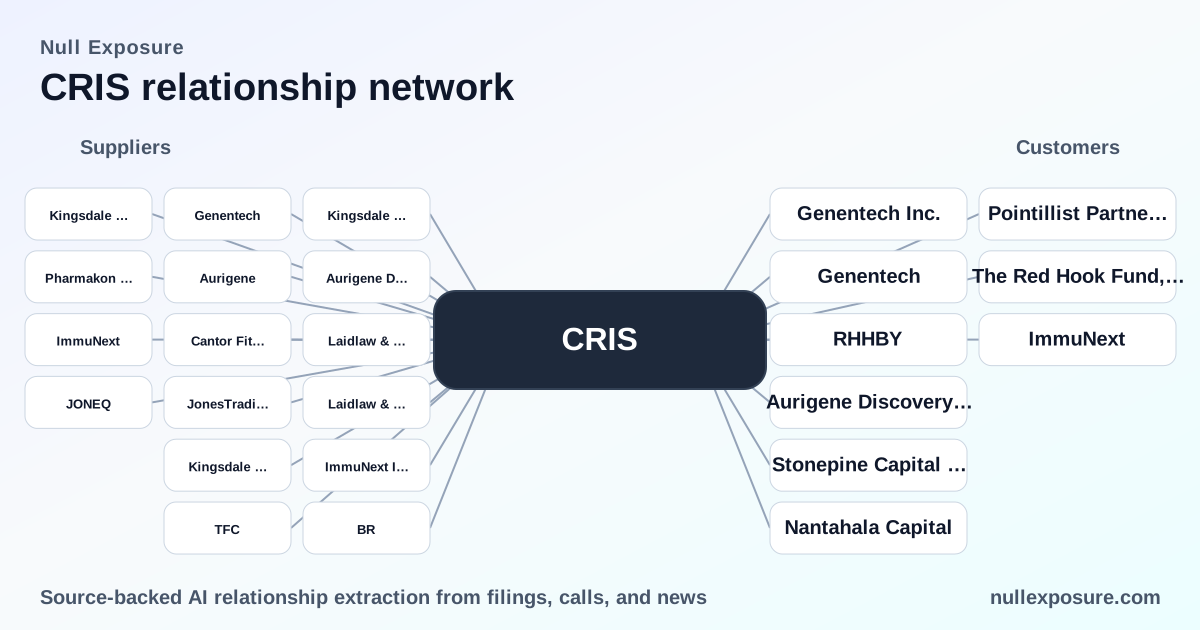
Curis (CRIS): Revenue by partnership — one counterparty and a pivot toward monetization
Curis operates as a small-cap oncology developer that monetizes through licensing and royalties on out‑licensed products, supplemented intermittently by asset sales and equity financings. The company’s commercial cash flow is dominated by a single partner that commercializes Erivedge; recent corporate actions — including an asset sale and capital raises — shift the risk profile from operating royalties toward one‑time monetizations and external financing. For investors and operators evaluating customer exposure, the central fact is clear: Curis’ revenue model is concentrated, partner‑dependent, and now supplemented by active balance‑sheet management.
For more context on partner concentration and deal flow, visit https://nullexposure.com/.
Business snapshot: Curis discovers and develops oncology candidates, then licenses commercialization rights to larger biopharma partners who pay royalties and milestone payments; the company records royalties as its principal revenue and periodically monetizes assets through sales or financings.
Key takeaways
- Extreme revenue concentration: Genentech accounted for virtually all Curis’ gross revenue in FY2024.
- Commercial outsourcing: Curis relies on larger partners for commercialization of approved assets (notably Erivedge).
- Recent de‑risking via monetization: A sale of Erivedge produced a one‑time gain in late 2025, and a private placement closed in early 2026.
- Capital markets activity: Strategic financings brought in institutional and hedge funds as new investors.
How the partnership map actually looks — one paragraph per relationship
Genentech Inc.
Genentech is Curis’ primary commercial partner: Curis licensed Erivedge® to Genentech (a Roche group member), and royalties from Genentech represented $10.9 million in 2024 — 100% of Curis’ gross revenues — and $9.9 million in 2023 (99% of gross revenues), per Curis’ 2024 Form 10‑K. According to multiple press releases and investor communications in FY2025, Genentech (through the Roche family) continues to commercialize Erivedge for advanced basal cell carcinoma. (Sources: Curis 2024 Form 10‑K; Curis press releases/earnings commentary FY2025.)
Roche (RHHBY)
Roche is the corporate parent in the commercial chain: public filings and company announcements describe Genentech as a member of the Roche Group that, together with Roche, commercializes Erivedge. Investors should view Roche/RHHBY as the ultimate commercial engine behind Erivedge distribution and price/volume outcomes. (Sources: Curis press releases and news items referencing Roche/Genentech collaboration, FY2020–FY2025.)
Aurigene Discovery Technologies, Ltd.
Curis has historical collaboration amendments with Aurigene relating to development and commercialization of CA‑170; under amended terms Aurigene received rights in portions of Asia in addition to its Indian and Russian rights, indicating Curis’ strategy of regional licensing to accelerate development and share commercialization risk. (Source: PR Newswire release on collaboration amendment, FY2020.)
ImmuNext
Curis engaged ImmuNext in a collaboration to develop CI‑8993, a monoclonal anti‑VISTA antibody, reflecting the company’s pattern of partnering early‑stage immuno‑oncology assets to third parties for development progress. (Source: PR Newswire release on collaboration terms, FY2020.)
Oberland
Curis recorded a $27.2 million one‑time non‑cash gain in Q4 2025 attributable to the sale of Erivedge to Oberland, per an earnings call transcript, signaling a strategic monetization of a legacy commercial asset and a material shift from recurring royalties to an upfront sale accounting. (Source: Q4 2025 earnings call transcript cited on Investing.com, FY2026.)
The Red Hook Fund, LP; Stonepine Capital Management; Pointillist Partners, LLC; Nantahala Capital
These four investment groups led a private placement that closed in early 2026; public reporting lists The Red Hook Fund, Stonepine, Pointillist and Nantahala among the lead investors. This financing provides fresh capital and introduces institutional investors into Curis’ cap table as part of its near‑term liquidity strategy. (Source: Financial press reports/Finviz coverage of the private placement, FY2026.)
How these relationships define Curis’ operating model and risk profile
- Contracting posture: Curis acts primarily as licensor and partner, not as a solo commercial operator; the company’s agreements transfer commercialization responsibility and market risk to larger biopharma partners. That model conserves internal commercial spend but concentrates counterparty exposure.
- Revenue concentration and criticality: The 10‑K disclosure that Genentech royalties accounted for ~100% of gross revenue in FY2024 is the dominant structural signal — revenues are critically dependent on one partner and one marketed asset. That level of concentration magnifies counterparty and product risk. (Source: Curis 2024 Form 10‑K.)
- Maturity of assets: Erivedge is a marketed product whose commercialization has been handled by an established partner; Curis has chosen to monetize that legacy asset through sale to Oberland, suggesting a move toward portfolio pruning and capital redeployment. (Source: Q4 2025 earnings commentary, FY2026.)
- Liquidity and capitalization posture: The FY2026 private placement led by institutional investors signals active balance‑sheet management and willingness to dilute or realign ownership to secure runway. (Source: Finviz and related press coverage, FY2026.)
Risks and what to watch next
- Royalty tail risk vs. one‑time gains: The sale of Erivedge reduces future royalty exposure but replaces recurring income with a finite accounting gain; assess how management intends to replace recurring revenue. (Source: Q4 2025 earnings call, FY2026.)
- Partner execution risk: Any changes in Genentech/Roche commercial strategy historically would have had outsized impact; with Erivedge sold, watch for how remaining collaborations (Aurigene, ImmuNext) progress toward value inflection points. (Sources: PR Newswire FY2020; Curis press updates FY2021–FY2025.)
- Capital dependence: Recent financings bring institutional backing but also shift governance and expectations; monitor cash runway and milestones tied to collaborator development programs. (Source: Finviz/press reports, FY2026.)
Conclusion — investor implications
Curis is not a diversified commercial operator; it is a partner‑centric biotech that historically derived almost all revenue from a single licensing relationship and is now pivoting through asset sale and external financing. For investors and operators, the company should be evaluated as a licensing/royalty business whose near‑term value drivers are the progress of partnered development programs and the effectiveness of management’s capital allocation following the Erivedge sale. For a structured view of contract counterparties and real‑time relationship tracking, see our platform at https://nullexposure.com/.
If you’d like a tailored briefing on counterparty concentration risks or a comparable peer analysis, visit https://nullexposure.com/ for our full coverage and model outputs.