Comstock Resources (CRK): Customer Relationships and Commercial Outlook
Comstock Resources operates as an independent oil and natural gas producer focused on the Haynesville and other North American basins, monetizing through the sale of produced gas and oil into both contracted and spot markets, plus selective asset monetizations and strategic supply agreements that broaden long‑term offtake channels. Investors should value CRK both as an asset‑backed upstream producer with commodity price exposure and as a company executing tactical monetizations and commercial partnerships to stabilize cash flow. For a structured lens on customer counterparty risk and commercial strategy, visit https://nullexposure.com/.
How Comstock sells product and what that means for revenue
Comstock sells natural gas and oil as its core products, reporting them separately in its financials and operating primarily in Texas and Louisiana. The company’s commercial posture combines three elements that define investor risk and optionality:
- Contracting posture (spot + index + fixed): Comstock explicitly sells production on a mix of first‑of‑month indexed contracts, daily spot market pricing, and occasional fixed‑price arrangements, which creates direct sensitivity to short‑term price cycles while allowing opportunistic hedging or fixed deals when available.
- Geographic concentration: Operations are concentrated in North America (Haynesville, Louisiana and Texas), which gives logistic and market advantages into Gulf Coast and U.S. power hubs but limits geographic diversification.
- Customer concentration and materiality: The company disclosed two purchasers representing material percentages of gas and oil sales in 2024 (21% and 12%), but the 10‑K states that losing any single purchaser would not have a material adverse effect because alternate buyers exist; this positions counterparty risk as immaterial at the corporate level.
- Product criticality and segment focus: Natural gas is the company’s core product; strategic partnerships to supply power generation hubs shift some volumes into higher‑duration channels that increase revenue visibility relative to spot sales.
These characteristics combine into a model where commodity exposure remains the dominant revenue driver, while asset sales and long‑term supply deals are being used to reduce cash‑flow volatility and support balance‑sheet flexibility.
Detailed readout of every reported customer and advisor relationship
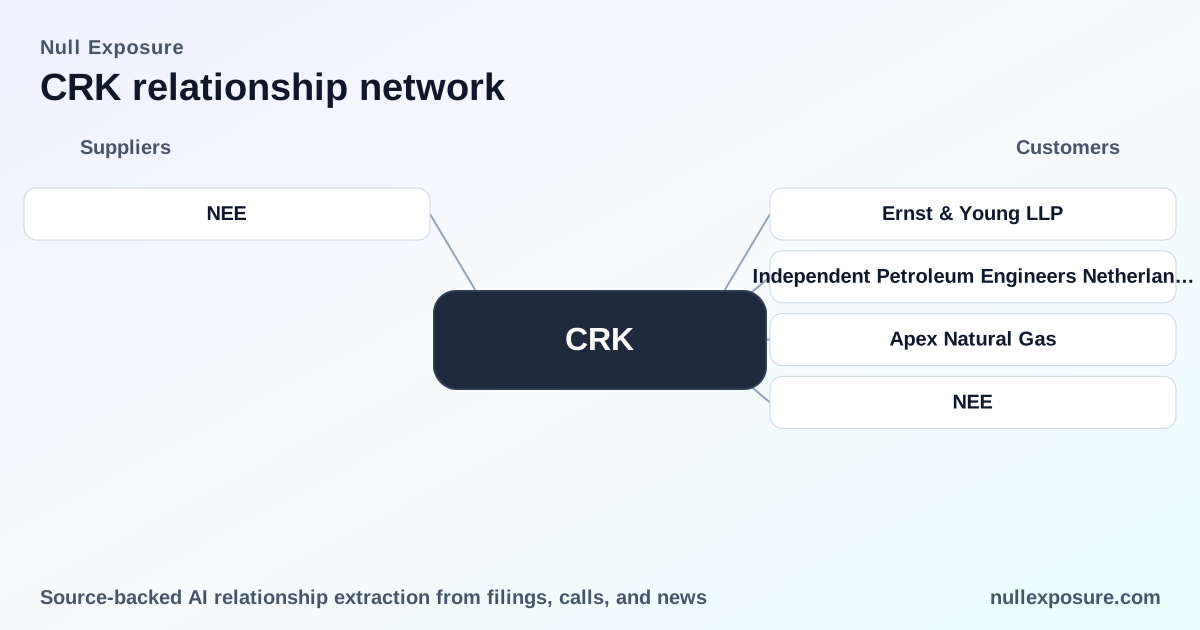
Ernst & Young LLP — Auditor consent listed in FY2024 10‑K
Comstock’s FY2024 10‑K includes the consent of Ernst & Young LLP, reflecting the firm’s role in auditing and attesting to Comstock’s financial statements for the period. According to the FY2024 Form 10‑K (filed Dec. 31, 2024), Ernst & Young provided the required audit consent language for the filing. (Source: Comstock FY2024 10‑K.)
Netherland, Sewell & Associates, Inc. — Independent petroleum engineer consent in FY2024
The 10‑K also cites the consent of independent petroleum engineers Netherland, Sewell & Associates, Inc., indicating the firm provided independent reserve and engineering work used in Comstock’s disclosures of proved and probable reserves. This consent is recorded in the FY2024 Form 10‑K. (Source: Comstock FY2024 10‑K.)
Apex Natural Gas — Asset sale buyer (Texas assets, ~ $430M)
Bloomberg and Reuters coverage reported that Apex Natural Gas agreed to acquire Comstock’s Texas natural gas assets for approximately $430 million, a transaction structured to monetize acreage and redeploy proceeds into core Haynesville development and balance‑sheet priorities; the deal was reported in December 2025 with closing scheduled later that month. (Source: Bloomberg coverage via TradingView and Finviz, December 2025.)
NextEra Energy / NextEra Energy Resources — Strategic offtake and power‑hub partner
Comstock has announced a strategic commercial collaboration with NextEra Energy / NextEra Energy Resources to supply natural gas from its Western Haynesville operations to planned gas‑fired power generation in Anderson County, Texas, part of a broader U.S.–Japan trade initiative; Comstock projects the facility could require volumes approaching 1 Bcf/day by 2031, with near‑term hub plans of multiple gigawatts (reported as up to 5.2 GW, with potential expansion). The March 23, 2026 press release and contemporaneous coverage describe NextEra as the builder/operator and Comstock as the supplier for the project. (Source: GlobeNewswire press release and related March 2026 coverage; additional context in Comstock news and TradingView reporting.)
What those relationships mean for valuation and downside protection
- Audit and engineering consents (Ernst & Young; Netherland, Sewell) are governance signals that validate reserve reporting and financial disclosure quality; these are standard but necessary; investors can treat them as confirmation that reserve and financial statements have passed third‑party attestations.
- Apex asset sale is a liquidity and portfolio‑management event. The ~$430 million Texas sale crystallizes value from non‑core acreage, reduces near‑term capital intensity, and improves flexibility to fund Haynesville development or pay down leverage. Bloomberg/Reuters reporting places the transaction in December 2025.
- NextEra partnership is commercially transformative. Supplying a major power‑generation hub operated by NextEra shifts a portion of Comstock’s production into a longer‑dated, large‑volume offtake channel, which materially improves forward cash‑flow visibility relative to purely spot sales; that channel also underpins midstream build‑out economics referenced in analyst coverage. Coverage spans March–May 2026 press releases and market writeups.
Risk profile tied to customers and contract mix
- Commodity price exposure remains the primary revenue risk because a sizeable share of sales is executed on first‑of‑month index and daily spot pricing; this configuration increases earnings volatility but preserves upside in commodity rallies.
- Customer concentration is present but non‑critical: two purchasers represented larger shares in 2024, yet the company’s 10‑K states loss of any single buyer would not be material given available markets for its production, reducing counterparty default risk as a systemic threat.
- Strategic partnerships can reduce volatility if executed: longer‑term supply to large buyers like NextEra will convert a portion of spot volumes into contractually anchored sales, improving EBITDA predictability and supporting valuation multiples tied to resilience.
Bottom line — investable thesis and key takeaways
- Comstock is an upstream gas‑focused operator that monetizes via spot/index sales, targeted asset sales, and selective long‑term supply agreements. Asset monetization to Apex and the NextEra power–hub supply deal together shift the company toward a mix of liquidity enhancement and growing contracted demand.
- Primary risks remain commodity price volatility and execution of midstream/offtake projects, but current disclosures treat customer concentration as immaterial and provide third‑party validation of reserves and financials.
- Key investor action: monitor build‑out milestones for the NextEra hub and the completion/earn‑outs around the Apex sale; these events will materially affect forward cash‑flow visibility and the balance‑sheet trajectory.
For a deeper, counterparty‑level analytics view and ongoing monitoring of Comstock’s commercial relationships, visit https://nullexposure.com/.