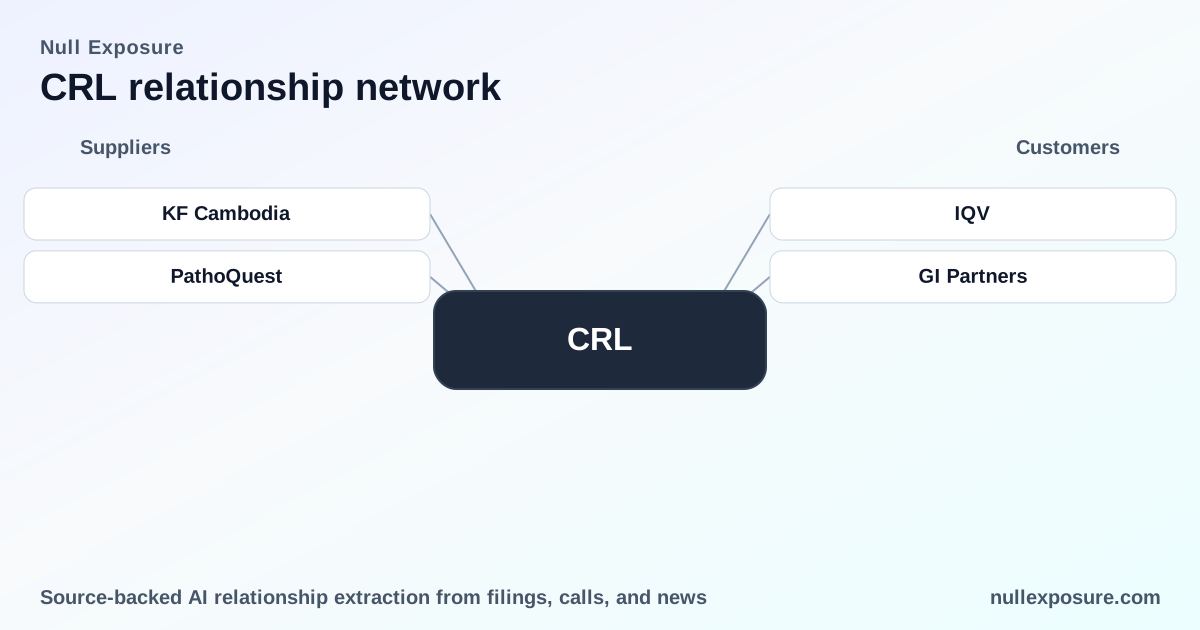
Charles River Laboratories (CRL) — customer relationships, recent deals, and operational signals for investors
Charles River Laboratories operates and monetizes as an outsourced solutions provider to the life‑sciences industry: it sells regulated and non‑regulated discovery and safety assessment services, research models and manufacturing/CDMO offerings to large pharmaceutical, biotech, academic and government customers, and recognizes the bulk of service revenue over time as work is performed. Revenue is diversified across services and geographies, with high operational scale in early‑stage R&D and growing manufacturing capabilities; cash flows depend on steady program throughput rather than single large contracts. Read more company coverage at https://nullexposure.com/.
Quick investor thesis
CRL is a services‑led platform that captures margin through scale, regulated capabilities, and integrated offerings across discovery, preclinical safety and manufacturing. The business model emphasizes recurring program work and short contractual payment cycles, low customer concentration, and geographically distributed capacity, which supports resilience but exposes CRL to execution risk during disposals and portfolio reshaping.
How to read the recent relationship activity
Recent headlines show CRL reshaping its portfolio of discovery and CDMO/cell solutions assets while maintaining active customer work across biotechs and academic partners. Two strategic divestitures and routine client manufacturing relationships define the near‑term picture: one buyer consolidates European discovery assets (IQVIA), another investor (GI Partners) picks up CDMO and Cell Solutions businesses under contingent arrangements, and ongoing customer manufacturing relationships continue with emerging biotech clients. These moves change revenue composition and capital intensity; investors should treat them as deliberate portfolio optimization rather than operational distress.
- Key takeaway: portfolio reshaping reduces CRL’s exposure to lower‑margin manufacturing over time and concentrates capital on higher‑margin discovery and safety services, but transition creates short‑term guidance risk.
Relationship-by-relationship breakdown (all documented links)
Below I summarize every relationship captured in the sourced results with concise sourcing.
IQV / IQVIA Holdings Inc.
Charles River agreed to sell certain European drug discovery/discovery services assets to IQVIA (IQV), for an upfront cash consideration in the mid‑hundreds of millions including contingent payments; those assets generated roughly $144 million in revenue in 2025. This transaction shifts European discovery capacity to a competitor/partner and provides CRL with immediate liquidity while trimming discovery footprint. Source: company press coverage and market reports (BioSpace press release and MarketScreener and TradingView coverage, March 2026 — see https://www.biospace.com/press-releases/iqvia-signs-agreement-to-acquire-drug-discovery-assets-from-charles-river-laboratories-expanding-end-to-end-drug-discovery-capabilities and related March 2026 articles).
GI Partners
CRL signed an agreement to sell its CDMO and Cell Solutions businesses to GI Partners, structured primarily with contingent, performance‑based payments and targeting businesses that produced combined revenue of about $143 million in 2025. The structure signals CRL’s intent to de‑risk capital intensity while monetizing assets through private capital that will assume operational scaling risk. Source: analyst and press summaries (Investing.com and TradingView coverage, May–March 2026 — see https://www.tradingview.com/news/tradingview:e9f331d6aee70:0-charles-river-laboratories-to-divest-cdmo-cell-solutions-and-european-discovery-assets-updates-2026-guidance/).
FibroBiologics (FBLG)
FibroBiologics reports that Charles River manufactured and released master and working cell banks for its CYWC628 program under FDA cGMP standards, with those banks passing safety tests early in 2026. That engagement illustrates CRL’s role as a regulated manufacturer supporting small‑cap biotech clinical supply needs. Source: FibroBiologics shareholder letter and coverage (GlobeNewswire and follow‑up commentary, January 7, 2026 — see https://www.globenewswire.com/news-release/2026/01/07/3214533/0/en/FibroBiologics-CEO-Issues-Letter-to-Shareholders.html).
SYBX (SybioX / referenced study)
Academic and industry work has relied on Charles River facilities for non‑human primate (NHP) safety studies under standard animal welfare and public health policies; a 2021 Nature article cites NHP studies performed at Charles River in compliance with regulatory guidance. This highlights CRL’s longstanding role as a contract research provider for academic and translational projects. Source: Nature article (2021 citation referenced in March 2026 aggregation — see https://www.nature.com/articles/s41467-021-26524-0).
Company-level operating constraints and what they mean for investors
The source evidence provides several consistent company‑level signals that inform CRL’s operating model and counterparty profile.
- Contracting posture — short‑term billing and low financing windows. CRL’s contracts generally do not include significant financing components and payment terms rarely extend beyond one year; revenue recognition is tied to progress. This produces higher cash visibility within a 12‑month window and reduces long‑dated receivable risk relative to long‑term fixed‑price projects.
- Customer concentration — low and diversified. No single client accounted for more than 4% of total revenue in 2024, and no client exceeded 8% in any segment, which is a material signal of diversified top‑line exposure and reduced customer credit concentration risk.
- Counterparty profile — large enterprises and government customers. The client base explicitly includes major global pharmaceutical companies, academic institutions and government agencies, indicating a mix of high‑credit counterparties and project‑focused smaller biotechs.
- Geography and scale — truly global operations. CRL operates over 130 sites in 20+ countries with commercial teams across North America, EMEA and APAC; this supports broad market access but increases operational complexity and regulatory compliance costs.
- Role and maturity — both service provider and manufacturer. CRL runs three reportable segments (RMS, DSA, Manufacturing) and acts as both regulated manufacturer (CDMO/Cell Solutions) and specialized service provider (DSA). The firm is actively rebalancing this mix through disposals noted above.
- Relationship criticality — active, programmatic engagements. Client programs are ongoing and recognized over time; these are mission‑critical to customers’ development timelines but rarely single‑client dominant.
Collectively, these constraints imply a resilient, diversified service business with predictable near‑term cash flows, but sensitivity to portfolio‑level capital redeployment and execution on divestitures.
Investment implications and risks
- Positive: Diversification and short payment cycles support cash generation and reduce counterparty concentration risk. Strategic divestitures (IQVIA, GI Partners) recycle capital and focus CRL on higher‑margin DSA services.
- Negative: Selling manufacturing assets reduces future CDMO revenue but also lowers capital intensity; contingent earn‑outs create execution‑dependent proceeds. Global footprint means currency and regulatory variability remain persistent risks.
What investors should watch next
- Integration and earn‑out performance under the GI Partners and IQVIA transactions will drive near‑term cash and margin outcomes.
- Revenue mix shifts across DSA vs Manufacturing over the next two quarters will indicate whether CRL successfully upgrades margin profile.
- Client program wins among large pharma vs biotech will show demand resilience; monitor segment guidance and backlog metrics in quarterly releases.
For a structured view of customer relationships and commercial exposures, visit https://nullexposure.com/ for detailed mapping and monitoring tools.
Bottom line
Charles River is a diversified, service‑heavy life‑sciences partner with low client concentration and a global operating footprint; recent deals reallocate capital away from manufacturing intensity toward strategic discovery and safety services. These actions strengthen cash flexibility while introducing short‑term execution risk tied to contingent deal payments and portfolio transition. Investors should weigh the improved margin profile against the timing and certainty of transaction proceeds when modeling CRL’s near‑term earnings trajectory.