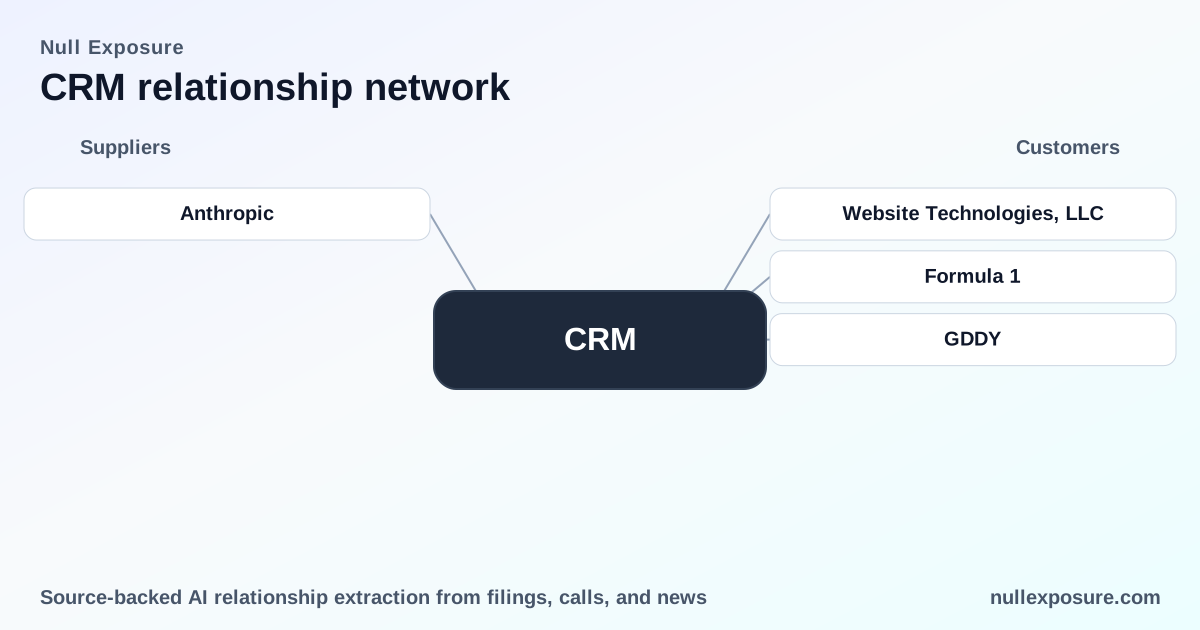
Salesforce (CRM): The CRM backbone, monetized by subscription and services
Salesforce sells multi-tenant cloud software and complementary enterprise services, monetizing primarily through subscription and term-license fees, support, and professional services to a global customer base; its scale, platform integrations and partner ecosystem convert product adoption into recurring revenue and high-margin upsell opportunities. For investors this is a subscription-led, enterprise-focused SaaS franchise with broad vertical reach and significant integration-driven stickiness. For more counterparty insights visit https://nullexposure.com/.
How Salesforce’s customer relationships shape the business model
Salesforce’s public disclosures and market mentions collectively paint a picture of a company that contracts mainly on subscription and term‑license models, sells upmarket through longer enterprise sales cycles while servicing SMBs with packaged offerings, and derives revenue from both software and professional services. The firm’s multi-tenant, platform‑centric architecture and partner ecosystem drive high switching costs and cross-sell potential, even as litigation and security incidents show the operational and reputational risks that accompany large-scale deployments.
- Contracting posture: Predominantly subscription with term licensing and support revenue components reported in the FY2025 filing.
- Concentration: No single customer contributed >10% of revenue in recent years, indicating low customer concentration at the revenue line-item level.
- Customer mix and criticality: Salesforce serves small business through large enterprise clients globally, and its systems are often embedded into critical customer workflows.
- Maturity and scope: The platform is mature, integrated across ecosystems (MuleSoft, Data Cloud, Agentforce), and supported by a broad system‑integrator and ISV partner network.
- Litigation & legacy risk: Per the FY2025 10‑K, Salesforce faces legacy litigation tied to a former customer (Website Technologies), a company‑specific disclosure that confirms a terminated customer relationship and downstream legal exposure.
If you want structured counterparty scoring and signal aggregation for CRM counterparties, explore our coverage at https://nullexposure.com/.
Customer roster — what each relationship reveals
-
Website Technologies, LLC: Salesforce disclosed in its FY2025 10‑K that it was named in state and federal actions tied to a former customer affiliated with Backpage, reflecting a terminated customer relationship and litigation exposure. (Source: Salesforce FY2025 10‑K)
-
EGAN (EGAN): eGain reports pre‑built integrations and deep connectors to platforms including Salesforce; management cites Salesforce as a target integration for product enhancements. (Source: EGAN Q4 2025 earnings call / GlobeNewswire, 2026)
-
Capstone Holding Corp. (CAPS): Capstone announced plans in 2026 to reduce reliance on legacy vendors including Salesforce as it pursues a “full stack AI” strategy. (Source: Globe and Mail / StockTitan, Mar 2026)
-
Data I/O (DAIO): Management says Service Cloud powers ticket intake and customer service workflows after a recent Service Cloud rollout. (Source: Investing.com / earnings call transcript, May 2026)
-
GIC (Global Industrial Company): Completed rollout of Salesforce across sales, marketing and service teams, signaling platform consolidation. (Source: InsiderMonkey transcript, Mar 2026)
-
Americas Car-Mart (CRMT): Scaled a Salesforce‑powered Collections CRM from pilot to broader rollouts, reaching ~15% of stores by Q3. (Source: InsiderMonkey / Investing.com transcripts, 2026)
-
Globant (GLOB): Recognized by Salesforce for expert-level implementation in MuleSoft, Data Cloud and Agentforce, highlighting system integrator leadership on Salesforce platforms. (Source: SahmCapital press release, Dec 2025)
-
Betterware de México (BWMX): Announced launch of a new CRM with Salesforce to service consultants and leaders, part of its Jafra + platform rollout. (Source: BWMX Q4 2025 earnings call, Mar 2026)
-
Banco Bradesco (BBD): Reported deployment of Salesforce for company segment beginning in 2024. (Source: Investing.com earnings-call transcript, May 2026)
-
BBAR (BBVA Argentina): LatinFinance coverage highlights Salesforce integrations improving CRM and customer experience in Argentina. (Source: 100Seguro / LatinFinance, FY2024 reporting)
-
Bed Bath & Beyond (BBBY): Public commentary links a tokenization/digital wallet initiative to Salesforce and Agentforce technology. (Source: Chain Store Age / public remarks, 2025)
-
The Children’s Place (PLCE): Migrated e‑commerce operations to Salesforce Customer Cloud in February 2026. (Source: FashionUnited, Apr 2026)
-
Otonomo (OTMO): Otonomo App is built on the Salesforce Platform and is available on AppExchange. (Source: Yahoo Finance / Dreamforce coverage, 2022 reference)
-
Formula 1: Expanded use of Agentforce 360 to streamline fan support and marketing as part of a deepened multi‑year partnership. (Source: Finviz / InsiderMonkey coverage, Mar 2026)
-
PG&E / Emberpoint (PCG‑P‑E): Salesforce committed to contribute to the digital foundation for Emberpoint, integrating disparate data for wildfire response. (Source: Homeland Prep News, Mar 2026)
-
Sprout Social (SPT): Global partnership with Salesforce delivers a 360° customer view and social customer care integrations. (Source: Sprout Social insights and webinars, 2022–2026)
-
TTEC (TTEC): Partnerships with Salesforce are cited as part of its contact center and AI Gateway integrations across platforms. (Source: GlobeNewswire / customerthink / Taiwan News, 2025–2026)
-
Unisys (UIS): Announced expanded collaboration with Salesforce to deliver AI‑driven field services at scale. (Source: PR Newswire, Apr 2026)
-
Bandwidth (BAND): Partnered with Salesforce on voice and messaging infrastructure for Agentforce contact centers. (Source: SahmCapital, Mar 2026)
-
Kemper Corporation (KMPR): Reports and breach notices claim hackers exfiltrated data from a Salesforce account; investigation and legal notices followed. (Source: Cybernews / PR Newswire, May 2026)
-
McGraw‑Hill (MH): Reported a data breach tied to a compromised Salesforce environment; the company worked with Salesforce to strengthen protections. (Source: BleepingComputer, May 2026)
-
Verb (VERB): Offers a CRM product with Salesforce synchronization for small businesses. (Source: GlobeNewswire archival release, 2021 referenced)
-
Docebo (DCBO): Market notes highlight “Docebo for Salesforce,” an integration that embeds learning into Salesforce workflows. (Source: Yahoo Finance / DCBO product pages, 2026)
-
AvePoint (AVPT): Positions governance and data protection across Salesforce and other cloud environments. (Source: GlobeNewswire, Feb 2026)
-
GoDaddy (GDDY): Disclosed MuleSoft integration and AI agent identity work with Salesforce in Q4 2025 reporting. (Source: SahmCapital, Mar 2026)
-
Aebi Schmidt (AEBI): Migrated operations to Salesforce to unify IT platforms by Nov 1 (per company commentary). (Source: Investing.com transcript, 2025)
-
Five9 (FIVN): Integration ties with Salesforce and other platforms support tailored AI/contact-center tools. (Source: TradingView / Zacks, 2026)
-
SharkNinja (SN): Invested in DTC infrastructure including Salesforce and a site redesign. (Source: TradingView / Zacks, May 2026)
-
ConnectOne Bancorp (CNOB): Management mentions various tools but includes Salesforce among enterprise systems supporting operations. (Source: Benzinga / earnings transcript, 2026)
-
Coca‑Cola FEMSA (KOF): Rolling out a Salesforce tool (Juntos Plus Advisor) in Mexico to support digital initiatives. (Source: Investing.com transcript, 2025)
-
nCino (NCNO): Company filing flags adverse changes in its relationship with Salesforce as a material risk point. (Source: GlobeNewswire / press release, 2026)
-
Privia Health (PRVA): Working with technology partners including Salesforce as part of clinical and administrative integrations. (Source: InsiderMonkey / Globe and Mail, 2026)
-
Moderna (MRNA): Reported selection of Agentforce to consolidate commercial operations (per market reports). (Source: MarketScreener, Apr 28, 2026)
-
Intermedia Unite (INTM): Product reviews note enterprise-tier integrations with Salesforce among other CRMs. (Source: PCMag review, 2024)
-
AirSculpt Technologies (AIRS): Recorded a $4.5M impairment tied to a portion of a Salesforce implementation project. (Source: company fourth-quarter report, 2025)
-
Justworks (JW): Lists Salesforce CRM among platform tooling. (Source: BuiltIn company profile, 2025)
-
Phreesia (PHR): Breach notice identified impact from a third‑party tool operated by Salesforce (Salesloft Drift). (Source: Strauss Borrelli / breach investigation, 2026)
-
Endava (DAVA): Strengthening partnership with Salesforce, investing in agent/Agentforce applications. (Source: InsiderMonkey transcript, 2026)
-
Stran Company (SWAG): Cited CRM integrations including Salesforce for automated workflows and consolidated reporting. (Source: Globe and Mail press release, 2026)
-
ADT (ADT): Implemented Salesforce across operations as part of an AI and digital transformation to handle customer service requests. (Source: ADT definitive proxy / StockTitan, 2026)
-
Wyndham Hotels (WH): Notes that providers like Salesforce contribute to AI-enabled shared services and operational efficiency. (Source: InsiderMonkey transcript, May 2026)
-
Choice Hotels (CHH): Deploying intelligent agents through a partnership with Salesforce to improve franchise operations and group demand capture. (Source: InsiderMonkey earnings transcript, 2026)
-
Definitive Healthcare (DH): Launched a Salesforce pilot for physician data and reduced integration time via automation. (Source: GlobeNewswire / earnings transcript, 2026)
-
GCMG (GCMG): Uses Salesforce to evaluate business development performance and sales analytics. (Source: SEC filing, Dec 31, 2025)
(For brevity in this investor note the above list consolidates the dataset’s unique customer relationships and their cited references.)
Investment implications — concentrated strengths and visible risks
- Strengths: Recurring revenue model, platform stickiness via integrations (MuleSoft, Data Cloud, Agentforce), a large partner ecosystem and low single‑customer revenue concentration support durable cash flows and upsell economics.
- Risks: Litigation tied to legacy customers, security incidents at large customers using Salesforce, and selective customer decisions to reduce dependence on legacy vendors are operational and reputational risks that can pressure adoption and professional services revenue.
Bottom line for investors
Salesforce is a highly monetized, subscription-first enterprise SaaS platform whose growth is driven by platform expansion, integrations and enterprise adoption; investors should weigh that recurring revenue strength against litigation and third‑party security risks documented across customer deployments. For systematic counterparty risk analytics and to track these signals over time, see our analysis hub at https://nullexposure.com/.