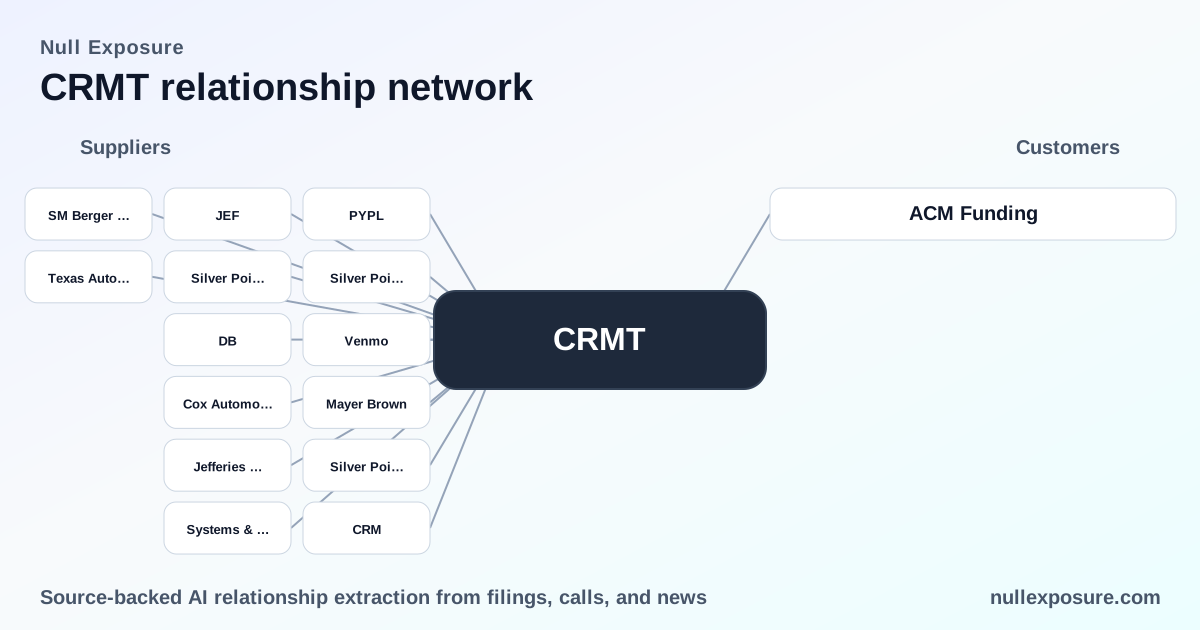
Americas Car-Mart (CRMT): Customer Relationships, Receivables and the Financing Engine
Americas Car‑Mart is an integrated used‑car retailer that monetizes through vehicle sales and captive-style installment financing to predominantly subprime individual buyers, then converts finance receivables into liquidity via securitization and receivables sales. The company's cash generation is therefore a function of retail throughput, credit spreads embedded in high‑rate installment contracts, and access to capital markets or funding counterparties to monetize originated receivables. For investors, the interplay between origination economics and receivables monetization is the primary value driver and risk pivot.
Learn more on the firm's network and customer relationships at https://nullexposure.com/.
The business model in one line: retail + finance, financed by the market
Americas Car‑Mart operates at the intersection of vehicle retailing and consumer finance. The company sells older model used vehicles at an average retail price near $19,400 (fiscal 2025), and finances substantially all purchases with installment contracts that typically run 18 to 79 months and carry fixed annual interest rates between 12.99% and 23.0%. Those longer‑dated contracts create durable assets on the balance sheet that the company converts to cash by selling or securitizing receivables to funding counterparties. Company disclosures and fiscal reporting show this integrated flow is the core, reportable segment and the principal revenue generator.
Operating characteristics that shape investor returns
Several company‑level signals determine how to value CRMT’s customer relationships and finance portfolio:
- Contracting posture and maturity: Installment contracts are long‑term receivables (average term ~48.3 months). That duration translates into meaningful interest income but also elongates exposure to credit migration and defaults.
- Customer counterparty profile: Contracts are written to individuals with impaired or limited credit histories, creating higher yield but elevated loss risk relative to prime financing.
- Geographic concentration: Sales and receivables are concentrated in the South‑Central U.S., with a notable share of revenue from Arkansas and neighboring states, amplifying regional economic and regulatory sensitivity.
- Materiality and critical accounting: Contract modifications affected $436.1 million (28.9%) of gross finance receivables as of April 30, 2025, and the allowance for credit losses is identified as a critical accounting estimate — a structural vulnerability for earnings volatility.
- Economic scale per account: Average retail price places the company in the sub‑$100k spend band, consistent with unit economics driven at the used‑car, high‑turn volume level.
- Role profile and product focus: CRMT functions simultaneously as seller, buyer (of financing outcomes), and service provider under an integrated sales‑and‑finance model, and the business reports a single core product segment centered on this integration.
- Relationship stage: Financing is an active part of everyday sales; the company originates and services receivables as a routine operating activity.
These are company‑level characteristics drawn from fiscal disclosures and form the lens through which each funding relationship should be assessed.
How receivable sales and securitization alter credit and liquidity dynamics
The firm’s ability to convert installment books into cash depends on counterparties willing to purchase or warehouse receivables and on the credit markets’ appetite for securitized subprime auto paper. CRMT’s financials show meaningful revenue—$1.343 billion in trailing twelve months—and a gross profit cushion ($603 million), but operating profitability and net income are under pressure (negative operating margin and EPS in the latest reported period). That disparity highlights the reliance on non‑operating liquidity solutions (receivables sales/securitization) to sustain growth and free cash flow. Market valuation metrics (market cap ~$104 million; EV/EBITDA ~44.8) imply investor skepticism around earnings durability and capital structure execution.
Relationship inventory: who buys the receivables
- ACM Funding — Americas Car‑Mart executed a purchase agreement with ACM Funding on December 17, 2025 to facilitate the transfer of auto receivables into a securitization trust, effectively monetizing originated installment contracts through an external funding counterparty. This agreement is presented as a material receivables transfer instrument in public reporting and press coverage. (Source: TradingView reporting on the December 2025 purchase agreement.)
This list includes every customer‑scope relationship surfaced in available reporting.
Why the ACM Funding tie matters to investors
The ACM Funding arrangement is not ancillary; it is part of the structural plumbing that converts installment receivables into cash. A dedicated receivables purchaser or funding SPV impacts:
- Liquidity timing: Sales to ACM Funding accelerate cash conversion versus holding loans to maturity.
- Risk transfer: The degree to which credit risk is retained versus transferred affects future volatility in provisions and earnings.
- Funding capacity: Access to ACM Funding and similar investors dictates the pace at which CRMT can scale origination without depleting balance sheet liquidity.
According to the December 2025 agreement reported publicly, the transaction’s explicit purpose was to enable transfer into a securitization trust, underlining CRMT’s reliance on external funding lines for receivables monetization (TradingView, March 2026 coverage).
What investors should monitor next
- Allowance for credit losses and modification metrics. The company identified modifications affecting $436.1 million of receivables, and the allowance is a critical estimate—watch quarterly movements and disclosure detail.
- Funding counterparties and contract economics. Monitor renewals or term changes with ACM Funding and any new purchasers that change the effective yields or credit retention profile.
- Originations and portfolio seasoning. With average terms near four years, the vintage profile and cumulative loss experience will determine future write‑offs.
- Regional macro and regulatory conditions. Sales concentration in the South‑Central U.S. concentrates exposure to state‑level policy and economic cycles.
- Liquidity and valuation signs. Given the company’s modest market cap and high EV/EBITDA, any weakening in funding access would amplify valuation downside.
For a deeper view of relationship dynamics and comparative funding counterparty behavior, visit https://nullexposure.com/.
Bottom line for investors
Americas Car‑Mart’s integrated retail‑and‑finance model drives higher yields through subprime installment contracts but requires continuous access to funding partners to monetize those assets. The ACM Funding purchase agreement is emblematic of the company’s business model: origination of long‑dated, higher‑yield receivables paired with external securitization liquidity. Credit provisioning, receivable modification volume, and the stability of funding counterparties are the decisive variables for returns and downside protection. Investors should treat CRMT as a financing‑intensive retailer where balance‑sheet management and counterparty relationships are as material to valuation as unit sales and gross margins.