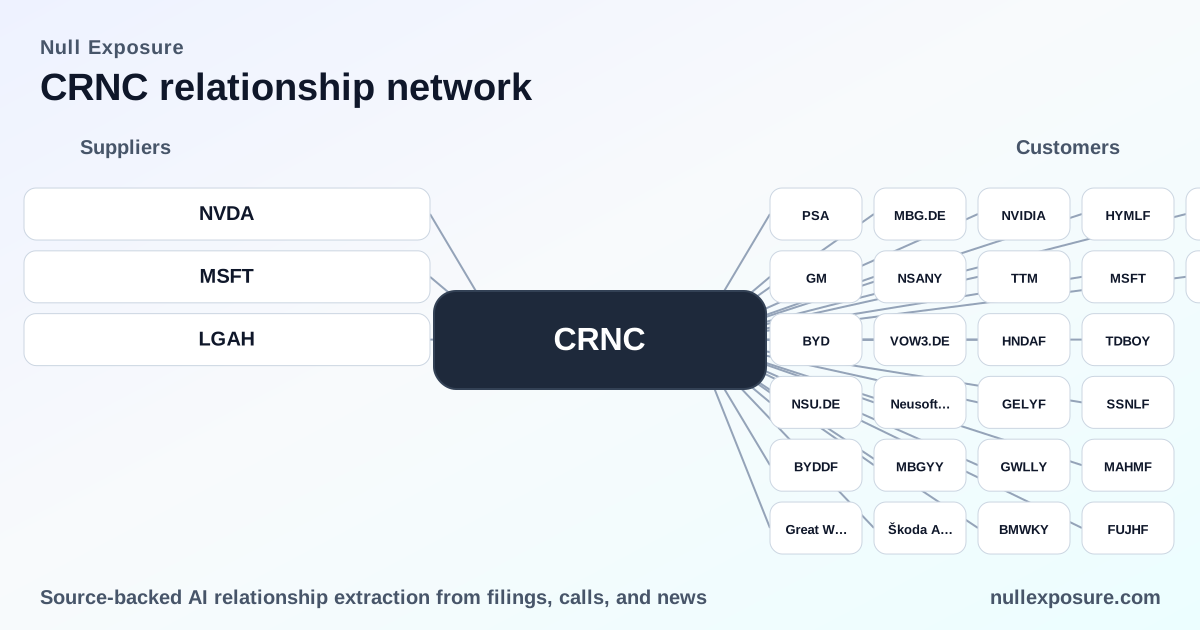
Cerence (CRNC) — customer map and what it means for revenue durability
Cerence builds in-car conversational and generative AI software and monetizes through per‑unit software licenses, multi‑year cloud subscriptions and professional services to automakers and cockpit software suppliers. Its commercial model blends high‑margin perpetual license revenue for edge components with recurring, usage‑linked cloud services and service fees for integration — a mix that scales with OEM production cycles and global platform rollouts. For a deeper look at the underlying signals and relationship footprints, visit https://nullexposure.com/.
Why customers matter: platform economics and concentration
Cerence’s go‑to‑market is focused on large OEMs and tier‑1 suppliers; the company sells software licenses for head units, provides cloud subscriptions for connected features, and delivers integration and maintenance services. That combination produces front‑loaded license receipts plus recurring revenue that is correlated with vehicle programs, and management consistently frames these as multi‑year engagements that give visibility into future revenue. The company’s own disclosures and call commentary show a global footprint across EMEA, APAC and the Americas, and the business is sensitive to a small number of large customer programs — losing a top relationship would materially affect results.
(If you want the full dataset and relationship signals in one place, explore https://nullexposure.com/.)
Customer relationships — what the public record shows
Below I list every customer relationship surfaced in recent filings and media mentioning Cerence; each entry is a concise plain‑English summary with the source noted.
PSA
Cerence reported that a generative AI program with PSA went live in fiscal Q3, indicating deployment into production vehicles. Source: Q3 FY2025 earnings call (crnc-2025q3-earnings-call).
BYD
Cerence is integrating its next‑generation conversational AI into BYD’s Atto 2 DM‑i for Europe, and management confirmed BYD started production programs in Q4 and Q3 rollouts; BYD is a recurring, strategic OEM customer. Sources: Automotive News (FY2026) and Q4 FY2025 / Q3 FY2025 earnings commentary.
BYDDF
Management highlighted a BYD program outside China spanning 14 languages, illustrating Cerence supports Chinese OEMs’ global expansion. Source: Q3 FY2025 earnings call (crnc-2025q3-earnings-call).
GM
Cerence cited program extensions and renewals with GM alongside new design wins, signaling continued platform adoption with North American OEMs. Source: Q3 FY2025 earnings call.
Škoda Auto
Škoda’s Laura voice assistant expanded capabilities through integration of Cerence’s Chat Pro, showing Cerence’s tech is used to enhance brand assistants. Source: Škoda press release (FY2026).
Mercedes‑Benz (MBG.DE / MBGYY / Mercedes)
Cerence signed a professional services agreement with Mercedes‑Benz and was named as the AI voice provider for Mercedes models (for example CLA EV), reflecting both services and embedded software relationships. Sources: Q3 FY2025 earnings call; Automotive News (FY2025).
Nissan (NSANY)
Nissan’s generative AI program with Cerence went live in fiscal Q3 alongside other OEM rollouts, indicating production deployments. Source: Q3 FY2025 earnings call.
NSU.DE / Audi
Audi is listed among programs that went live in Q3; separately, management noted a Volkswagen Group brand selected Cerence xUI for next‑gen systems. Sources: Q3 FY2025 earnings call; Q3 FY2025 earnings call (Volkswagen Group mention).
Volkswagen Group (VOW3.DE)
Cerence signed a Volkswagen Group deal for one of its brands to adopt xUI as the basis of its next‑gen system, a strategic platform win inside a global OEM. Source: Q3 FY2025 earnings call.
Neusoft Corporation / Neusoft
Cerence signed an MoU to embed its conversational and generative AI into Neusoft’s NAGIC intelligent cockpit platform for joint development and distribution. Source: Neusoft press releases and multiple news reports (FY2026).
Great Wall Motor
Management cited program extensions and renewals with Great Wall Motor, reflecting ongoing business with Chinese OEMs. Source: Q3 FY2025 earnings call.
JLR (Jaguar Land Rover) / TTM
Cerence expanded generative AI capabilities with JLR and is working in parallel to build future in‑car experiences based on xUI. Source: Q3 FY2025 earnings call.
Hyundai
Management listed Hyundai among new design wins in Q3, signaling additional OEM adoption in Korea. Source: Q3 FY2025 earnings call.
Microsoft / MSFT
Cerence is partnering with Microsoft to roll out a mobile work agent that brings Microsoft 365 Copilot, Teams and Outlook into the car through voice‑first interfaces. Source: Q4 FY2025 earnings call and industry reporting (FY2025).
NVIDIA
Management disclosed plans to expand partnerships with NVIDIA as part of platform and compute collaborations for AI deployments. Source: Q4 FY2025 earnings call.
Samsung / SSNLF
Cerence resolved litigation with Samsung that resulted in a one‑time lump‑sum payment of $49.5 million in the period, a non‑recurring boost to revenue. Source: Q4 FY2025 earnings call and subsequent press coverage (FY2026).
Toyota / TDBOY
Cerence announced deals with Toyota to bring generative AI‑powered solutions into Toyota vehicles, reflecting large OEM traction. Source: Q4 FY2025 earnings call.
Geely / GELYF / Geely Auto
Geely selected Cerence xUI for next‑generation LLM‑powered in‑car experiences; management also reported Geely programs went live in Q3 and Q4. Source: Q3/Q4 FY2025 earnings calls and FY2026 press items.
BMW / BMWKY
BMW was named among key wins in the quarter, indicating additional premium OEM engagement. Source: Q4 FY2025 earnings call.
Mahindra
Mahindra’s program was listed among generative AI deployments that went live in fiscal Q3. Source: Q3 FY2025 earnings call.
Subaru
Subaru was one of nine programs that started production in Q4, suggesting a production ramp. Source: Q4 FY2025 earnings call.
Ford / FOVSY
Cerence signed deals to expand its audio AI presence across Ford’s lineup, indicating both voice and audio AI penetration. Source: Q4 FY2025 earnings call.
Daihatsu / DDMGF
Daihatsu was listed as a new design‑win alongside Hyundai, representing Cerence’s wide OEM reach in Asia. Source: Q3 FY2025 earnings call.
Operating model constraints that drive commercial risk and optionality
- Contract mix: Cerence sells edge software under per‑unit perpetual licenses while also offering multi‑year cloud subscriptions and usage‑based connected services, creating a hybrid revenue profile that combines upfront license revenue with recurring streams (company disclosures).
- Counterparty profile: Customers are large enterprises (major global OEMs and tier‑1 suppliers), which provides scale but concentrates risk — management warns that loss of a largest customer would be material.
- Geography and concentration: Revenue is global (FY2025 split roughly 16% Americas, 42% Europe, 42% Asia), so product wins in one region can meaningfully move top‑line growth.
- Relationship maturity: Cerence’s ties are long‑term and mature, built over decades with many OEMs and suppliers; this yields visibility but couples revenue to vehicle program life cycles.
- Product mix: The business combines software, cloud services and professional services, which smooths volatility but ties growth to both software adoption and ongoing service contracts.
- Special case — Nuance IP history: Cerence’s public filings note historical intellectual property and licensing arrangements with Nuance, which illustrate the company’s role as both licensor and licensee in industry IP flows (company filing excerpts).
Investment implications: what to watch
- Production ramps at BYD, Geely, Volkswagen Group and Mercedes are the primary levers for recurring revenue growth; program start dates and language/region scope (for example BYD’s 14‑language program) are leading indicators.
- Mix shift toward cloud/usage will increase revenue predictability if subscriptions and usage fees scale as vehicles come online.
- Non‑recurring items (Samsung settlement) distort short‑term comparatives; investors should normalize results when modeling recurring margins.
For a structured view of these customer signals and to monitor future call and press mentions in one place, visit https://nullexposure.com/.
Overall, Cerence’s customer footprint is broad, strategically aligned with major OEM platform programs, and structured to convert design wins into mixed license and recurring revenue streams — but success depends on execution of multi‑year production ramps and the migration of OEMs toward cloud‑backed in‑car AI.