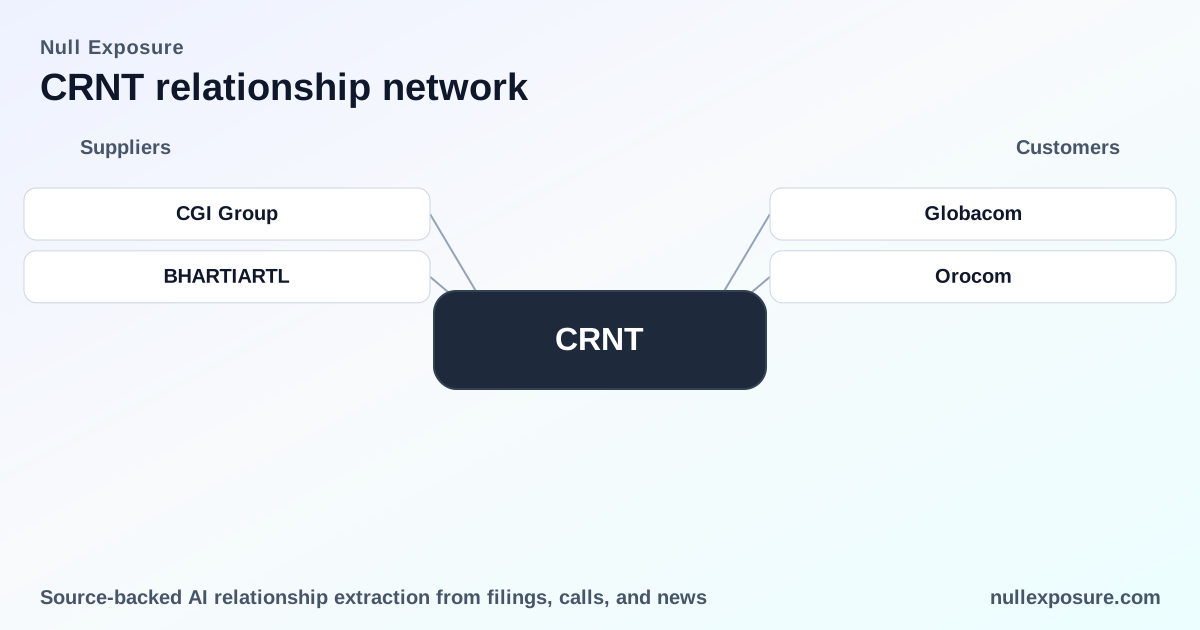
Ceragon Networks (CRNT): Customer Relationships That Drive Revenue and Risk
Ceragon Networks sells wireless backhaul equipment and managed solutions to mobile carriers and service providers, monetizing through large, project-based hardware sales, multi-year service contracts, and recurring maintenance. The business converts network expansion demand in emerging and developed markets into lump-sum and follow-on revenue streams; execution on those projects determines near-term profitability and cash flow. For deeper research coverage visit the Null Exposure platform: https://nullexposure.com/.
Executive snapshot: how Ceragon earns its keep
Ceragon is a niche communications-equipment vendor focused on backhaul products that connect cell sites to core networks. Its commercial model is project-led with a recurring services overlay: customers buy high-capacity transport platforms and then purchase installation, network optimization, and ongoing support. Financially, the company reported Revenue TTM of $338.7M and Gross Profit TTM of $114.6M, while Market Capitalization stands near $230M, reflecting the small-cap profile and execution sensitivity of the business. Operating margin is positive on a TTM basis, but quarterly growth and EPS are volatile, underscoring the dependence on timing and profitability of large customer projects.
Key structural drivers:
- Project concentration: large carrier deals drive revenue inflections.
- Capital intensity for customers: carriers invest in physical backhaul, making Ceragon a vendor to critical infrastructure.
- Margin leverage: successful delivery and after-sales services expand margin profile; delivery failures or project overruns compress margins.
Customer relationships in the record: concrete examples and sources
The source set for customer relationships includes two discrete items that reveal Ceragon's customer profile and execution outcomes. Each relationship below is summarized in plain English with the relevant source noted.
Globacom (Nigeria) — network expansion contract
Ceragon signed a multimillion-dollar network expansion deal to supply a customized solution covering long-haul rural links, high-capacity metro transport, and access networks for Globacom, enabling the operator to expand geographic reach and improve subscriber experience. According to a DevelopingTelecoms report on March 9, 2026, the deal spans both rural and metro segments and is explicitly structured to grow Globacom’s market share (DevelopingTelecoms, March 2026).
Orocom (Peru) — large Peru project that produced financial strain
A major project executed in Peru with Orocom generated debt that materially increased Ceragon’s reported loss for FY2023, signaling execution or contractual issues on that engagement. Israeli business paper Globes noted the FY2023 impact and traced part of the company’s increased debt to the Peruvian project with Orocom (Globes, March 2026).
What these relationships reveal about Ceragon’s operating posture
The two documented relationships expose a clear commercial pattern and hazard set:
- Contracting posture — project-centric and customized: The Globacom contract is a bespoke, multi-segment engagement, consistent with Ceragon’s positioning as a solutions provider rather than a commodity supplier. Projects combine hardware, software, and integration services, which elevates both pricing power and execution complexity.
- Concentration and customer criticality: Carrier customers like Globacom and Orocom represent high-criticality counterparties for whom backhaul is essential; losing or underdelivering on such contracts directly affects carrier rollouts and Ceragon’s reputation. This dynamic generates outsized revenue swings tied to a small number of deals.
- Maturity and execution risk: The Orocom case shows that large projects can produce balance-sheet volatility when execution or contractual structures generate unforeseen costs or payment timing problems. That outcome signals that Ceragon’s maturity as a program integrator has not fully immunized it against project-level overruns.
- Geographic exposure: The documented deals span Nigeria and Peru, demonstrating exposure to emerging-market operators where buildouts are both growth engines and operationally demanding.
No customer-scope constraints were reported in the reviewed records; this absence is a company-level signal rather than a relationship-specific exemption. In other words, there are no explicit constraint entries captured for CRNT customer records in the provided material.
Investment implications — balancing upside with execution risk
The customer evidence supports a thesis of earnings leverage tied to large carrier rollouts, but also highlights execution-induced margin volatility.
Opportunities:
- High potential pricing on tailored solutions: Customized deals like the Globacom engagement allow Ceragon to extract premium pricing and win multi-segment deployments.
- Aftermarket revenue: Ongoing maintenance and optimization services create recurring revenue streams that stabilize margins when projects are executed cleanly.
Risks:
- Project execution and receivables: The Orocom-Peru episode is a concrete example of how a single project can erode earnings and increase debt, making Ceragon’s P&L and cash flow sensitive to project delivery and payment terms.
- Customer and geographic concentration: A small number of large customers in emerging markets increases event risk; wins drive outsized upside while losses or delays produce outsized downside.
- Margin and growth volatility: Reported quarterly revenue declines and negative EPS trends in recent periods reflect the operational leverage inherent in Ceragon’s project model.
Investors should weigh Ceragon’s technical niche and carrier-level relationships against the track record of project complexity and balance-sheet sensitivity. Analysts’ consensus (Analyst Target Price around $4.54) and the company’s improving forward P/E signal a constructive view from some coverage, but these valuations presuppose improved project execution and contract structuring.
Strategic considerations for operators and partners
For carriers evaluating Ceragon as a vendor, the customer records deliver two operational takeaways:
- Procure with contract protections: Given the execution history, carriers should require clear milestones, performance guarantees, and payment-safeguards on large buildouts.
- Demand integrated delivery plans: The combined rural and metro scope of deals like Globacom’s necessitates rigorous integration and local resource planning to avoid cost overruns that can destabilize vendor-financing structures.
If your team requires systematic coverage of carrier-vendor relationships and contract risk across small-cap networking suppliers, review our research hub for full dossiers and trend tracking: https://nullexposure.com/.
Bottom line
Ceragon’s revenue engine is project-driven sales to carriers, with meaningful upside when large, customized deals are executed successfully and follow-on services are secured. The Globacom contract underscores Ceragon’s ability to win strategic carrier expansions, while the Orocom Peru project highlights the real-world execution risk that can translate into debt and reported losses. For investors, the distilled imperative is straightforward: assess Ceragon on the basis of contract quality, milestone discipline, and geographic risk—wins compound profit; overruns erode it.