Cronos Group (CRON): Customer Relationships, Concentration, and Commercial Risk
Cronos Group is a vertically oriented cannabinoid company that monetizes through wholesale sales to provincial and territorial cannabis control authorities in Canada, direct-to-retail channels where allowed, and through international medical and consumer distribution agreements. Revenue comes largely from branded dried flower, pre-rolls, vaporizers, edibles and tinctures sold under core adult-use brands; Cronos also uses strategic investments and partnerships to extend distribution and supply capabilities. For investors, the customer profile is a mix of large, contract-driven public-sector buyers at home and early-stage distributor and market-entry relationships abroad. For more structured coverage and relationship signals, see https://nullexposure.com/.
Short thesis for investors
Cronos’ revenue base is highly dependent on a small set of large, government-controlled buyers in Canada, which creates predictable volume but concentrated counterparty risk; simultaneous international expansion and strategic capital deployments (for example, into retail or distribution partners) provide optionality but do not yet offset the domestic concentration. Monitor receivables, provincial procurement dynamics, and the economics of newer distribution channels to judge earnings stability.
How Cronos sells and the commercial posture that matters
Cronos operates primarily as a seller to government-controlled buyers in Canada’s provincially organized adult-use market, which gives those buyers leverage on pricing, assortment, and payment terms. According to Cronos’ 2024 Form 10‑K, the company sells products to cannabis control authorities in all provinces and the Yukon (with Saskatchewan handled via private retailers), and it reports sales attributed by customer geography in its financial statements. This structure produces:
- Contracting posture: buyer-driven, with procurement rules and product listings set by provincial authorities.
- Concentration and criticality: a small number of provincial buyers generate a large share of revenue, making each major account commercially critical to near-term top-line performance.
- Maturity: the Canadian adult-use channel is the company’s most mature market; overseas medical and distributor relationships are earlier-stage growth avenues.
The customer relationships cited in public sources
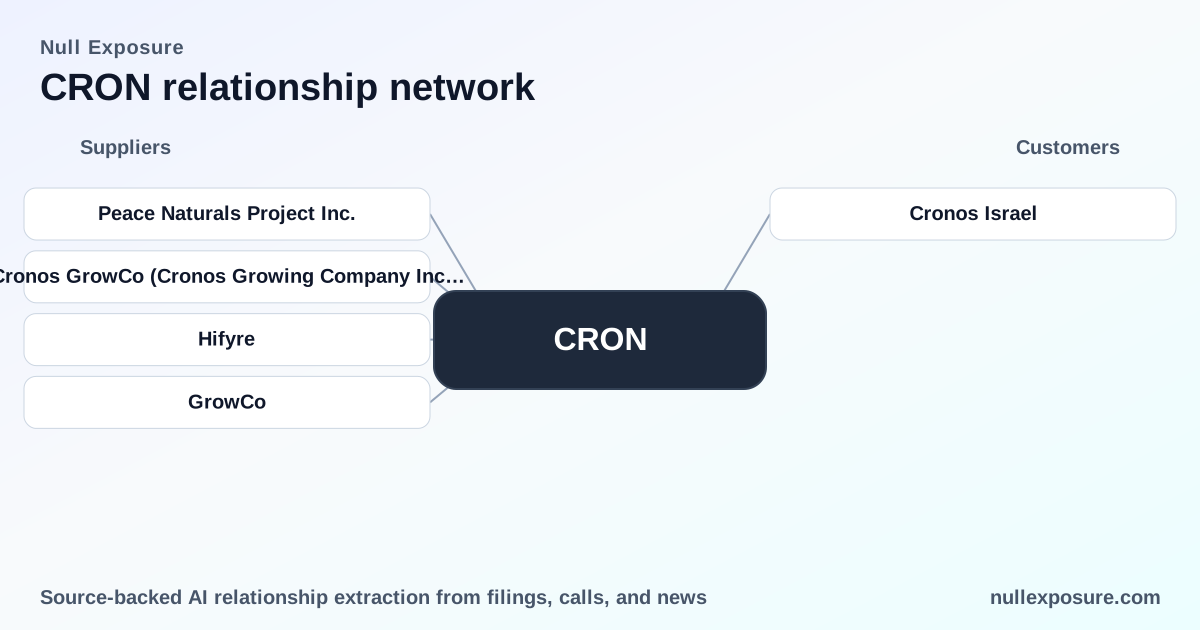
Cronos Israel
Cronos’ filing documents a corporate consolidation in Israel: the company reports that “the Israeli codes were transferred by non-controlling interests to Cronos Israel in exchange for their equity interests in the Cronos Israel entities.” This reflects an internal reorganization that consolidates Israeli operations and intellectual property under a Cronos-controlled entity. Source: Cronos Group 2024 Form 10‑K (FY2024).
High Tide Inc. (HITI)
Media coverage reports Cronos provided capital support to High Tide Inc., with a headline noting “High Tide Inc. (HITI) Secures $30M from Cronos to Fuel Global Expansion,” indicating Cronos’ use of strategic financing or partnership to accelerate a retail/distribution partner’s growth. This transaction signals Cronos’ willingness to deploy capital to support downstream distribution capabilities that can augment market access. Source: InsiderMonkey report (March 2026).
Company-level constraints that shape customer risk and opportunity
The public filings and extracted relationship signals show several company-level constraints that determine the profile of Cronos’ customer risk — these are presented as portfolio-level signals unless the excerpt explicitly names a counterparty.
- Government counterparty orientation (high confidence): Cronos sells to cannabis control authorities across most Canadian provinces and territories, positioning provincial governments as its primary counterparty type and exposing the company to regulatory procurement cycles and pricing frameworks established by those authorities.
- North America as the revenue base (very high confidence): The company reported net revenue by region with Canada materially dominant (for the year ended December 31, 2024, Canada accounted for the largest share of net revenue), underlining an NA-heavy revenue mix.
- EMEA and APAC expansion signals (moderate-to-high confidence): Cronos cites shipments into the UK and intent to expand supply for markets including Australia, Germany and the UK; these are early international distribution moves that increase optionality but are not yet equivalent to the Canadian base.
- Material customer concentration (very high confidence): The 2024 Form 10‑K states two major customers—Ontario Cannabis Retail Corporation and Alberta Gaming, Liquor and Cannabis Commission—accounted for approximately 32% and 17% of consolidated net revenue, respectively, and two customers together accounted for 49% of net revenue before excise taxes. This concentration creates near-term revenue volatility risk from changes in provincial ordering patterns.
- Receivables concentration and credit exposure (high confidence): The filing notes that 27% of accounts receivable was due from a single customer as of December 31, 2024, creating counterparty credit concentration that investors should monitor.
- Seller role and route-to-market (high confidence): Cronos describes itself as a seller of finished consumer products to a limited number of major customers and authorised distributors, highlighting the company’s dependence on a small set of purchasers for throughput and shelf presence.
Together these constraints create a commercial profile where contract terms, collection practices, and provincial listing placements materially affect near-term cash flow, while international distribution and strategic partner investments represent growth levers that will take time to scale.
What investors should watch next
- Monitor quarterly receivables and any changes in the proportion of revenue tied to the two largest provincial buyers; a small shift in provincial purchasing can move consolidated revenue materially.
- Track the cadence and structure of international shipments and distributor agreements (UK, Germany, Australia) for signs that non‑Canadian revenue is scaling and diversifying counterparty mix.
- Assess the performance and stated economics of strategic investments, such as the reported capital provided to High Tide, to determine whether these moves are accretive to distribution reach or primarily financial exposures.
For a concise view of relationship signals and how they interact with corporate filings, see https://nullexposure.com/.
Bottom line: key takeaways
- High concentration risk—two provincial buyers generated nearly half of pre-excise revenue in 2024, creating a single-buyer sensitivity to procurement changes.
- Government-led contracting—primary customers are cannabis control authorities, which shapes pricing leverage, listing access, and payment rhythms.
- International growth is real but nascent—shipments to the UK and partnerships for Australia/Germany expand optionality, and strategic capital deployments into retail/distribution are complementary moves rather than immediate offsets to Canadian concentration.
Investors valuing stability should require clear evidence of geographic revenue diversification or reduced receivables concentration; investors focused on upside should monitor execution against the company’s stated international and channel expansion milestones.