Crocs Inc: Customer Relationships Drive Wholesale Reach and Collaboration Value
Crocs, Inc. designs, manufactures and sells casual footwear and accessories and monetizes through a two-channel model: wholesale distribution (≈70% of sales) and direct-to-consumer retail and e‑commerce. The company leverages brand collaborations and licensed local distributors to extend reach across more than 85 countries, capturing margin through product design, brand partnerships, and selective retail expansion. For investors evaluating Crocs’ customer relationships, the critical read is that the business is wholesale‑centric, partnership-driven, and geographically diversified, with short‑term distribution contracts and a clear emphasis on visibility programs such as shop‑in‑shops and mono‑brand stores. For partner-level insights, see NullExposure for deeper coverage: NullExposure.
How Crocs sells and why partner relationships matter
Crocs’ operating model is built around a wholesale backbone supported by a DTC growth engine. Wholesale partners and regional licensees operate as distributors and resellers, buying under defined pricing and territory agreements and then selling through multi‑brand retailers, mono‑brand partner stores, and e‑tailers. Direct channels—company stores and the Crocs.com platform—carry higher margin but still represent the minority of revenue. The company also extracts value from collaborations (e.g., LEGO, McDonald’s), which drive retail placements, social engagement, and episodic premium pricing.
- Contracting posture: Distribution agreements typically run one to five years and include performance clauses, indicating a relatively short‑term, renewable contracting posture that enables rapid reallocation of channel resources.
- Geographic footprint and concentration: Crocs sells in 85+ countries with North America a dominant region (evidence shows a large share of HEYDUDE revenues and U.S. revenue prominence), while the wholesale channel remains the primary distribution lever globally.
- Role and criticality: Partners act primarily as distributors/resellers; Crocs depends on them for shelf presence, localized merchandising, and retail execution—making these relationships strategically critical for reach and brand representation.
- Maturity: The distribution system is mature in core markets with long‑standing license relationships (e.g., Italian distribution since 2006), but Crocs continues to evolve execution through shop‑in‑shops and collaborative retail rollouts.
These company‑level signals come from public filings and firm commentary in FY2026 and earlier; they shape investment views on partner concentration risk, margin dynamics, and the scalability of DTC expansion. For a partner‑by‑partner readout, the following captures every relationship documented in recent coverage.
Partner-by-partner: what investors need to know
Coin (Italy)
Crocs is rolling out shop‑in‑shop projects with Coin as part of an Italian strategy to increase in‑store visibility and dedicated corners within multi‑brand retailers; Coin is cited as a partner in this initiative. According to FashionNetwork (May 2, 2026), Crocs is stocked in about 1,500 Italian multi‑brand retailers and is pursuing shop‑in‑shop projects with Coin.
Source: FashionNetwork, May 2, 2026.
Foot Locker
Foot Locker is a retail partner in market rollouts for collaboration products, including the India phase of a Crocs×Lego collection that will reach Foot Locker outlets as part of the broader retail release. BestMediaInfo reported the phased India launch strategy and named Foot Locker among select outlets carrying the collection in May 2026.
Source: BestMediaInfo, May 2026.
Artcrafts International
Artcrafts International operates Crocs’ Italian distribution under license and has managed retail and e‑commerce development since Crocs’ market entry there in 2006, signaling a long‑standing licensed distributor relationship that supports local retail expansion. FashionNetwork’s May 2026 report quotes Artcrafts’ role and historical stewardship of Crocs in Italy.
Source: FashionNetwork, May 2, 2026.
VegNonVeg (India)
VegNonVeg is listed among select Indian retailers chosen for the wider retail release of the Crocs×Lego collection following a digital pre‑launch, positioning VegNonVeg as a localized retail partner for collaboration launches. BestMediaInfo covered the phased India rollout and named VegNonVeg for May 2026 retail distribution.
Source: BestMediaInfo, May 2026.
Slam Jam
Slam Jam carried the Ripple collaboration product at a €90 price point, demonstrating Crocs’ strategy of selective high‑visibility placements with streetwear retailers for premium collaborative items. FashionNetwork noted availability at Slam Jam in its Italy distribution coverage (May 2026).
Source: FashionNetwork, May 2, 2026.
Back Door
Back Door functions similarly to Slam Jam as a boutique retail partner handling Crocs collaboration items in Italy; FashionNetwork cited Back Door as a point‑of‑sale for the Ripple product. This highlights Crocs’ targeted approach to placing premium collaborations in trend‑setting retail environments.
Source: FashionNetwork, May 2, 2026.
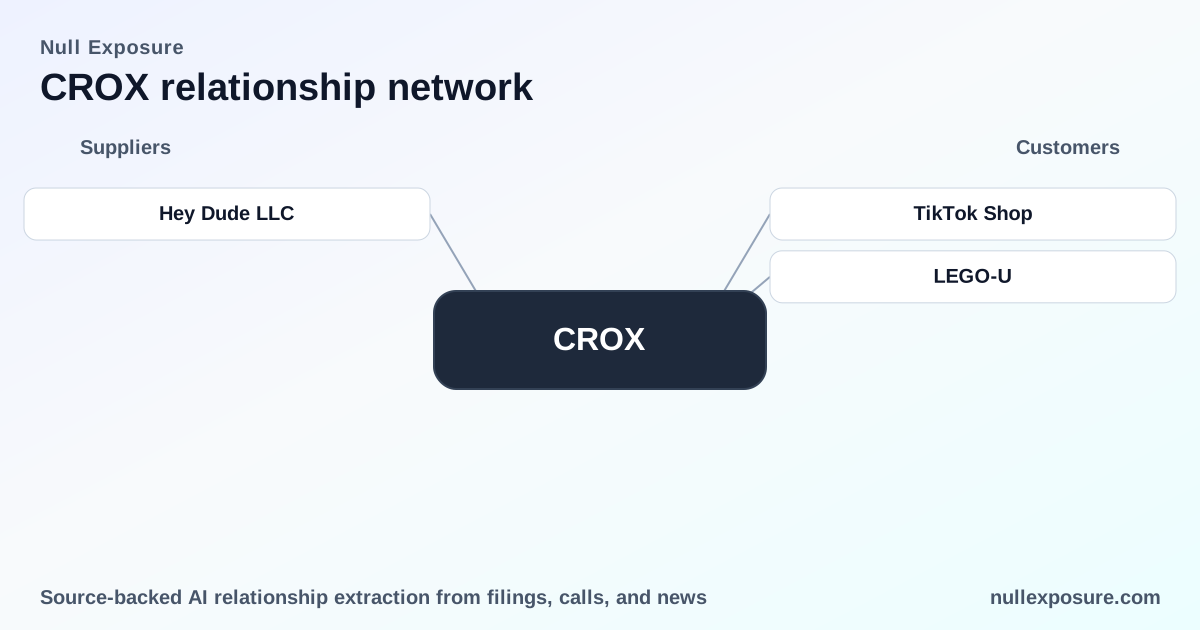
TikTok Shop
Crocs reports it is the number one footwear brand on TikTok Shop in the U.S., signalling strong social‑commerce traction and a sales channel that drives discovery and incremental revenue for collaboration and core SKUs. This was stated on Crocs’ Q4 2025 earnings call transcript (InsiderMonkey, March 2026).
Source: InsiderMonkey (earnings transcript), March 9, 2026.
Lego / LEGO‑U
Lego is a branded partner in a global collaboration with Crocs, and will sell the footwear in some Lego retail locations—an example of co‑branding that extends Crocs into different retail footprints and customer cohorts. The Detroit News covered the Lego partnership and retail plan in January 2026.
Source: Detroit News, January 23, 2026.
LEGO‑U (duplicate listing)
A duplicate result lists LEGO‑U with the same retail placement note; the underlying reporting is identical—Lego will sell the footwear at select Lego retail locations as part of the global collaboration rollout. This duplicate appears in the monitored results for FY2026.
Source: Detroit News, January 23, 2026.
Houston Rodeo
Crocs runs experiential and retail programs at the Houston Rodeo, supporting partnerships that drive authentic connections with HEYDUDE consumers and recurring live‑event retail presence; Crocs cited this on the Q1 2026 earnings call. This indicates a deliberate event‑marketing channel for targeted audience engagement.
Source: InsiderMonkey (earnings transcript), May 2026.
McDonald’s (MCD)
Crocs partnered with McDonald’s on a limited‑time Happy Meal promotion, leveraging McDonald’s broad retail footprint and promotional engine to amplify brand reach across family and mass‑market cohorts. MarketBeat reported the McDonald’s Happy Meal collaboration in March 2026.
Source: MarketBeat, March 2026.
OVS (Italy)
OVS is named alongside Coin as a partner for shop‑in‑shop projects in Italy, showing Crocs’ effort to convert multi‑brand retailers into semi‑dedicated brand showcases to improve in‑store visibility of Crocs assortments. FashionNetwork quoted this shop‑in‑shop initiative in May 2026.
Source: FashionNetwork, May 2, 2026.
Investment implications and risk framing
- Visibility and conversion depend on wholesale partners. With roughly 70% of sales coming from wholesale, Crocs’ brand and revenue realization are materially linked to distributor and retail execution. This elevates partner execution risk and the value of shop‑in‑shop programs.
- Contractual flexibility reduces long‑term lock‑in but raises renewal risk. Typical distribution agreements of one to five years give Crocs the agility to reallocate channel strategy but also create periodic renegotiation events that can affect near‑term revenue stability.
- Geographic diversification offsets single‑market shocks, but North America remains a concentration point for HEYDUDE revenues—investors should monitor regional sales cadence and channel mix shifts.
- Collaborations are strategic margin drivers. Partnerships with Lego, McDonald’s and fashion retailers enable episodic premium pricing and broaden audiences; however, these are execution‑dependent and require precise inventory and marketing coordination.
For partner‑tier diligence and ongoing monitoring of Crocs’ customer network, NullExposure provides structured relationship coverage and alerts—visit NullExposure for partner intelligence and updates.
Bold partnerships, short distribution terms, and a wholesale‑first footprint define Crocs’ go‑to‑market posture; investors should weigh channel concentration, renewal cycles, and collaboration conversion when modeling forward revenue and margin trajectories.