CRS Customer Relationships: Who Drives Carpenter Technology's Revenue and Risk
Carpenter Technology Corporation manufactures and distributes specialty metals and alloys, monetizing through direct sales, service-center inventory programs, and firm-price framework arrangements with industrial and aerospace customers. The company operates its own global network of service and distribution centers that supply just-in-time inventory, support processing services, and execute annual purchasing commitments under negotiated selling prices — a model that converts raw-material exposure and processing capabilities into recurring commercial relationships and margin capture. Learn more about our coverage at https://nullexposure.com/.
How Carpenter’s go-to-market actually works (and why it matters to investors)
Carpenter sells engineered metal products into diversified end markets but with pronounced exposure to aerospace engine production. The company charges for material plus value-added services through a mix of spot shipments and framework contracts that include committed consumption schedules and firm prices tied to raw-materials when established. Carpenter’s ownership of distribution and service centers across North America, EMEA and APAC converts product sales into sticky logistical relationships — that is, customers buy both metal and continuity of supply.
- Contracting posture: Company filings describe firm-price sales arrangements with annual purchase commitments and consumption schedules (company-level signal). This structure locks in volumes and pricing formulas, creating predictable revenue but also forward-looking commodity exposure.
- Role mix: Carpenter functions as seller, distributor and service provider simultaneously; it sells materials, operates stocking programs, and provides processing/finishing services from its global centers.
- Geographic diversification: Revenue is material in North America, Europe and Asia-Pacific, which reduces single-region concentration but increases dependence on global industrial cycles.
- Relationship maturity and criticality: Filings and market coverage indicate active, long-tenured relationships — particularly in aerospace — where proprietary nickel and cobalt alloys are described as critical inputs for high-temperature engines.
The customer roster investors need to know
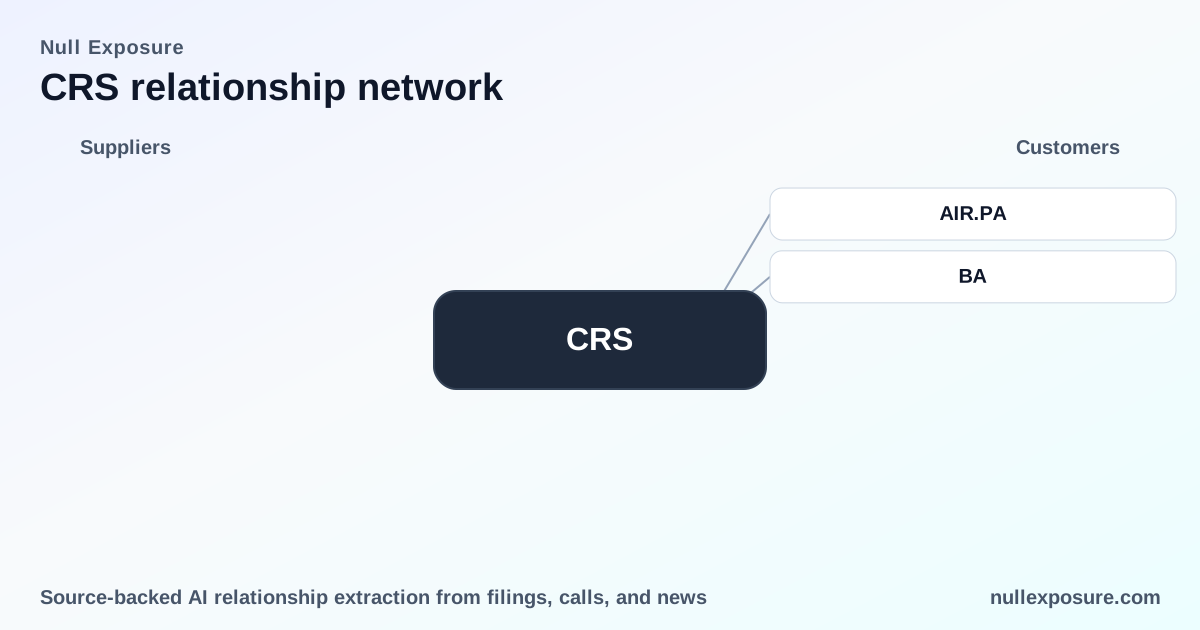
Airbus — a central aerospace buyer
Carpenter is positioned as a primary beneficiary of the aerospace engine ramp at Airbus, supplying proprietary nickel and cobalt alloys used in next‑generation fuel-efficient, high‑temperature jet engines. According to a Simply Wall St narrative dated March 9, 2026, the coverage highlights Carpenter’s role as an essential supplier to Airbus in FY2026 (SimplyWall.St, Mar 9, 2026).
Boeing — large-scale engine and airframe exposure
Boeing shows up in the same market narrative as a major consumer of Carpenter’s alloys, with the company described as a primary supplier benefiting from Boeing’s engine-production increases. The Simply Wall St piece referenced production dynamics tied to FY2026 demand (SimplyWall.St, Mar 9, 2026).
BA — duplicate reference to Boeing’s relationship
An additional mention indexed as “BA” reiterates the Boeing relationship and the same thesis: Carpenter’s proprietary alloys are integral to engine manufacturing and thus linked to Boeing’s engine ramp activity (news record dated March 9 and March 9/12, 2026; SimplyWall.St).
SWBI — industrial/defense components customer
A press release from The Outdoor Wire on March 10, 2026 identifies SWBI using components “designed with a Carpenter 1580 steel bolt, 8620 steel carrier, and chromed firing pin,” evidencing Carpenter’s role supplying specialty steels for industrial and defense-related applications (The Outdoor Wire, Mar 10, 2026).
What the filings and constraint signals tell investors about operational risk
Company-level disclosures and extracted constraint signals paint a clear picture of Carpenter’s commercial architecture and associated exposures:
- Framework contracts and forward commodity exposure: Filings describe firm price sales arrangements that include annual purchasing commitments and consumption schedules, and Carpenter uses commodity forward contracts to support those arrangements. That creates predictable revenue but links margins to forward raw-material economics (company filing language from fiscal year ended June 30, 2025).
- Global footprint, not single-market dependency: Revenue breakdowns for the year ended June 30, 2025 show meaningful sales in North America, Europe and Asia-Pacific, supporting resilience to localized demand shocks but exposing the company to synchronized global aerospace cycles.
- Integrated service and distribution model: Carpenter operates its own worldwide network of service and distribution centers, enabling just‑in‑time stocking programs and closer customer integration; this is a structural advantage for winning and retaining large industrial and aerospace accounts.
- Relationship stage is active and historically performant: Filings note that customers have historically performed under contractual arrangements and that Carpenter extends credit and hedging arrangements to support firm-price sales. That establishes an operational baseline of active, recurring engagements rather than one-off spot sales.
Investment implications — consolidation of upside and concentrated cyclicality
Carpenter’s commercial relationships create a convex investment profile:
- Upside: The aerospace engine ramp at Boeing and Airbus scales demand for high‑temperature nickel and cobalt alloys, translating directly into higher revenue and improved utilization of service centers. The presence of framework contracts preserves revenue visibility and supports margin leverage when commodity inputs stabilize.
- Downside: Firm-price commitments combined with commodity forward positions create margin risk if raw-material costs rise unexpectedly after prices are contracted. Heavy exposure to aerospace production schedules concentrates cyclicality into a small set of large customers.
- Structural mitigants: Ownership of distribution/service centers and multi-region sales reduce single-customer and single-region fragility, and the seller/distributor/service-provider role mix increases switching costs for customers.
Key takeaway: Carpenter’s relationships are commercially embedded and revenue-bearing, but investors must reconcile predictable contract volumes with commodity price sensitivity and aerospace cyclicality.
Learn more analysis and data at https://nullexposure.com/.
What investors should monitor next
Track these concrete indicators over the next 12–18 months to validate the thesis and watch risk migration:
- Aerospace engine production rates at Boeing and Airbus, which directly scale demand for Carpenter’s alloys.
- Commodity curve movements for nickel and cobalt and Carpenter’s forward contract position disclosures; these determine margin pressure under firm-price arrangements.
- Contract renewals and the language of framework agreements in periodic filings for any shifts in pricing mechanics or commitment thresholds.
- Service-center utilization and inventory turns across North America, EMEA and APAC as a proxy for end-market strength and customer stickiness.
- Receivables and credit exposure tied to large customers given Carpenter’s extension of credit in support of firm-price arrangements.
Bottom line
Carpenter’s customer relationships are a blend of strategic industrial partnerships and operationally embedded supply — particularly across aerospace. The commercial model delivers revenue visibility through framework contracts and differentiated service capabilities, while exposing margins to raw-material swings and aerospace cyclicality. For investors, the earnings upside from engine ramps is real and measurable; the counterweight is commodity-driven margin volatility that requires active monitoring of procurement and contract terms.