CRISPR Therapeutics (CRSP): Customer relationships, concentration risks, and commercial posture
CRISPR Therapeutics develops gene-editing therapeutics and monetizes primarily through collaborations and milestone/licensing receipts in addition to nascent product revenue; its reported top-line is currently driven by partner collaboration payments rather than diversified commercial sales. For investors, the core thesis is simple: CRSP is a development-stage biotech that converts R&D value into cash through strategic partnerships and regulatory-driven product launches, creating a revenue profile that is highly concentrated, timing-sensitive, and dependent on payer access and regulatory geography.
For a structured counterparty readout and continual monitoring of material customer exposures, visit https://nullexposure.com/ for our platform coverage.
How CRSP makes money and why customers matter
CRISPR Therapeutics’ financial footprint shows a company transitioning from partner-funded R&D to early commercial activity. The firm recognizes large, lumpy collaboration revenues when partners remit payments tied to development progress or licenses, while ongoing product sales are still limited relative to those collaboration inflows. This operating model produces high revenue concentration, irregular cash inflows tied to partner milestones, and acute sensitivity to reimbursement and regulatory wins in multiple jurisdictions.
- Contracting posture: CRSP executes collaborative agreements that front-load commercial and development risk onto partners or create milestone-triggered cash events for CRSP. That posture reduces near-term dilution risk but concentrates counterparty dependence.
- Concentration and criticality: Historical revenue shows extreme concentration in single-partner receipts; this creates single-counterparty risk and elevated business sensitivity to that partner’s program priorities.
- Maturity: Financials reflect a company still loss-making with modest product revenue; commercial scale and recurring sales are nascent, so partner revenues and approvals remain the primary cash drivers.
Customer relationships in the record
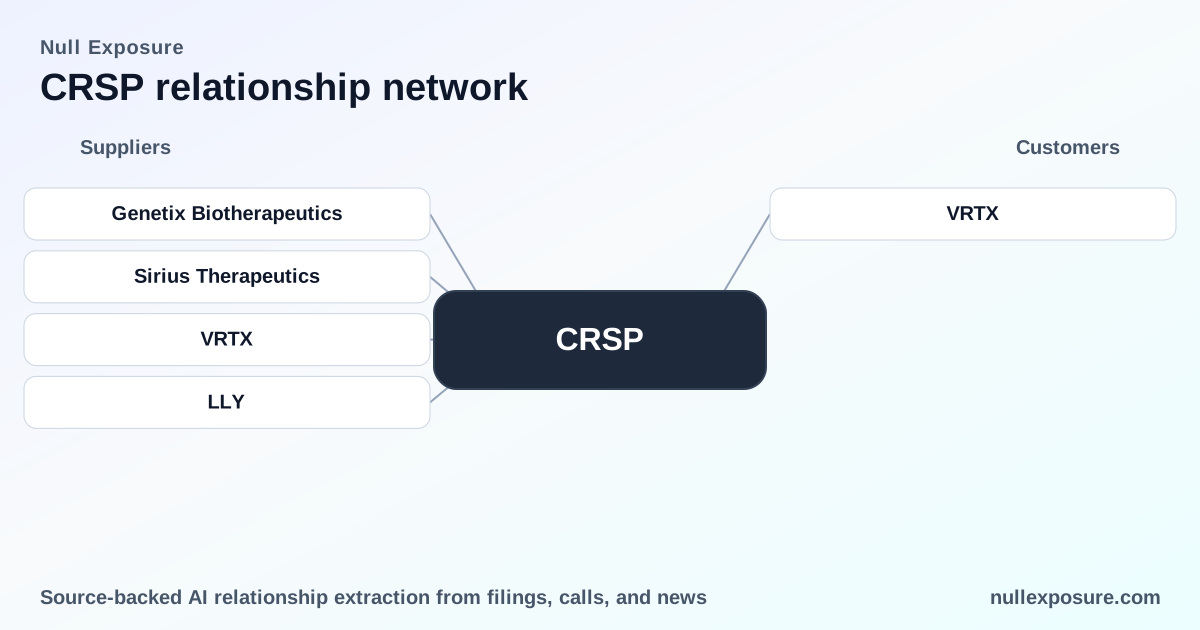
CRSP’s surfaced customer relationships in the reviewed materials are narrowly concentrated; every hit relates to the company’s collaboration with Vertex Pharmaceuticals (VRTX). Below are the explicit results reported in the source set.
Vertex Pharmaceuticals — mention #1
CRISPR recorded total revenues of $35.7 million in the year-ago period, of which $35 million was collaboration revenue from Vertex Pharmaceuticals, indicating that Vertex drove nearly all reported revenue in that interval. This figure was reported in a TradingView news piece citing Zacks on March 9, 2026. (TradingView / Zacks, Mar 9, 2026.)
Vertex Pharmaceuticals — mention #2 (duplicate entry)
The same TradingView/Zacks item appears again in the dataset, reiterating that $35 million of CRSP’s prior-year revenue originated from Vertex collaboration payments. The duplicate entry underlines the dataset-level emphasis on that single counterparty as the primary revenue source in that comparative period. (TradingView / Zacks, Mar 9, 2026.)
Takeaway: Both records reference the identical revenue fact—Vertex accounted for virtually all of CRSP’s reported revenue in that referenced year-ago quarter—illustrating extreme counterparty concentration in reported top-line receipts.
What the relationships imply about risk and execution
The Vertex-linked receipts are not ordinary product sales; they are collaboration revenues, which are inherently volatile and event-driven. When a single partner supplies nearly all recognized revenue, three investor-relevant dynamics follow:
- Single-counterparty dependency: Historic reliance on Vertex for ~98% of the cited period’s revenue signals that CRSP’s near-term cash profile is dependent on partner timing and deliverables.
- Event risk: Regulatory milestones, trial readouts, or partner strategic re-prioritization can produce sizeable swings in bookings and recognized revenue.
- Commercial transition requirement: For the company to replace irregular collaboration receipts, a durable set of payer relationships and repeatable product sales must scale—an operational challenge that requires time, capital, and execution.
Company-level constraints that shape customer dynamics
Two structural constraints drawn from CRSP’s disclosures frame how customer relationships will evolve and how investors should model counterparty risk.
- Government payors and reimbursement exposure: Company filings emphasize that coverage and adequate reimbursement from third-party payors, including government programs such as Medicare and Medicaid, are central to commercial viability for its products. That creates payer-concentration risk and implies CRSP must engage payors and navigate government pricing and compliance regimes as its products commercialize.
- Global regulatory footprint: CRSP notes that its gene-editing product CASGEVY has received approvals across the United States, EU, UK, Canada, Switzerland and parts of the Middle East for specific indications, which establishes a multi-jurisdictional commercial requirement and a complexity premium on distribution and payer strategy.
These constraints are company-level signals about maturity and commercial posture: regulatory approvals broaden market access but simultaneously increase the importance of sophisticated payer contracting and global logistics. They also imply that revenue volatility from partner payments will transition—over time—toward revenue streams governed by reimbursement dynamics rather than purely milestone-based receipts.
For a consolidated counterparty and contract-level monitoring toolkit, consider our platform at https://nullexposure.com/.
Investment implications and what to watch next
Investors evaluating CRSP should prioritize the following monitoring items:
- Partner payment cadence: Continued reliance on milestone and collaboration receipts keeps earnings lumpy; track announced payments from Vertex or other partners and the underlying milestone triggers.
- Payer coverage decisions: Government and commercial payer decisions will determine whether early approvals translate into recurring product revenue.
- Diversification of revenue: New partnerships, licensing deals, or scaled product sales will materially reduce single-counterparty risk. Announcements that shift revenue mix away from large collaboration payments should be read as de-risking events.
- Regulatory and compliance developments: Given the role of government programs and the global approval footprint, compliance challenges or changes in reimbursement policy will have outsized effects on realized revenue.
Bottom line
CRISPR Therapeutics is a development-stage biotech whose current revenue profile is dominated by collaboration receipts—historically, Vertex Pharmaceuticals supplied nearly all reported revenue in the cited period. That concentration is the principal counterparty risk for investors until broad-based commercial sales and diversified payer arrangements develop. The company’s pathway to stable, recurring revenue depends on converting regulatory approvals into reimbursed product uptake across multiple jurisdictions while diversifying away from milestone-driven partner receipts.
For ongoing counterparty scans, contract analytics, and a deeper read on CRSP’s partner exposures, visit https://nullexposure.com/.