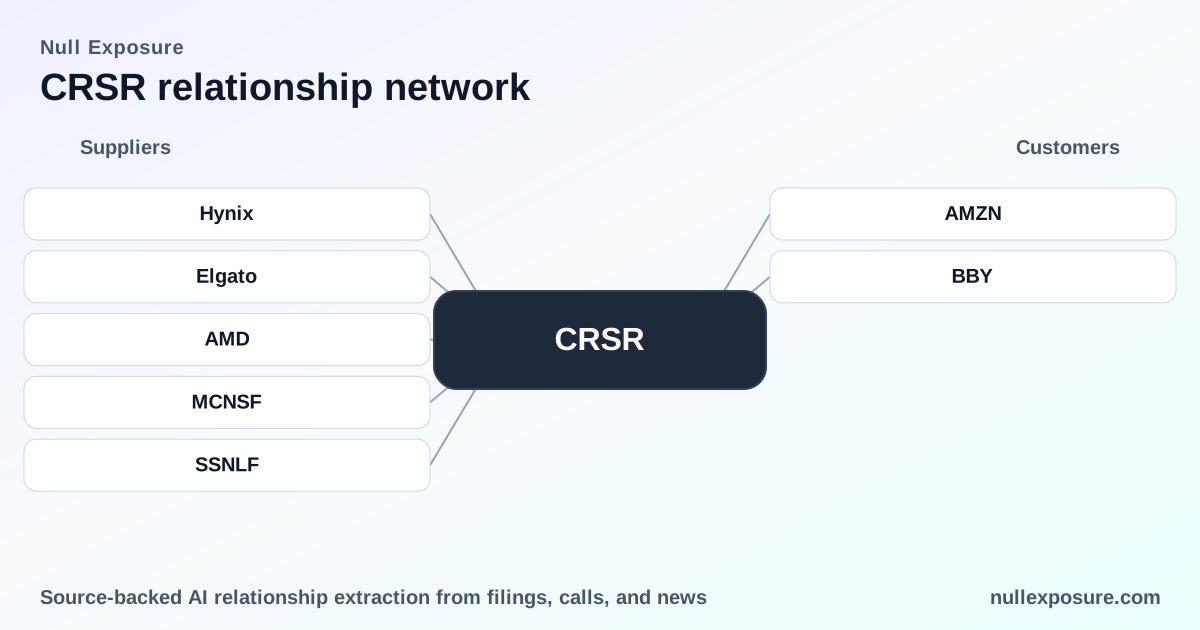
Corsair (CRSR): Retail-Driven Hardware Growth with Concentrated Customer Risk
Corsair designs, markets, and distributes gaming and creator peripherals, components and systems and monetizes through product sales of high-performance hardware complemented by proprietary software (iCUE, Elgato suite) and ancillary digital services such as extended warranties and creator marketplace features. The company operates a channel-led model that funnels volume through a small set of large retailers and e-retailers, generating the bulk of revenue from hardware SKUs while software and services act as margin-enhancing attachments.
For an interactive breakdown of customer concentrations and disclosure evidence, visit https://nullexposure.com/.
What investors need to know about Corsair's operating model
Corsair is a classic consumer-electronics manufacturer built on branded, retail-distributed hardware. Revenue is driven by product cycles and retail distribution, not long-term recurring contracts. That operating posture defines both the upside — rapid scale if a product hits at retail — and the downside — swift revenue volatility when retailer listings, promotional cadence, or inventory allocation shift.
Key business-model characteristics:
- Contracting posture: short-term, channel-driven — Corsair sells into retailers and distributors rather than under multi-year supply contracts, which places a premium on account management and retail ordering dynamics.
- Customer concentration is material — A small number of large retailers account for a significant portion of net revenue, creating single-counterparty sensitivity that amplifies execution risk.
- Counterparties are large enterprises — The company’s revenue mix is skewed toward major retail and e-retail platforms, which have substantial bargaining power on pricing, placements and promotional terms.
- Geographic diversification with regional weightings — Corsair’s sales are global, with North America, EMEA and Asia Pacific composing the revenue footprint, enabling cross-regional hedging of product cycles but not eliminating concentration risk at the retail partner level.
- Product mix: hardware-first, services and software as enhancers — Hardware is the primary revenue engine; proprietary software and digital services increase customer stickiness and provide margin lift.
Operating constraints that matter to investors
- Short-term customer agreements increase revenue volatility and place emphasis on maintaining retailer relations and promotional execution.
- A limited number of large retailers and distributors represent a significant fraction of net revenue, creating measurable counterparty concentration risk.
- Corsair distributes globally — it ships to nearly 80 countries — with material revenue split: roughly 53% Americas, 36% EMEA and 11% Asia Pacific in 2024.
- The company’s exposure is materially in the hardware segment, with software and services as smaller but complementary businesses that improve customer experience and after-sale monetization.
For a structured view of how those constraints translate into customer-level exposures, see the Null Exposure platform: https://nullexposure.com/.
Customer relationships surfaced in public sources
Amazon — news mention (FY2026)
A March 9, 2026 StockTwits news article highlights Corsair as a “popular” memory brand sold through e-retail channels such as Amazon, underscoring the company’s retail positioning and category relevance on large e-commerce platforms. Source: StockTwits news article, March 9, 2026.
BBY — news mention (FY2026)
The same March 2026 report cites Best Buy (ticker BBY) alongside Amazon as a primary retail channel for Corsair memory and peripheral products, confirming brick-and-mortar placement as an important distribution vector. Source: StockTwits news article, March 9, 2026.
Best Buy — news mention (FY2026)
Best Buy is explicitly named in the March 2026 coverage as one of the main retailers selling Corsair-branded memory and peripherals, reflecting Corsair’s reliance on large national electronics chains for consumer reach. Source: StockTwits news article, March 9, 2026.
Amazon — Form 10‑K disclosure (FY2024)
Corsair’s 2024 Form 10‑K discloses that sales to Amazon accounted for 30.9% of net revenue in 2024 and 30.7% in 2023, making Amazon a single counterparty of material importance to top-line performance. Source: Corsair 2024 Form 10‑K (fiscal year ended December 31, 2024).
AMZN — duplicate Form 10‑K reference (FY2024)
The company’s customer concentration table in the same 2024 10‑K reiterates Amazon (AMZN) as an individual customer comprising more than 10% of total net revenue for the periods presented, consolidating the regulatory evidence of material exposure. Source: Corsair 2024 Form 10‑K (fiscal year ended December 31, 2024).
Implications for investors and operators
-
Concentration risk is the headline investment risk. With Amazon constituting roughly 31% of revenue in 2024, Corsair’s topline and inventory planning track the ordering and promotional decisions of a single dominant e-retailer. That creates near-term sensitivity to the timing of product launches, promotional windows and Amazon’s inventory strategies.
-
Short-term contracting raises execution premiums. The absence of long-term purchase agreements forces Corsair to continually win shelf and buy-box placements through product competitiveness and retail relationships rather than contractual revenue certainty. Operationally, this requires fast supply-chain responsiveness and disciplined channel promotions.
-
Geographic diversification reduces country risk but not counterparty risk. Corsair sells across North America, EMEA and APAC — the 2024 split was roughly 52.9% Americas, 36.2% EMEA, 10.9% Asia Pacific — which stabilizes exposure to regional demand cycles, but the company’s reliance on a few global retailers keeps counterparty concentration high.
-
Hardware remains the cash engine; software and services are optional margin enhancers. Proprietary tools like iCUE and Elgato’s streaming suite strengthen product ecosystem lock-in and provide avenues to increase lifetime value, but they are not yet a structural hedge against retail channel volatility.
-
Operational levers for management: investors should monitor Corsair’s inventory turnover, promotional cadence with major retailers, and any moves to deepen direct-to-consumer or subscription-based revenue to reduce single-retailer dependence.
Bottom line
Corsair is a retail-centric hardware business with material concentration in a handful of large retailers, above all Amazon at ~31% of 2024 revenue. The company’s success depends on product-led victories in key retail channels and on maintaining tight operational control across inventory and promotions. For investors, the story is a trade-off between persistent upside from successful product cycles and downside from concentrated retail exposure; tracking retailer order flows and quarterly disclosure of customer concentrations is essential.
For a closer breakdown of these customer relationships and how they influence credit and revenue risk, visit https://nullexposure.com/.