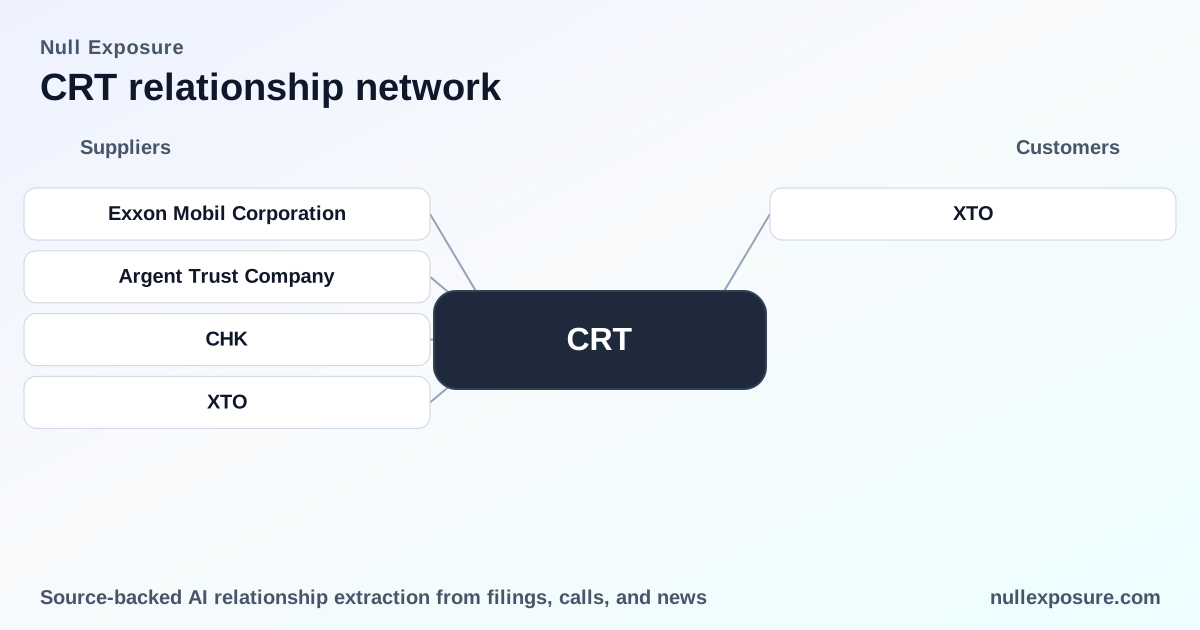
Cross Timbers Royalty Trust (CRT): Royalty cash flows paid by a single operator, predictable distributions, concentrated counterparty exposure
Cross Timbers Royalty Trust collects oil and gas royalties and distributes net proceeds to unitholders; its operating model monetizes through monthly payments of net income from an upstream operator rather than through direct production or capital investment. For income investors, CRT offers a high-yield, low-capex exposure to legacy U.S. oil and gas production, but that yield is tightly coupled to the economics and operating continuity of the trust’s principal payor. Learn more about our coverage at https://nullexposure.com/.
The trust model in plain language: predictable checks, concentrated counterparty risk
Cross Timbers is an express royalty trust headquartered in Dallas that owns non-operated interests in producing leases. CRT does not run wells — it receives royalty and net income payments and passes them through as monthly distributions, which create a cash-income profile attractive to income-oriented strategies. The upside to investors is distribution yield and minimal capital requirements; the downside is exposure to production declines, commodity pricing, and, crucially, the operational performance of the paying operator.
Operationally, CRT’s structure produces several characteristic business features:
- Contracting posture: CRT functions as a passive counterparty that is paid by a dominant operator, so the trust’s cash flow is governed by the operator’s monthly net income remittances rather than by CRT-controlled capital allocation.
- Concentration: The trust’s cash flows concentrate around a small set — effectively a single primary operator in the available reporting — increasing counterparty and operational concentration risk.
- Criticality: The operator’s production and payment cadence are critical to CRT’s distribution reliability; interruptions or changes in receipts directly affect per-share distributions.
- Maturity: Royalty trusts historically house mature, declining production; CRT’s cash flows reflect legacy acreage with limited scope for new drilling by the trust itself, supporting a defensive income profile but limited growth optionality.
There are no explicit contractual constraints listed in the provided relationship data set; that absence is a company-level signal indicating the publicly available text does not enumerate further contractual contingencies beyond the standard trust/operator payment arrangement.
Who pays CRT’s distributions — the relationship inventory
Below are every relationship item surfaced in the review results, presented as short, investor-directed summaries with source context.
-
XTO (listed in SureDividend’s High Dividend article): CRT’s monthly distributions are reported as paid by XTO Energy, positioning XTO as the operational payor for the trust’s cash receipts. According to SureDividend’s High Dividend profile (published March 9, 2026), CRT offers a royalty-based exposure to U.S. oil and gas production and receives monthly distributions paid by XTO Energy. Source: SureDividend, High Dividend profile (March 9, 2026) — https://www.suredividend.com/high-dividend-crt/
-
XTO Energy (same High Dividend article, separate mention): The article repeats that CRT’s market-cap and royalty structure put it in the small-cap, high-yield category, with XTO Energy making the monthly remittances that underwrite CRT’s payouts. According to the same SureDividend piece (March 9, 2026), XTO Energy is the entity that conducts the monthly payment process to unitholders. Source: SureDividend, High Dividend profile (March 9, 2026) — https://www.suredividend.com/high-dividend-crt/
-
XTO (from SureDividend’s Monthly Dividend article): In a second SureDividend piece focused on monthly dividend stocks, CRT’s cash flows are described as the trust receiving net income from XTO Energy on the last business day of each month, reinforcing the timing and cadence of distribution mechanics. According to SureDividend’s Monthly Dividend Stock article (March 9, 2026), XTO Energy, a subsidiary of ExxonMobil, pays the trust’s net income monthly. Source: SureDividend, Monthly Dividend Stock (March 9, 2026) — https://www.suredividend.com/monthly-dividend-stock-crt/
-
XTO Energy (same Monthly Dividend article, repeated entry): The Monthly Dividend profile reiterates the operational relationship and explicitly links XTO Energy to ExxonMobil ownership, which is relevant to counterparty credit and operational scale considerations. SureDividend’s Monthly Dividend piece (March 9, 2026) notes XTO Energy is a subsidiary of ExxonMobil and pays CRT’s net income monthly. Source: SureDividend, Monthly Dividend Stock (March 9, 2026) — https://www.suredividend.com/monthly-dividend-stock-crt/
What the relationship map implies for investors
The relationship data consistently identifies XTO Energy as the operational payor for CRT’s receipts and confirms a monthly payment cadence tied to net income remittances. That single-operator flow produces a clear set of investment implications:
- Predictability of distributions is high in stable operational environments because payments are calendared monthly and historically regular. CRT’s dividend history and the trust’s reported dividend yield (7.03% per the latest data) reflect that reliability as of the latest quarter.
- Counterparty concentration is the principal risk: a disruption at XTO or changes in its contractual treatment of the trust’s net income would directly affect distributions. The public notes that XTO Energy is an ExxonMobil subsidiary introduces some counterparty credit context — scale and credit quality are materially different if the payor is a large integrated operator rather than a small independent.
- Asset maturity and limited growth: Royalty trusts typically distribute existing production cash flows rather than reinvesting for growth, so CRT’s equity upside is tied to commodity price changes or improved operating efficiency from the operator rather than drilling-led production expansion controlled by the trust.
Valuation and positioning: yield versus concentration
CRT trades with metrics consistent with a small, income-oriented royalty trust: market capitalization approximately $64.56 million, trailing P/E ~14.2, and a ~7% dividend yield. Price-to-book and EV multiples are elevated relative to large-cap E&P peers because the market prices a high-distribution, low-capex cash-flow stream rather than growth prospects.
Key investor takeaways: income investors get a high current yield and monthly cash flow but accept pronounced counterparty concentration and limited growth optionality. Institutional ownership is low (about 2.17%), which increases the potential for retail-driven price moves and liquidity sensitivity. The trust’s operating margins and profit metrics are strong on a trailing basis, reflecting the pass-through nature of royalty receipts.
If you want a focused breakdown of CRT’s counterparty exposure and payment cadence for portfolio analysis, review our CRT relationship dossier at https://nullexposure.com/.
Bottom line: a high-yield, operator-dependent income vehicle
Cross Timbers Royalty Trust is a classic royalty-income vehicle: low operational complexity for the trust, predictable monthly cash flows, and concentration risk centered on XTO Energy as the paying operator. For income-focused investors, CRT’s yield and monthly distribution schedule are compelling, but underwriters must price in counterparty dependence and limited upside from organic production growth. Assess CRT as a yield play with operator risk rather than as an equity claim on controllable upstream growth.