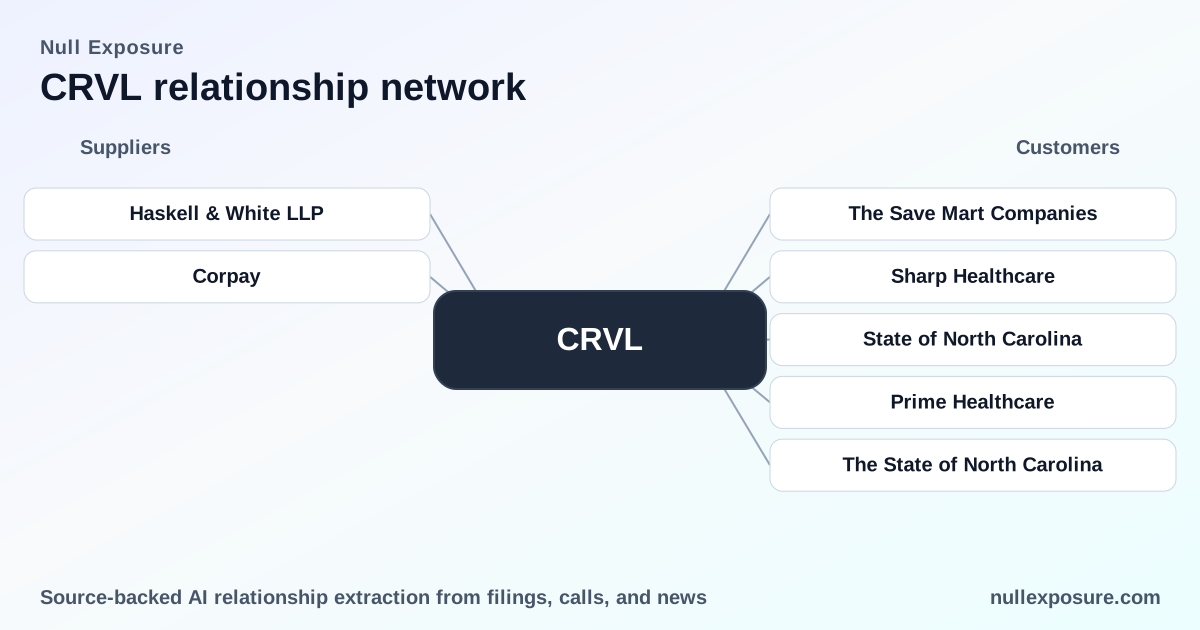
CorVel (CRVL): Customer Footprint Confirms a National, Service‑Driven Monetization Model
CorVel monetizes by selling medical cost‑containment and managed care services to employers, insurers, TPAs and government payors; revenue is recurring through annual contracts with frequent auto‑renewal and scale derived from national coverage and claim volume. The company's business model is service‑led rather than asset‑intensive: fees for claims management, bill review, networks and payment integrity drive recurring revenue (CorVel reports roughly $941m revenue TTM and mid‑teens operating margins). For a concise view of CorVel relationship signals, visit https://nullexposure.com/.
What recent customer reporting reveals to investors
Public communications over 2025–2026 reinforce a consistent commercial picture: CorVel partners with a mixture of public-sector payors and large private employers/health systems to deploy outcome‑oriented workers’ compensation programs, and these partnerships are used publicly to showcase measurable results and industry awards. The narrative is dominated by recognition—Theo Awards—and disaster‑response work for a state payor, which together illustrate both the marketing value and the operational importance of these customer relationships.
Key operational features for investors:
- Short contractual terms with auto‑renewal: CorVel signs annual contracts that commonly auto‑renew, creating a high renewal cadence but limited long initial commitment lengths.
- Government as a meaningful counterparty type: CorVel explicitly serves governmental entities alongside employers and insurers, exposing the company to public procurement and emergency response requirements.
- Low customer concentration: No single customer accounted for 10% or more of revenue in recent fiscal years, which lowers single‑client counterparty risk. These company‑level signals underpin how to think about revenue durability and procurement risk for CRVL.
Detailed relationship log (each mention in the public record)
The Save Mart Companies — StockTitan mention (FY2025)
CorVel highlighted The Save Mart Companies as a partner in a program framed around prevention, early intervention, efficient claim resolution and collaborative execution, signifying a tailored enterprise deployment for a large employer. Source: StockTitan news item cited March 9, 2026 referencing FY2025 partner recognition.
Sharp Healthcare — StockTitan mention (FY2025)
Sharp Healthcare is listed among CorVel partners honored for proactive workers’ compensation programs, indicating collaboration with a large health system on claims and network strategies. Source: StockTitan news item cited March 9, 2026 referencing FY2025.
State of North Carolina — StockTitan mention (FY2025)
CorVel named the State of North Carolina as a partner setting standards in proactive workers’ compensation programming, consistent with state‑level engagement. Source: StockTitan news item cited March 9, 2026 referencing FY2025.
State of North Carolina — GlobeNewswire release (Sept 10, 2025; FY2025)
A GlobeNewswire release describes CorVel’s role supporting the North Carolina Office of State Human Resources after large‑scale infrastructure damage, ensuring uninterrupted access to medical care, medications and wage replacement across a 25‑county FEMA disaster area—evidence of operational criticality in emergency situations. Source: GlobeNewswire press release, September 10, 2025.
Prime Healthcare — local press (FY2026)
A regional news report discussing an employment matter at Prime Healthcare referenced an individual’s prior role handling indemnity claims and later leadership in claims—contextual linkage that places Prime Healthcare within the broader worker’s compensation and claims ecosystem that CorVel services. Source: mynewsla.com article, March 5, 2026 (FY2026).
The Save Mart Companies — GlobeNewswire release (Sept 10, 2025; FY2025)
The GlobeNewswire release also details that The Save Mart Companies partnered with CorVel on a four‑pillar strategy for worker safety and claim resolution—underscoring an implementation case that CorVel uses to demonstrate measurable program results. Source: GlobeNewswire press release, September 10, 2025.
The Save Mart Companies — Yahoo Finance repost (FY2025)
A Yahoo Finance article reprinted CorVel’s announcement recognizing The Save Mart Companies for program achievements, amplifying the public visibility of that customer relationship. Source: Yahoo Finance news item, repost of September 2025 announcement.
The State of North Carolina — Yahoo Finance repost (FY2025)
Yahoo Finance also summarized CorVel’s work with North Carolina, including the emergency response elements noted in the GlobeNewswire release—showing broad syndication of the state engagement. Source: Yahoo Finance news item (reposting CorVel release), September 2025.
Sharp HealthCare — Yahoo Finance repost (FY2025)
Yahoo Finance reproduced CorVel’s announcement that included Sharp HealthCare as an award winner, highlighting CorVel’s strategic positioning with health systems for workers’ compensation innovation. Source: Yahoo Finance news item, September 2025.
Sharp HealthCare — GlobeNewswire release (Sept 10, 2025; FY2025)
The GlobeNewswire release lists Sharp HealthCare among the 2025 Theo Award winners alongside the State of North Carolina and The Save Mart Companies, reflecting CorVel’s use of partner awards to validate its managed‑care solutions. Source: GlobeNewswire press release, September 10, 2025.
(NB: the public record includes multiple syndicated mentions of the same three partner names—The Save Mart Companies, Sharp HealthCare, and the State of North Carolina—as well as a regional reference to Prime Healthcare.)
Operational constraints and business model signals investors should weigh
- Contracting posture: CorVel’s customer engagements are typically one‑year contracts with auto‑renewal, creating frequent renewal opportunities and potentially lower switching friction for buyers; this is a company‑level characteristic, not tied to any single partner.
- Counterparty mix: The firm serves government, insurers, TPAs and self‑administered employers nationwide, indicating diversified buyer types and exposure to public procurement rules.
- Geographic scale: Services are delivered across the United States, which supports volume economics but exposes CorVel to state‑level regulatory and payment dynamics.
- Concentration profile: No single customer represented ≥10% of revenue over recent fiscal years, which reduces client concentration risk but also means top‑line growth depends on broad market penetration.
- Role and segment: CorVel operates as a service provider and seller of claims‑processing, bill review and related managed care services within the risk‑management segment.
- Relationship maturity: Many engagements are renewing through auto‑renewals rather than long‑dated locked contracts; this supports revenue visibility while keeping annual renewal risk active.
Investment implications: what to watch next
- Commercial proof points are marketing assets. Awards and state emergency work create visible references that help sales into public and large private customers; investors should track new contract wins and renewals for revenue momentum.
- Renewal cadence is both a strength and a monitoring point. Annual terms with auto‑renewal enable agility but require consistent service quality to avoid attrition.
- Government work raises operational stakes. State engagements—particularly disaster response—demonstrate criticality but also place emphasis on public‑sector procurement compliance.
- Low concentration lowers single‑client risk but demands broad execution to sustain growth; watch retention metrics and penetration into large verticals such as retail and health systems.
For a structured view of CorVel customer relationship signals and to compare these patterns across peers, see https://nullexposure.com/.
CorVel’s customer narrative is clear: national scale, service‑led monetization, and an emphasis on measurable program outcomes. For investors, the near‑term question is execution—maintaining renewals and converting public recognition into sustained new business growth.