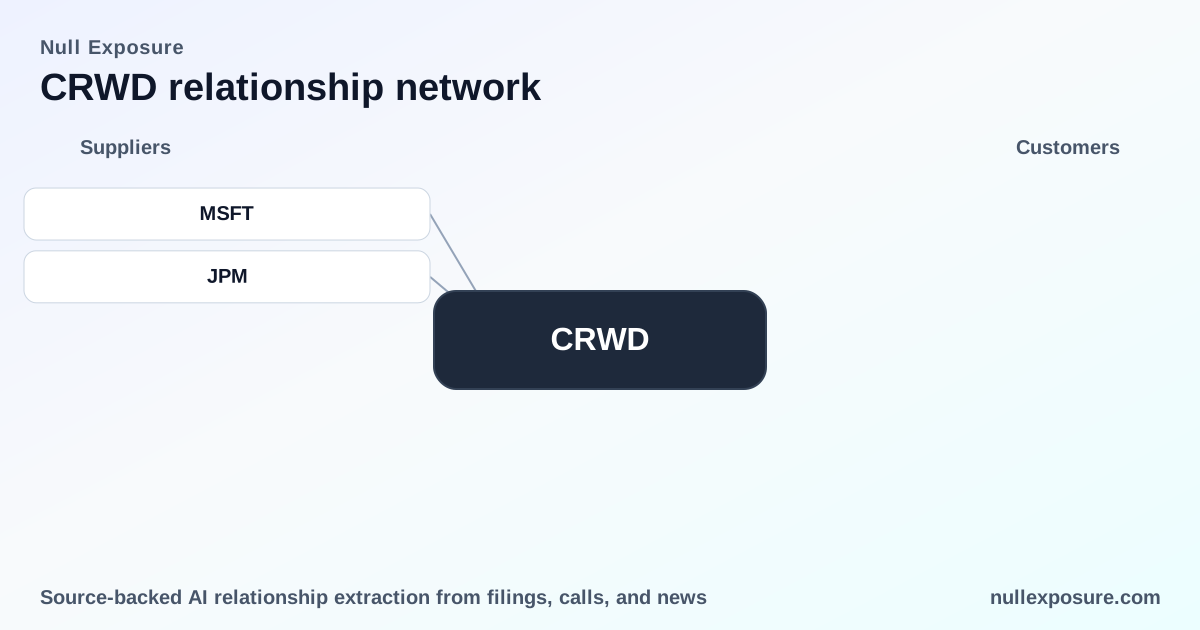
CrowdStrike (CRWD): Customer Relationships Drive a SaaS-First Security Franchise
CrowdStrike operates a cloud-native endpoint and cloud workload protection platform—Falcon—that it licenses on multi-year SaaS subscriptions and augments with professional incident response and advisory services. The company monetizes through recurring module-based subscriptions, expansion as customers add endpoints and modules, and time-and-materials services; this model produces predictable recurring revenue while preserving upside from cross-sell and professional services.
Explore more customer intelligence at https://nullexposure.com/.
Why customer relationships matter for CRWD investors
CrowdStrike’s operating model is subscription-centric and expansion-driven. Public filings explicitly state that a substantial majority of customers buy subscriptions longer than one year and that Falcon’s value is delivered through 29 cloud modules sold via SaaS. This produces a contracting posture where retention and net expansion are the primary revenue levers rather than one-off license sales. The company reports a broad customer base—more than 74,000 organizations as of January 31, 2025—so revenue concentration risk across a small number of accounts is lower than for niche enterprise-only vendors, but enterprise and government logos remain strategically important.
Key company-level signals for investors:
- Contracting posture: Predominantly subscription, multi-year terms that support visibility into recurring revenue.
- Counterparty mix: A deliberate go-to-market spanning small business, mid-market, large enterprise, and government buyers—CrowdStrike builds for scale from Fortune-class customers down to SMBs.
- Geographic footprint: Large exposure to North America with active international expansion; the sales model combines direct and channel partners globally.
- Relationship dynamics: Most relationships are active with a structural propensity to ramp—customers frequently add endpoints and modules after initial deployment.
- Business model composition: Core SaaS subscription revenue supplemented by professional services and incident response engagements.
Together, these characteristics create sticky recurring revenue with embedded expansion optionality, but they also put customer success, product differentiation, and renewal economics at the center of valuation and margin outcomes.
Notable customer and partner relationships observed in recent sources
Absolute (ABST): endpoint resilience integration
Absolute and CrowdStrike have announced an integration that focuses on endpoint resilience—helping customers stop breaches, limit downtime, and recover endpoints at scale. This integration is positioned as complementary to CrowdStrike’s Falcon capabilities. Source: Absolute corporate materials and press pages (March–May 2026) — https://www.absolute.com/press-releases/new-absolute-security-research-shows-top-endpoint-security-controls-fail-22-percent-of-the-time and https://www.absolute.com/blog/absolute-secure-endpoint-80-adding-a-new-level-of-endpoint-resilience.
Google Cloud: real-time cloud detection and response presence
Coverage of cloud backup and resilience in Google Cloud referenced CrowdStrike’s role in delivering real-time Cloud Detection and Response capabilities on Google Cloud, signaling that CrowdStrike’s cloud workload protection is integrated into major cloud ecosystems and is part of multi-vendor cloud security stacks. Source: SiliconANGLE coverage of Commvault and Google Cloud (April 2026) — https://siliconangle.com/2026/04/22/commvault-brings-full-suite-data-backup-resilience-capabilities-google-cloud/.
Qualtrics (XM): strategic partnerships for high-security customers
A market commentary on Gartner positioning for Qualtrics notes that Qualtrics maintains strategic partnerships with leaders like CrowdStrike for customers with the highest security requirements, including those pursuing FedRAMP High and ISO certifications. This positions CrowdStrike as a preferred security partner for compliant, high-assurance enterprise applications. Source: Yahoo Finance coverage of Qualtrics and Gartner (May 2026) — https://finance.yahoo.com/news/qualtrics-named-leader-2026-gartner-182600149.html.
(These sources reflect the set of relationship mentions surfaced in the collected results.)
What these relationships signal about CrowdStrike’s commercial footprint
- Ecosystem integration: Partnerships and product integrations with security vendors like Absolute and platform providers like Google Cloud reinforce CrowdStrike’s role as a platform provider that must interoperate with endpoint resilience tools, cloud providers, and enterprise application vendors. That increases deployment velocity and reduces friction in heterogeneous environments.
- Channel and strategic sales motion: Mentions in partner press and market coverage show that CrowdStrike participates in joint GTM plays with cloud and security ISVs, which helps broaden addressability beyond direct sales.
- Enterprise and compliance credibility: References to Qualtrics’ FedRAMP and ISO customers indicate CrowdStrike’s relevance in regulated and compliance-heavy environments, an attractive attribute for government and large enterprise pipelines.
Investment implications and a practical risk checklist
- Recurring revenue with expansion optionality is the primary growth engine. Given the SaaS, multi-module model, a majority of revenue growth depends on net expansion and renewals rather than new one-time license deals.
- Valuation reflects this growth premium. CrowdStrike trades at premium multiples (Price-to-Sales ~24.7; EV/Revenue ~23.1) that embed high growth and margin improvement expectations; downside to growth or slowdown in net retention will compress multiples rapidly. (Company metrics from latest TTM disclosures.)
- Operational dependency on customer success and product-led adoption. The company’s stated tendency for customers to expand usage over time aligns incentives toward investing in early deployment success and upsell motions.
- Diverse but strategically important buyer mix. The firm serves SMBs through enterprise and government, which diversifies revenue but requires tailored go-to-market strategies and sales investments across segments.
- Services revenue is complementary but outcome-critical. Incident response and professional services are priced on time-and-materials, creating revenue volatility but also cementing deep relationships and enabling renewal/expansion.
Investor checklist:
- Monitor net retention metrics and renewal cohorts to confirm expansion economics.
- Track channel and cloud partner integrations that drive large-bundle sales in enterprise accounts.
- Watch margin trajectory as the company balances R&D and GTM investments against the high valuation premium.
Explore additional customer intelligence and relationship-level detail at https://nullexposure.com/.
Conclusion — read the customer signals, not just the product claims
CrowdStrike’s customer relationships—visible through partner integrations and referenced strategic partnerships—support the thesis of a subscription-first security platform with durable expansion mechanics. For investors, the core question is execution: sustain high net retention and enterprise/government penetration to justify the current premium multiples. The balance of recurring SaaS revenue, cross-sell runway across 29 modules, and ecosystem integrations gives CrowdStrike both a defensible commercial moat and a set of operational dependencies that should be monitored closely.