Crown Crafts (CRWS): Retail-Facing Manufacturer with a High-Conviction Customer Base
Crown Crafts manufactures infant, toddler and juvenile products and monetizes by selling branded and private‑label soft goods directly to large retailers and specialty channels. Revenue is driven by wholesale contracts with a small number of large customers, where Walmart and Amazon alone accounted for roughly two-thirds of gross sales in FY2025. For investors and operators assessing customer risk and runway, the commercial model is simple: scale production, win shelf space, and supply seasonal and evergreen product programs to major merchandisers. For a concise data-backed view of these customer relationships, see https://nullexposure.com/.
How Crown Crafts makes money and why customers matter
Crown Crafts operates principally in one segment — infant, toddler and juvenile products — which it sells mainly to mass merchants, large chain stores, mid‑tier retailers, specialty stores, grocery/drug channels, wholesale clubs and internet accounts. The company’s sales model is transactional and retail-driven, not dependent on long‑term purchase agreements; Crown Crafts does not enter into long‑term purchase commitments with customers. That posture creates both flexibility and exposure: flexibility to reallocate production quickly, but exposure to order reductions and private‑label displacement from large retail buyers.
- Concentration is a clear structural feature: the top two customers were approximately 66% of gross sales in FY2025, a material dependency that shapes pricing power, working capital and inventory risk.
- Geographic footprint is predominantly North American, with sales outside the U.S. representing about 8% of gross sales in FY2025.
- Customer mix skews large enterprise and mid‑market retailers, which brings scale but also buyer pressure and category re‑sourcing risk.
If you want a consolidated access point to the source material and relationship maps, visit https://nullexposure.com/ for the firm-level rollup.
Customer concentration: the math that forces operational choices
According to Crown Crafts’ FY2025 10‑K, Walmart accounted for 47% of gross sales and Amazon 19% in fiscal 2025, making these two retailers the dominant revenue drivers. That 66% concentration is material and dictates capital allocation, capacity commitments and trade promotion strategy. Crown Crafts’ short‑term contracting posture requires constant category wins to maintain volume and leaves the company sensitive to retail private‑label programs and direct sourcing trends.
Who’s buying today — relationship snapshots
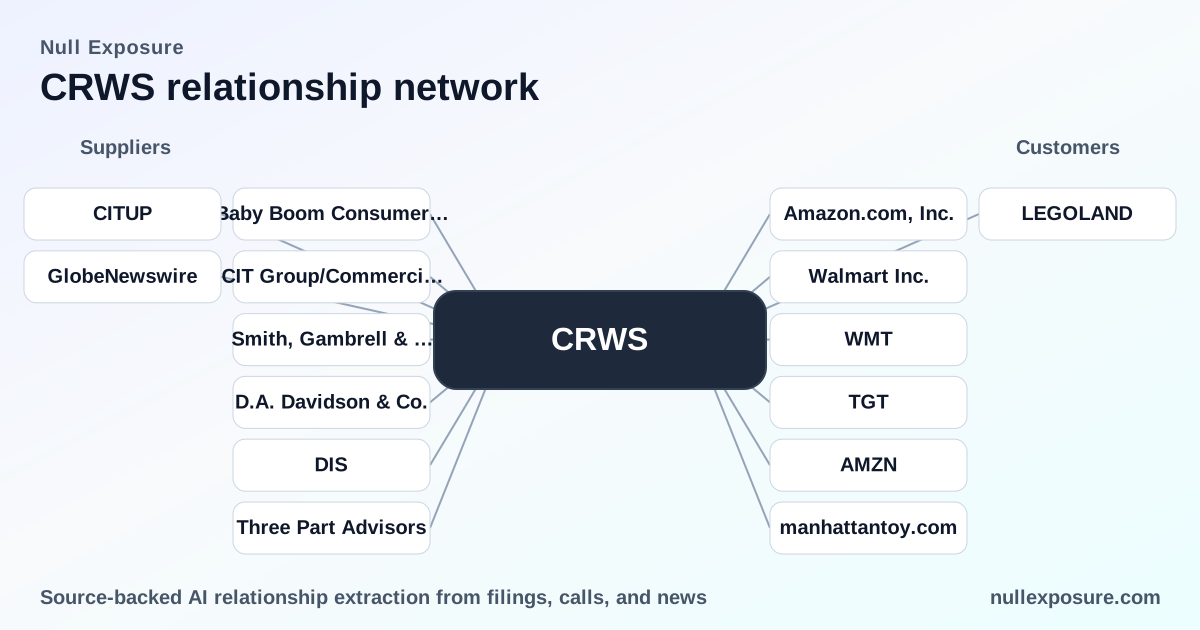
Below are the customer relationships identified in Crown Crafts’ public filings and recent market commentary. Each is summarized in plain English with source context.
Amazon.com, Inc.
Amazon accounted for 19% of Crown Crafts’ gross sales in FY2025 and FY2024, establishing it as a significant and persistent wholesale channel for the company’s baby and juvenile products, per the FY2025 10‑K. (Source: Crown Crafts FY2025 10‑K, filing disclosures.)
Walmart Inc.
Walmart was the single largest customer, representing 47% of gross sales in FY2025 (42% in FY2024), underscoring a dominant retail dependence that concentrates topline risk and operational leverage. (Source: Crown Crafts FY2025 10‑K.)
Target / TGT
Target shows up repeatedly in earnings call commentary as a key account where Crown Crafts has both presence and recent losses in select categories; management noted Target moved some categories (bib and diaper bags) to private‑label or direct sourcing, reducing Crown Crafts’ position in those lines. (Sources: Q3/FY2026 earnings call transcripts reported by InsiderMonkey and The Globe and Mail / Motley, March 2026.)
LEGOLAND / LEGOLAND Shanghai
Crown Crafts disclosed supplying plush product for a LEGOLAND soft opening, indicating a specialty/experiential channel placement beyond mass retail and a product placement that can support brand visibility in parks and attractions. (Source: Q4 FY2025 earnings call transcript and Investing.com transcription, May 2026.)
manhattantoy.com (Manhattan Toy)
A Manhattan Toy relaunch referenced by market coverage states dolls will be available through specialty retailers and manhattantoy.com starting May 2026, signaling Crown Crafts’ participation in specialty toy channels and collaborations with third‑party brand/retailer platforms. (Source: StockTitan news coverage, March 2026.)
Operational constraints and what they mean for value and risk
The public filings and call transcripts produce a compact set of company‑level signals that shape investor assessment:
- Short‑term contracting posture: Crown Crafts does not enter long‑term purchase agreements with customers, which increases agility but heightens revenue volatility when retailers change sourcing strategies. (Company disclosure.)
- Large enterprise and mid‑market counterparties: The customer base consists principally of mass merchants, large chain stores and mid‑tier retailers, which gives scale but reduces pricing flexibility. (Company disclosure.)
- North American revenue concentration: Sales outside the U.S. accounted for about 8% of gross sales, so macro developments in the U.S. retail environment disproportionately affect results. (Company disclosure.)
- Material customer concentration: Top two customers were ~66% of gross sales in FY2025 — a structural constraint that requires active account management and contingency planning for loss of programs. (Company disclosure.)
- Seller role and single segment focus: Crown Crafts is primarily a seller of core infant/toddler products — strength in focus but vulnerability to category disruptions or retail re‑sourcing. (Company disclosure.)
These are company-level constraints derived from filings and commentary, not relationship-specific assertions unless the excerpt explicitly referenced that counterparty.
Key investment implications
- Upside drivers: Regaining program share at Target, expanding private‑label manufacturing agreements with large retailers, and diversifying retail channels (specialty and international) increase revenue resilience. Evidence of new specialty placements (LEGOLAND, Manhattan Toy) suggests management is pursuing complementary channels beyond big‑box retailers.
- Primary risks: high customer concentration, retailer private‑labeling/direct sourcing, and short‑term contractual exposure. Those are the dominant determinants of downside volatility in earnings and cash flow.
- Operational priority for management: secure multi‑category commitments, deepen Amazon and Walmart programs while moving to shorter replenishment cycles that preserve margin, and expand non‑U.S. sales to reduce single‑market dependence.
For investors prioritizing customer‑risk visibility, Crown Crafts offers both clarity and concentration: you know where the revenue sits, but that clarity comes with exposure. For a summarized, investor‑oriented matrix of Crown Crafts’ customer relationships and constraint signals, visit https://nullexposure.com/.
Bold takeaway: Crown Crafts is a retail‑facing, single‑segment manufacturer whose near‑term trajectory is tightly coupled to the program decisions of a handful of large retailers — Walmart and Amazon in particular — and to its ability to reclaim or replace lost Target programs.