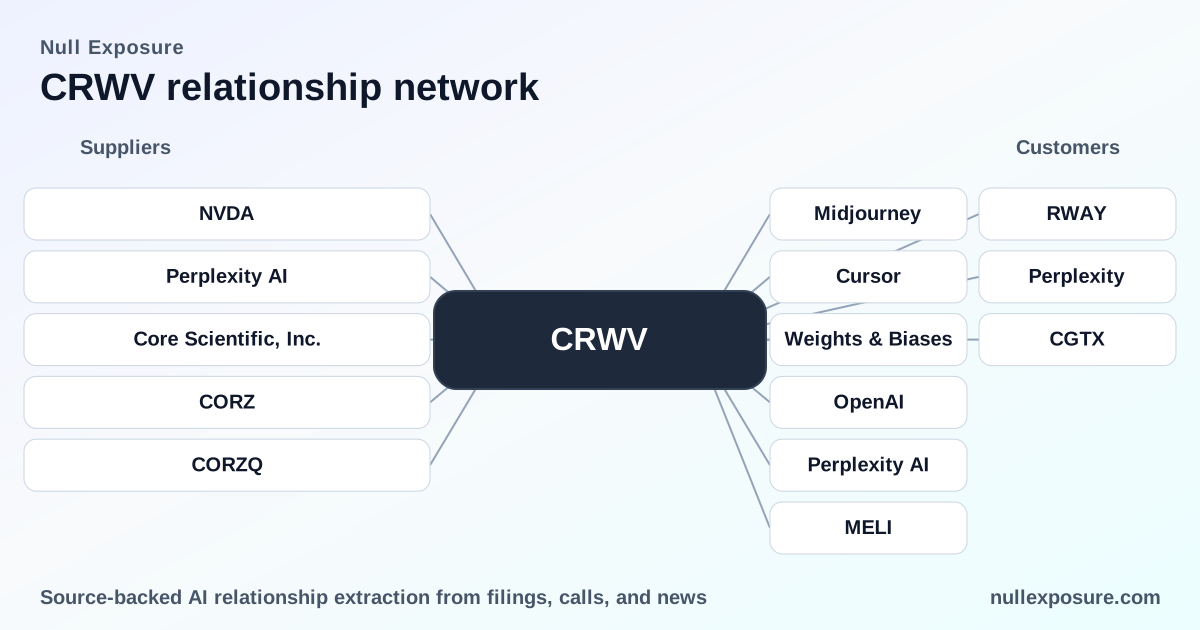
CoreWeave (CRWV) — Customer Relationships and Strategic Revenue Map
CoreWeave operates a purpose-built AI cloud that sells GPU compute capacity through a mix of reserved instances, multi-year capacity agreements and spot-like consumption to AI model developers and enterprise users; the company monetizes by leasing large-scale, low-latency GPU infrastructure and capturing long-duration total contract value (TCV) from hyperscalers, model providers and enterprise AI adopters. Recent multi-billion dollar commitments from Meta, Jane Street, OpenAI and others transform CoreWeave from a niche GPU provider into a de facto infrastructure partner for leading AI customers, while creating both revenue visibility and customer concentration dynamics investors must weigh. For deeper company relationship analytics, visit https://nullexposure.com/.
What the customer roster means for CRWV's economics
CoreWeave’s growth is driven by two durable levers: long-term capacity commitments (multi-year contracts and equity-linked strategic investments) and high-margin reserved instances for model training and inference. That commercial posture produces predictable cash flow when capacity is committed, but it also creates customer concentration risk and capital intensity: large, long-dated contracts finance data center builds and debt facilities but concentrate revenue and bargaining leverage with a handful of counterparties. CoreWeave’s public commentary and market reporting signal a transition from hyperscaler-era reliance toward a broader roster of AI model providers and enterprises, yet Microsoft and Meta remain structurally important while ramp schedules for other deals will determine near-term margin trajectory.
- Contracting posture: CoreWeave sells large TCV deals and reserved instances plus some open consumption; this favors multi-year, capital-backed commitments over purely short-term spot revenue.
- Concentration and criticality: A small number of large customers drive outsized revenue; that creates counterparty dependence but also strategic lock-in for model providers that require certified low-latency GPU capacity.
- Maturity and ramp: Several multi-year agreements are disclosed to ramp through 2027–2032, which offers revenue visibility but pushes capital deployment and ramp execution risk into the near term.
Deal roll call — every observed relationship and what it implies
Below I list each customer relationship reported in public sources. Each entry is a concise, plain-English takeaway followed by the cited source.
Weights & Biases
CoreWeave disclosed hundreds of millions of dollars of additional CoreWeave Cloud TCV from Weights & Biases customers in H2 2025, indicating successful cross-sell into an ML observability ecosystem. (CoreWeave 2025 Q4 earnings call, Mar 7, 2026)
Midjourney
CoreWeave added Midjourney as a reserved-instance customer amid the company’s record quarter for new reserved customers, signaling adoption by high-volume generative AI service providers. (CoreWeave 2025 Q4 earnings call, Mar 7, 2026)
Cursor
Cursor was named among the AI-native customers for whom CoreWeave added reserved capacity, reflecting continued traction with developer-focused AI platforms. (CoreWeave 2025 Q4 earnings call, Mar 7, 2026)
Jane Street
CoreWeave signed an approximately $6 billion AI cloud agreement with Jane Street, and Jane Street committed a $1 billion equity investment at $109 per share as part of that arrangement, tying a major trading firm to CoreWeave capacity across multiple facilities. (MLQ.ai report; Investing.com reporting, April–May 2026)
OpenAI
Multiple notices reference a deal disclosed pre-IPO described as worth up to $11.9 billion (and referenced in reporting as part of a broader set of large commitments), positioning OpenAI as a strategic, high-value customer in CoreWeave’s growth narrative. (PR Newswire / GlobeNewswire / Marketscreener reporting on securities class action filings, Mar 2026)
Perplexity AI
CoreWeave announced a multi-year agreement under which Perplexity will deploy inference workloads on CoreWeave’s NVIDIA GB200-powered platform, highlighting CoreWeave’s push into low-latency inference contracts. (MLQ.ai reporting, Mar 2026)
Meta Platforms (META)
Meta committed approximately $21 billion of AI cloud capacity through December 2032, with press coverage describing the expansion of Meta-backed commitments to roughly $35 billion, making Meta one of CoreWeave’s largest long-dated customers. (MLQ.ai; Investing.com; TradingKey reporting, Apr–May 2026)
Microsoft (MSFT)
Analyst commentary and market reporting repeatedly call out Microsoft as a large revenue contributor (reported ~67% of FY25 revenue in some analyses), underscoring both CoreWeave’s historical dependence on a hyperscaler and the material upside from successfully diversifying that exposure. (TradingKey analyst coverage / market-movers, May 2026)
Anthropic
CoreWeave disclosed a multi-year cloud infrastructure agreement with Anthropic to support deployment of the Claude models, representing another top-tier model provider using CoreWeave capacity. (MLQ.ai; Investing.com reporting, Apr–May 2026)
IBM
In coverage of the Anthropic agreement, CoreWeave’s customer roster was described as including IBM among top AI model providers working with the platform, reinforcing CoreWeave’s enterprise and provider mix. (MLQ.ai reporting, Apr 2026)
Mistral
Mistral was listed among the top model providers included in CoreWeave’s customer cohort, adding to the company’s credentials as a multi-provider infrastructure partner. (MLQ.ai reporting, Apr 2026)
Nvidia (NVDA)
Nvidia shows up in reporting of CoreWeave’s customer roster as a technology partner and GPU supplier, reflecting the hardware lineage behind CoreWeave’s capacity offering. (MLQ.ai reporting, Apr 2026)
Cohere (COHR)
Cohere was named among the leading AI model providers working with CoreWeave, reinforcing the supplier’s footprint across the top model teams. (MLQ.ai reporting, Apr 2026)
Runway (RWAY)
Runway was cited among the new reserved-instance customers CoreWeave onboarded in Q4 2025, indicating adoption by creative AI companies. (CoreWeave 2025 Q4 earnings call, Mar 7, 2026)
Mercado Libre (MELI)
Mercado Libre was named as an enterprise customer added to CoreWeave’s reserved-instance base in Q4 2025, signaling Latin American enterprise engagement. (CoreWeave 2025 Q4 earnings call, Mar 7, 2026)
Poolside
Reporting notes a failed or altered data-center arrangement with Poolside that led Poolside to seek a new partner, a discrete event demonstrating that not all site-level deals progress to long-term operation. (Investing.com reporting, May 2026)
BCE
BCE has publicly outlined plans to use CoreWeave for AI-related capacity to support a $2 billion AI revenue target by 2028, indicating telecom partnership use-cases outside hyperscalers. (NAI500 / InsiderMonkey reporting, May 2026)
Galaxy Digital (GLXY)
Analysts flagged Galaxy’s reliance on CoreWeave for data-center revenues and the funding requirement implications, revealing CoreWeave’s role as a customer or revenue source for adjacent infrastructure players. (SimplyWall.St reporting, May 2026)
SuRo Capital (SSSS)
An earnings reference noted CoreWeave as a defining, large position in SuRo Capital’s portfolio, signaling investor-level concentration and strategic importance to select public investors. (SuRo Capital earnings call excerpt, 2025 Q3)
Cognition (CGTX)
Cognition was listed among new reserved-instance customers CoreWeave added in Q4 2025, consistent with CoreWeave’s focus on AI-native model developers. (CoreWeave 2025 Q4 earnings call, Mar 7, 2026)
Strategic implications and risks for investors
- Revenue visibility vs. concentration: Large multi-year contracts provide predictable top-line upside, but reliance on a few hyperscalers or model providers creates execution and renegotiation risk if usage or pricing dynamics shift.
- Capital intensity: Agreements frequently align with debt and project financing (e.g., loan facilities backed by long-term contracts), meaning CoreWeave’s margin profile depends on successful facility builds and contract ramps.
- Customer diversification is underway: Recent deals with Jane Street, Anthropic, Perplexity and others indicate a deliberate move to broaden revenue sources beyond Microsoft and Meta, which should reduce single-customer risk as these ramps complete.
If you are modeling CoreWeave’s revenue and balance-sheet sensitivity, use the disclosed TCVs and ramp timelines reported in public filings and market coverage to stress-test concentration scenarios. For a consolidated view of relationship-level signals and ongoing updates, see https://nullexposure.com/.
Bold takeaways: CoreWeave is now a central GPU infrastructure supplier to leading AI providers and select enterprises; the company’s value rests on executing multi-year builds and converting large TCVs into recurring revenue while managing concentration and capital intensity.