Cloudastructure (CSAI): Customer Map and What It Means for Investors
Cloudastructure sells cloud-native AI video surveillance, remote guarding and related hardware to property managers and enterprise customers, and it monetizes through recurring monthly subscription services, professional services and one-time hardware sales. The business combines ratable subscription revenue for software and monitoring with spot hardware recognition and a mixed contract posture that ranges from month-to-month plans to multi‑year agreements with penalties. For investors this means predictable recurring revenue growth tempered by measurable customer concentration and an active enterprise sales motion.
Want a concise way to track Cloudastructure’s customer relationships and risks? Visit https://nullexposure.com/ for a structured view.
Why the customer list matters — a quick investor thesis
Cloudastructure targets large, multi-location property management firms and commercial customers; this customer profile supports high lifetime value per account and scalable deployment economics. The company recognizes subscription revenue ratably over terms while hardware sales are recognized on delivery, creating diverse near-term margin dynamics: services deliver recurring gross margin, hardware generates upfront cash but lower margins. The corporate filings show meaningful revenue concentration—several named customers accounted for material shares of 2024 revenue—which elevates near-term revenue volatility even as enterprise contracts deepen stickiness.
How Cloudastructure contracts and where risk concentrates
- Cloudastructure’s core revenue is generated through subscription contracts that are billed monthly and recognized ratably, and the company explicitly offers service month‑to‑month unless a three‑year contract with penalties is signed. This creates a blended contracting posture of both short-term flexibility and longer-term committed deals. (Source: Cloudastructure Form 10‑K, FY2024.)
- Hardware sales are recognized at delivery, which introduces lumpiness into quarter-to-quarter revenue. (Source: Cloudastructure Form 10‑K, FY2024.)
- The business operates as one operating segment focused on AI video surveillance and Remote Guarding services, reinforcing that customer concentration impacts the whole company rather than a single product line. (Source: Cloudastructure Form 10‑K, FY2024.)
- Materiality of customers is non-trivial: the 2024 filing shows SunRoad Enterprises and several other named accounts each contributing high single-digit to double-digit percentages of revenue, indicating concentration risk that investors must monitor. (Source: Cloudastructure Form 10‑K, FY2024.)
Detailed customer relationships every investor should know
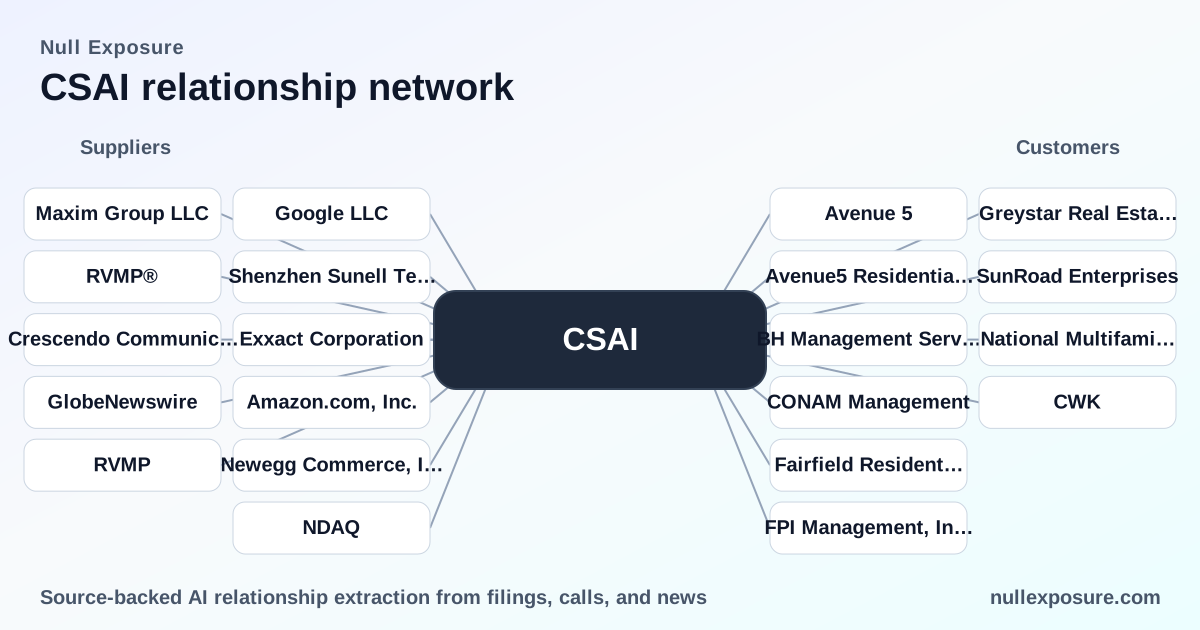
Below are every customer relationship disclosed across the company’s filings and related releases, summarized in plain English with source notes.
- SunRoad Enterprises — SunRoad accounted for approximately 18% of 2024 revenue, making it the largest single named customer and a clear concentration exposure. (According to Cloudastructure’s Form 10‑K for the year ended December 31, 2024.)
- CONAM Management — CONAM accounted for roughly 6–9% of revenues in filings, marking it as a material commercial relationship. (Cloudastructure Form 10‑K, FY2024.)
- Avenue5 Residential, LLC (Avenue 5 / Avenue 5) — Avenue5 represented about 11% of total revenue in 2024 and is also listed among the top industry property management partners. (Cloudastructure Form 10‑K, FY2024.)
- Fairfield Residential / Fairfield Properties — Fairfield contributed approximately 9% of 2024 revenue, placing it among the company’s larger customers. (Cloudastructure Form 10‑K, FY2024.)
- Wingate — Wingate accounted for about 9% of 2024 revenue, another significant single-customer weight in the revenue mix. (Cloudastructure Form 10‑K, FY2024.)
- RV Mobile Power (RVMP) — RV Mobile Power generated approximately 7% of revenue at year-end 2024. (Cloudastructure Form 10‑K, FY2024.)
- Greystar Real Estate Partners — Named as a contracted customer and listed among the top 10 NMHC managers with an active contract in place as of the 10‑K date. (Cloudastructure Form 10‑K, FY2024.)
- Cushman & Wakefield (CWK) — Contracted and explicitly listed among the top NMHC property managers with a live agreement noted in the 10‑K. (Cloudastructure Form 10‑K, FY2024.)
- FPI Management, Inc. — Included in the top‑10 NMHC list of contracted property managers disclosed in the 10‑K. (Cloudastructure Form 10‑K, FY2024.)
- BH Management Services, LLC — Identified as a contracted top‑10 NMHC property manager in the filing. (Cloudastructure Form 10‑K, FY2024.)
- Federal Capital Partners — Listed among other customers with an approximate revenue contribution reported in the company filing. (Cloudastructure Form 10‑K, FY2024.)
- The Wolff Company — Named as a customer in the company’s list of material or notable accounts. (Cloudastructure Form 10‑K, FY2024.)
- The Habitat Company — Included on the customer roster disclosed in the 10‑K. (Cloudastructure Form 10‑K, FY2024.)
- Gold Crown Management, Inc. — Identified in the 10‑K customer list with an indicated revenue share. (Cloudastructure Form 10‑K, FY2024.)
- MBK Rental Living — Listed among customers in the FY2024/2025 disclosures. (Cloudastructure Form 10‑K, FY2024.)
- American Landmark Apartments — Included in the company’s disclosed customer roster. (Cloudastructure Form 10‑K, FY2024.)
- AJ Capital Partners — Named as a customer in the filing. (Cloudastructure Form 10‑K, FY2024.)
- The Breeden Company — Appears on Cloudastructure’s customer list disclosed in the 10‑K. (Cloudastructure Form 10‑K, FY2024.)
- Gold Crown Management — (Duplicate listing in disclosures) included among other customers with reported revenue percentages in the filing. (Cloudastructure Form 10‑K, FY2024.)
- National Multifamily Housing Council (NMHC) — The NMHC selected Cloudastructure to deploy AI‑powered video surveillance and Remote Guarding at a luxury Houston community, an institutional endorsement reported in news coverage and press releases in early 2026. (MarketScreener and Cloudastructure press releases, Feb–Mar 2026.)
Each bullet references the disclosures in Cloudastructure’s 2024 Form 10‑K as filed with the SEC and related press coverage where noted; these documents provide the basis for revenue percentages and contract confirmations.
What the relationship map means for valuation and operational risk
- Concentration is the primary operational risk. A small number of customers accounted for a large share of revenue in 2024, so contract renewals with those names are critical to near‑term revenue stability. (Cloudastructure Form 10‑K, FY2024.)
- Contracting mix supports both churn management and near-term flexibility. Month‑to‑month subscriptions reduce long-tail risk for new customers, while three‑year contracts with penalties create durable revenue where the company secures committed deployments. (Cloudastructure Form 10‑K, FY2024.)
- Revenue recognition mix creates quarter-to-quarter variance. Ratable recognition on subscriptions smooths revenue, while hardware deliveries and professional services create lumpy upside, affecting short-term margin visibility. (Cloudastructure Form 10‑K, FY2024.)
- Validation from industry groups amplifies commercial opportunities. Selection by the NMHC to deploy AI monitoring at a luxury Houston community is a visible institutional win that accelerates enterprise sales pipeline development. (MarketScreener, Feb–Mar 2026.)
What to watch next
- Monitor renewal timing and contract length for the largest accounts (SunRoad, Avenue5, Fairfield, Wingate, RVMP) because any nonrenewal or pricing pressure will significantly impact short‑term revenue. (Cloudastructure Form 10‑K, FY2024.)
- Track the mix of subscription ARR versus one‑time hardware sales to understand margin trajectory and cash conversion.
- Watch enterprise endorsements and channel partnerships—like the NMHC selection—as indicators of scalable pipeline expansion. For a consolidated view of relationship risk and company filings, see https://nullexposure.com/.
Conclusion: Cloudastructure’s customer roster validates product-market fit in multi‑family and enterprise property management, and its subscription-first model supports recurring revenue growth. Investor focus should be on customer concentration, contract tenure, and the evolving mix of subscription versus hardware revenue as the key drivers of both upside and near-term volatility.