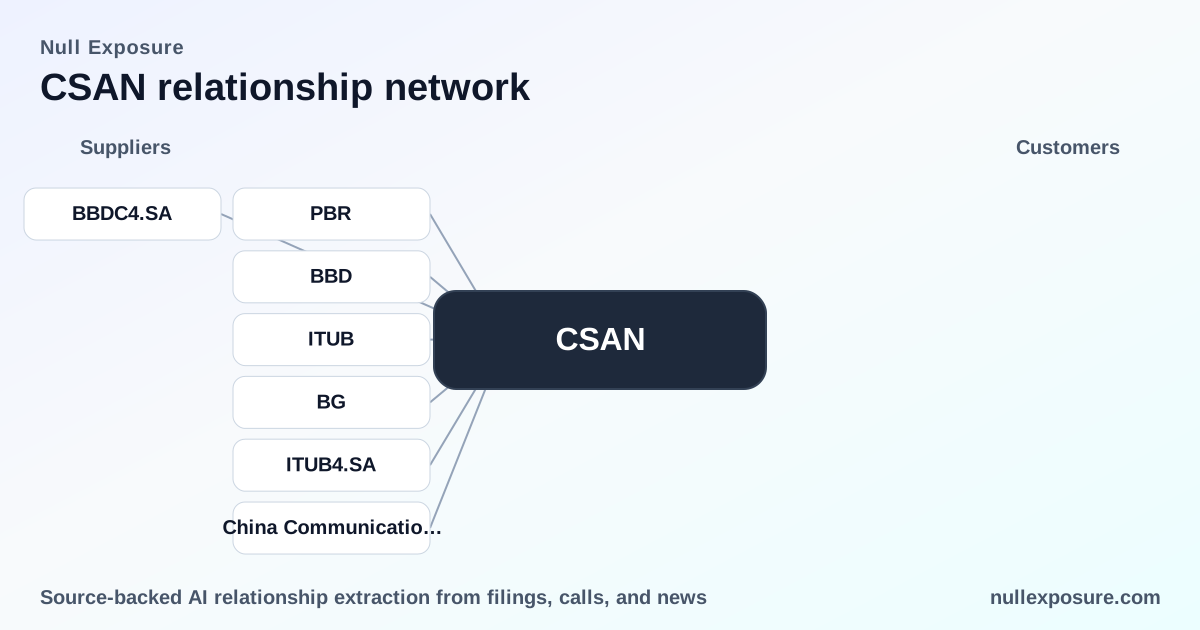
Cosan SA (CSAN) — customer map, commercial posture, and investment implications
Cosan SA operates as an integrated fuel distribution and downstream energy company, monetizing through wholesale and retail fuel sales, branded station networks and related lubricants and services across Brazil and international markets. Cosan’s core revenue engine is fuel distribution and branded retail (Raízen/partnered networks) combined with lubricant sales and energy services, delivering sizable top-line scale (Revenue TTM ~$40.4B) while producing an uneven bottom line profile. Learn more about the coverage and primary signals at https://nullexposure.com/.
Why customer relationships matter for an investor in Cosan
Customer relationships in downstream energy are both revenue drivers and risk amplifiers. For Cosan, relationships with global oil majors and branded distributors translate into distribution scale, margin stability on branded products, and reputational linkage to global fuel suppliers. Conversely, dependency on a small set of major brand partners concentrates commercial negotiation power and exposes Cosan to upstream pricing and branding decisions.
From an operating-model perspective, focus on these characteristics:
- Contracting posture: Standard commercial distribution and branding agreements dominate the model; these are long-standing, industry-standard arrangements that hinge on supply contracts and brand licensing rather than bespoke technology or one-off projects.
- Concentration: The presence of global majors as commercial partners signals material customer concentration risk; a handful of large counterparties can materially influence volumes and pricing.
- Criticality: For Cosan, branded distribution partners are operationally critical — they anchor retail footfall, supply chains, and lubricant channels.
- Maturity: The relationships reflect a mature, incumbent downstream business, driven by established brands and physical retail networks rather than early-stage partnerships.
These structural characteristics shape how investors should model counterparty risk, credit exposure and margin volatility in Cosan’s forecasts.
What the public customer map shows (two named partners)
Below are the customer relationships surfaced in the customer-scoped review. Each relationship summary is concise and source-cited.
Mobil (XOM)
Mobil is identified as a lubricants brand operating in Latin America where Cosan’s commercial footprint competes and transacts. A TradingKey company profile referencing FY2026 notes Mobil’s lubricants presence under the Mobil brand in Latin America and Comma in other geographies, indicating Cosan operates in the same commercial ecosystem where Mobil-branded lubricant flows are a meaningful product category. (TradingKey, May 2026)
Investment implication: Mobil’s regional lubricant distribution dynamics inform competitive pricing and shelf placement for Cosan’s lubricant and convenience-retail operations; exposure to global lubricant majors concentrates negotiation leverage on suppliers and channel partners.
Shell (SHEL)
Shell is referenced through Raízen Combustíveis, which distributes fuel largely via Shell-branded gasoline stations — a core retail channel overlapping Cosan’s operations. TradingKey’s FY2026 profile explicitly cites Raízen’s fuel distribution through Shell-branded service stations, linking Cosan’s retail and distribution market to global downstream branding arrangements. (TradingKey, May 2026)
Investment implication: A Shell-branded retail presence in Cosan’s markets signifies that branded supply agreements and co-branding dynamics are key determinants of station-level volumes and unit economics; changes in partner brand strategy would have immediate downstream revenue and margin effects for Cosan.
Constraints and what the search did not surface
The customer-focused review returned no explicit contractual constraints or flagged counterparty clauses in the supplied constraints set. This absence is a company-level signal: no public constraint excerpts were surfaced in the customer-scope review, which investors should interpret as either limited public disclosure of contract-level terms or an open commercial posture without identified structural restrictions in the dataset reviewed.
How investors should treat that signal:
- Do not assume bespoke protective clauses or material exclusivity based on these results. The lack of named contractual constraints means your valuation should not rely on hidden structural lock-ins.
- Underwrite counterparty risk explicitly. Given the presence of major branding partners, model the potential for concentrated counterparty negotiation leverage and the operational impact of supply-brand changes.
- Request contract diligence if material to your position. For large exposures, obtain direct confirmation of term length, exclusivity, termination triggers and volume commitments.
If you want a deeper, cross-checked view of Cosan’s commercial relationships and contract-level exposures, explore additional coverage at https://nullexposure.com/.
How these relationships feed risk-adjusted valuation
Two practical effects deserve emphasis for investors:
- Revenue concentration and counterparty leverage. Major brand partners like Shell and Mobil function as both customers and market anchors. Concentration increases downside risk if a partner changes supply terms or branding strategy, and increases renegotiation leverage for those partners.
- Operational criticality with limited upside optionality. Branded distribution is essential to Cosan’s retail economics, but it is also a mature market with low product differentiation; upside is tied to volume growth, network optimization and fuel margin stability rather than transformative new contracts.
Given Cosan’s scale (Revenue TTM ~$40.4B; Market Cap ~$4.0B) and negative EPS (Diluted EPS -3.16), investor focus should be on operational cash generation, working capital resilience and the contractual tenure of its distribution agreements.
Bottom line: actionable takeaways for investors and operators
- Key takeaway: Cosan operates a mature downstream distribution and retail business where a small number of large branded partners materially affect commercial outcomes; Shell- and Mobil-linked channels are strategically significant.
- Primary risk: Customer concentration and partner negotiation power are the primary idiosyncratic risks to model; absence of public constraint excerpts increases the importance of direct contract diligence.
- Primary opportunity: Operational improvements at the retail and lubricant margin level, and optimized branded network economics, will drive the clearest path to value realization.
For a practical next step, institutional investors and operators should request counterparty contract summaries from Cosan’s investor relations and cross-check retail network economics against branded partner terms. Further analysis and continuous monitoring of partner announcements are essential to detect early changes in supply or branding strategy.
Explore our coverage and request tailored counterparty analysis at https://nullexposure.com/.