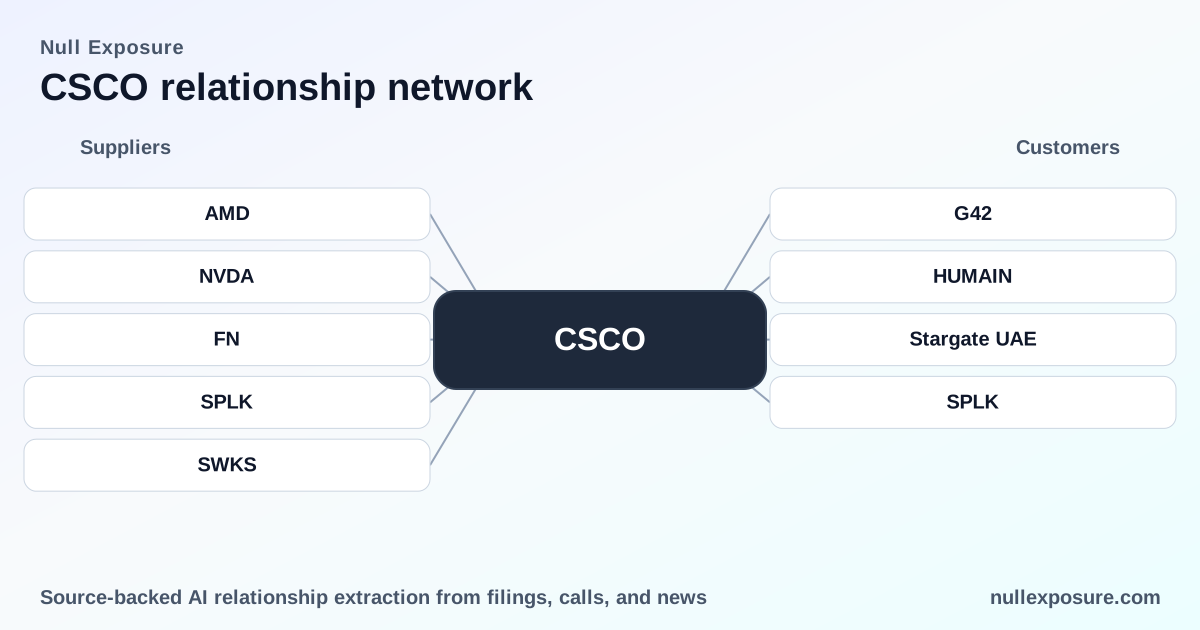
Cisco (CSCO) — A map of customer relationships that shape revenue and risk
Cisco sells networking hardware, software, and services to enterprises, service providers, public institutions and governments; it monetizes through a mix of product sales, perpetual licensing and an accelerating subscription/SaaS base (software revenue grew materially with the contribution of Splunk). The company’s go-to-market is hybrid: mission‑critical hardware and infrastructure are sold through distributors and channel partners while recurring software and subscription services increasingly drive margin and valuation multiple expansion. For a quick view of relationship signals and how they translate to commercial and concentration risk, see https://nullexposure.com/.
Operational profile and what it means for investors
- Contracting posture: Cisco executes multi‑obligation contracts that split hardware (perpetual) and software (SaaS/subscription) revenue streams; the company classifies hardware, perpetual licenses and SaaS as distinct performance obligations, and total subscription revenue has increased meaningfully (subscription revenue up 15%, driven by Splunk).
- Customer mix and concentration: Cisco serves governments, large enterprises and service providers globally; these counterparty types create a mix of predictable recurring revenue and episodic large-ticket hardware projects.
- Geographic footprint: The business is organized and reported across Americas, EMEA and APJC, reflecting balanced global exposure.
- Criticality and maturity: Cisco’s infrastructure is mission‑critical for customers (networking/security) while the company is transitioning to higher-margin software and AI offerings, reducing some legacy hardware cyclicality but introducing partner and integration risk.
A quick tour of every customer relationship surfaced in the coverage
- G42 — Cisco identified newly forged Middle East strategic partnerships including G42 as progressing and cited the sovereign AI opportunity for FY2026; this connection underlines Cisco’s focus on large public‑sector and sovereign AI deployments (CSCO Q4 FY2025 earnings call, March 2026).
- HUMAIN — Named alongside G42 in Cisco’s Middle East strategic partnership remarks, HUMAIN figures in Cisco’s push into sovereign AI projects and regional AI programs (CSCO Q4 FY2025 earnings call, March 2026).
- Stargate UAE — Also cited in the same earnings call as part of Cisco’s Middle East strategic partnerships, Stargate UAE highlights Cisco’s government‑facing engagements in the region (CSCO Q4 FY2025 earnings call, March 2026).
- CHDN (Churchill Downs Incorporated) — Cisco announced a multi‑year partnership to be Churchill Downs’ official enterprise networking and infrastructure partner, demonstrating a stadium/venue reference account for enterprise networking (Cisco newsroom press release, May 2026).
- EGAN (eGain Corporation) — eGain launched an AI agent integrated with Cisco Webex Contact Center to deliver knowledge at point of service, showing a software integration partner that complements Cisco’s contact‑center and AI push (press releases and FinancialContent/industry coverage, Jan–Mar 2026).
- IBM — Cisco is collaborating with IBM on programs referenced in IBM’s FY2025 narrative (quantum and government initiatives), indicating cross‑vendor R&D and government program participation (IBM Q4 FY2025 earnings commentary, March 2026).
- INTM (Intermedia Unite) — Intermedia’s product documentation lists compatibility with Cisco hardware, reflecting ecosystem interoperability for unified communications and VoIP deployments (PCMag/Intermedia product review, 2024–2025 reporting).
- ZM (Zoom) — Zoom’s Conference Room Connector supports H.323/SIP systems from providers such as Cisco, enabling Cisco hardware to interoperate with cloud conferencing, underscoring joint customer deployment scenarios (Zoom S‑1 filing language cited in secondary reports, FY2019 disclosure).
- NSIT (Insight Enterprises) — Insight highlighted that it was the first partner to launch the Cisco Secure AI Factory with NVIDIA, positioning Insight as a lead systems integrator in Cisco’s AI security initiatives (Insight press coverage and earnings excerpts, FY2026).
- MSGE (Madison Square Garden Entertainment) — MSGE deploys Cisco enterprise networking and data center infrastructure across the venue, an example of Cisco’s event/venue infrastructure footprint (Cisco newsroom release, Dec 2025).
- SCSC (ScanSource / KBZ AV distribution context) — ScanSource (and its KBZ AV business) is a committed Cisco distributor; ScanSource’s 10‑K notes Cisco as a >10% supplier, signaling channel concentration for that reseller (ScanSource 10‑K and RAVEPubs coverage, FY2025–FY2026).
- SHAZ (Sharon AI) — Sharon AI and Cisco announced Australia’s first Cisco Secure AI Factory with NVIDIA, showing Cisco’s partner‑led rollouts of its AI factory concept in APAC (company press release via Marketscreener/Business Wire, Feb–May 2026).
- KVHI (KVH Industries) — KVH’s CommBox Edge Secure Suite references Cisco Talos and Snort rulesets for threat detection, illustrating Cisco security technology embedded in third‑party cybersecurity products (KVH press release/Mar 2025 coverage).
- SNX (TD SYNNEX) — Cisco named TD SYNNEX distributor of the year globally and regionally, confirming TD SYNNEX’s strategic role in Cisco’s distribution network (TD SYNNEX Q4 FY2025 earnings transcript and press coverage, FY2026).
- PHI (PLDT Enterprise) — PLDT Enterprise is working with Cisco to modernize enterprise networks across the Philippines, demonstrating telco/enterprise modernization programs in APAC (local press coverage, 2026).
- CXAI (CXApp / Kins Technology) — CXApp announced itself as a preferred partner for Cisco Spaces, indicating Cisco’s location‑services and spaces platform partnerships in enterprise customer experience tooling (company press release, FY2023–FY2026).
- CNXN (Connection) — Connection earned Cisco Gold Provider designation, reflecting authorized reseller status and the role of national integrators in distributing Cisco solutions (press coverage/finviz, FY2026).
- AMBO (Ambow Education) — Ambow announced a strategic partnership with Cisco for international career education, showing Cisco’s channel into training and certification networks (Ambow press note, Nov 04 historical press).
- SPLK / Splunk — Cisco noted that Splunk–Cisco synergies delivered a 14% year‑over‑year increase in new Splunk logos in Q4, reflecting material go‑to‑market lift from the Splunk acquisition and cross‑sell motion (CSCO Q4 FY2025 earnings call, March 2026).
- AUDC (AudioCodes) — AudioCodes expanded certified voice solutions for Webex Calling, demonstrating ecosystem partners that extend Cisco’s UCaaS and PSTN connectivity offerings (AudioCodes announcements, FY2026).
- ITRI (Itron) — Itron is working with Cisco to provide improved Internet connectivity for smart devices (smart meters), indicating Cisco’s role in critical‑infrastructure and IoT connectivity (CybersecurityDive reporting, FY2026).
- PLUS (Plus 10‑K disclosure) — A 10‑K filed by PLUS (fiscal 2025) states that Cisco Systems products represented roughly 32%, 44% and 40% of its technology segment net sales across recent years, signaling significant dependency for some resellers/integrators (PLUS 10‑K, FY2025).
What these relationships imply for investors and operators
- Revenue mix is shifting: Splunk’s contribution and subscription growth push Cisco toward higher recurring revenue, improving visibility and valuation multiple support.
- Channel concentration is real: Distributors and resellers (TD SYNNEX, ScanSource, Connection, PLUS) are material conduits; supplier concentration for some partners translates into counterparty concentration risk on the go‑to‑market side.
- Government and sovereign programs are strategic: Middle East sovereign AI partnerships and explicit government customer language show Cisco competes for large, lucrative public projects that are often multi‑year and high‑touch.
- Integration ecosystem matters: Partnerships with eGain, AudioCodes, Zoom, Splunk and NVIDIA/AI‑factory partners demonstrate that Cisco’s value accrues via integrations—this raises both upsell potential and execution risk around partner enablement.
For a deeper signal map or to monitor these relationships over time, visit https://nullexposure.com/ — the homepage has the gateway to relationship intelligence and evidence.