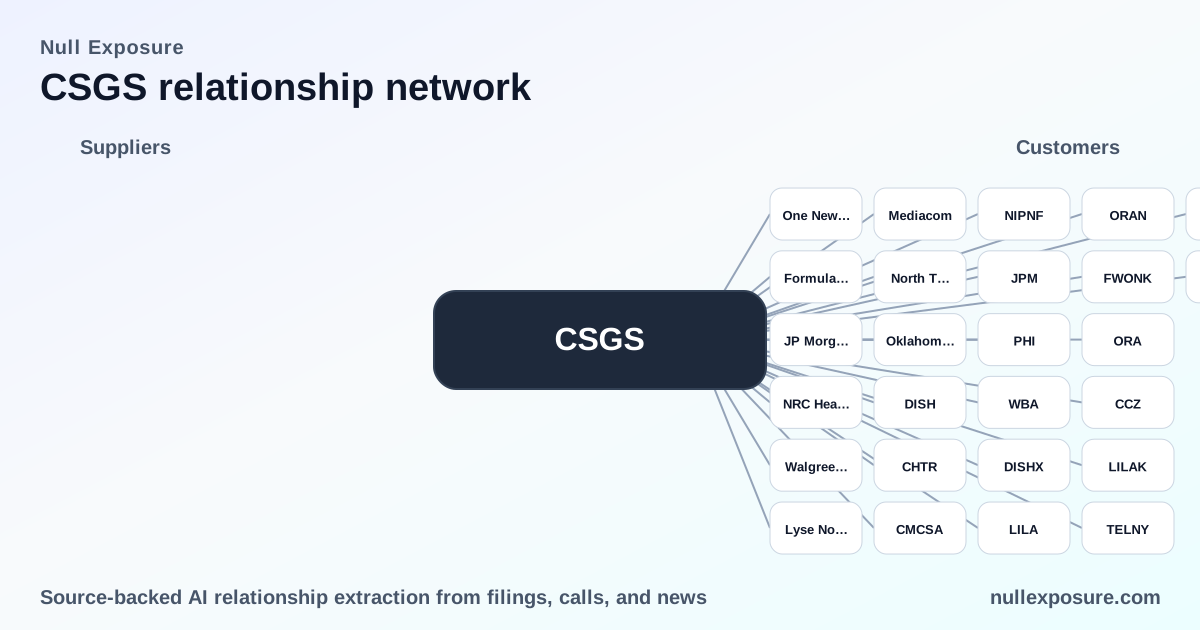
CSG Systems International — customer map and what it means for investors
CSG is a purpose-built SaaS and managed‑services company that monetizes by selling revenue‑management, customer‑experience, and payments platforms to large communications, financial and enterprise customers. Revenue streams combine long‑term managed‑service and licensing arrangements with subscription and usage‑based fees, producing a high‑visibility recurring base that is nevertheless concentrated among a few very large customers. For relationship intelligence and source traceability, visit https://nullexposure.com/.
Quick reading: the core commercial model
CSG sells mission‑critical billing, payments and CX software and operates those systems for customers in three ways: perpetual/term licensing, managed services, and SaaS subscriptions where fees are often monthly or per‑transaction. The company’s own filings state that managed arrangements typically run three to five years and that some flagship deals (for example Comcast) have been extended out to 2030 — a structure that combines high recurring revenue with meaningful counterparty concentration (Charter and Comcast together generate roughly a third to 40% of revenue).
Relationship roll call: every named customer in the record
Below are plain‑English summaries of every customer relationship called out in the provided results, with source context.
Charter Communications
CSG reports Charter as one of its two largest customers, contributing roughly 20% of 2024 revenue and representing a material, long‑term revenue source. According to CSG’s 2024 Form 10‑K, Charter accounted for $240 million (≈20%) of revenue in 2024. (Source: CSG 2024 10‑K — Significant Customer Relationships.)
Comcast
Comcast is the other top duopoly customer, contributing roughly 18–19% of revenue in recent years and covered by a contractual extension through 2030 for certain services. The 10‑K and subsequent filings cite Comcast as a major contributor, and company commentary notes a customer agreement extended to December 31, 2030. (Source: CSG 2024 10‑K; Amended Agreement disclosure.)
DISH Network
DISH is a multidecade CSG client for billing and payments and signed a multi‑year renewal that continues CSG’s platform role through 2030. Multiple SEC filings and press releases in early 2026 describe a contract renewal and long‑standing operational relationship. (Source: CSG 2024 10‑K; press releases Jan 2026.)
Liberty Latin America (including Liberty Communications of Puerto Rico)
CSG announced an expansion with Liberty Latin America and separately references an extension with Liberty Communications of Puerto Rico, reflecting ongoing regional engagements across Liberty’s portfolio. CSG discussed a “fantastic expansion” with Liberty and an extension with Liberty Puerto Rico in earnings commentary. (Source: Q1 & Q2 2025 earnings calls; press releases FY2025–FY2026.)
Comcast / CCZ (alternate ticker mentions)
Alternate ticker references in the feed (CCZ) point to the same Comcast relationship, cited by SEC filing excerpts showing material revenue contributions and contract disclosures. (Source: CSG 2024 10‑K and related SEC filings.)
JPMorgan Chase
CSG expanded its solutions within financial services to help JPMorgan Chase improve cardholder overdraft experiences, signaling product breadth outside communications. This expansion was discussed on CSG’s Q1 2025 earnings call. (Source: Q1 2025 earnings call.)
Walgreens
Walgreens is named among non‑CSP enterprise customers for CSG’s platforms, cited in the company’s MD&A and earnings commentary as an example of retail/healthcare accounts. (Source: CSG 2024 10‑K; Q1 2025 earnings call.)
Formula 1
CSG lists Formula 1 as a 2024 sales win and customer, reflecting CSG’s ability to win branded, event‑driven enterprises for CX and billing solutions. (Source: Q1 2025 earnings call.)
NRC Health
NRC Health is listed among large non‑CSP customers working with CSG’s solutions, mentioned in the 2024 Form 10‑K as part of the company’s broader client roster. (Source: CSG 2024 10‑K.)
Lyse Norway
Lyse Norway is identified as a 2024 new sales win, illustrating CSG’s reach into European utility and telco customers. (Source: Q1 2025 earnings call.)
Mediacom
CSG extended a 30‑year relationship with Mediacom, indicating a decades‑long, durable partnership with the U.S. cable operator. Company remarks on the Q1 2025 earnings call announced the extension. (Source: Q1 2025 earnings call.)
North Texas Tolling Authority (NTTA)
NTTA selected CSG for data‑driven customer‑experience solutions, representing CSG’s vertical expansion into tolling and transportation accounts. This win was announced on a 2025 Q1 earnings call. (Source: Q1 2025 earnings call.)
Oklahoma Turnpike Authority
CSG announced a win with the Oklahoma Turnpike Authority in Q4 2024, reinforcing momentum in tolling and transportation services. (Source: Q1 2025 earnings call commentary referencing Q4 2024.)
One New Zealand
One New Zealand was cited among 2024 sales wins, signaling continued penetration into APAC telco markets. (Source: Q1 2025 earnings call.)
Telenor Denmark
Telenor Denmark is listed as a 2024 sales win in the company’s earnings commentary, part of a string of European telco customer additions. (Source: Q1 2025 earnings call.)
PLDT
CSG highlighted an extension with PLDT — the Philippines’ largest integrated telecom — confirming a long‑standing relationship in the region. (Source: Q1 2025 earnings call.)
ePLDT Group
CSG entered a partnership with ePLDT Group to support enterprise services in the Philippines, including Quote & Order and Encompass solutions to accelerate activation and billing simplification. (Source: April 2026 press releases and coverage.)
VITRO Inc.
VITRO, ePLDT’s data‑center subsidiary, selected CSG platforms alongside ePLDT to modernize enterprise offerings and accelerate go‑to‑market processes. (Source: FY2026 press coverage and company announcements.)
Banglalink
Banglalink selected CSG to boost customer experience, representing further expansion in emerging-market telco accounts. (Source: FY2026 press release via FinancialContent.)
Zain Sudan
Zain Sudan engaged CSG to rebuild wireless business capabilities rapidly, reflecting CSG’s telco service footprint in Africa. (Source: FY2026 press release via FinancialContent.)
M1
M1 selected CSG Ascendon to power digital B2B services, an example of platform deployment for digital customer journeys in Southeast Asia. (Source: FY2026 press release.)
Orange Business
Orange Business was announced as a new deal and positioned as a leading enterprise integrator working with CSG to deliver enterprise digital services. (Source: Q2 2025 earnings call; FY2026 press commentary.)
NEC Corporation / NIPNF
NEC Corporation is the announced buyer in December 2025 for an $80.70 per‑share cash transaction valuing CSG, and NEC commentary appears in news coverage around the acquisition. (Source: December 2025/May 2026 news items covering the NEC transaction.)
What the relationship map signals for investors
CSG’s commercial architecture is clear and consequential for valuation and risk analysis:
-
Contracting posture: The business mixes long‑term managed‑service contracts (3–5 years and multi‑year amended agreements) with SaaS subscriptions that are month‑to‑month or auto‑renewing, and usage‑based transaction fees for payments. This hybrid model supports recurring revenue while linking growth to transaction volume. (Source: CSG 10‑K disclosures and contract excerpts.)
-
Concentration and materiality: Two customers account for approximately 36–40% of revenue in recent quarters (Charter and Comcast), producing both predictability and counterparty risk that investors must monitor at renewal points. (Source: 2024 10‑K and Q1/Q2 2025 earnings commentary.)
-
Criticality and role: CSG’s platforms are treated as mission‑critical billing, payments and customer‑management systems by customers; the company functions as licensor, seller, and service provider (operating software in customer, CSG, or third‑party data centers). That operational role increases switching costs and revenue stickiness. (Source: 10‑K relationship and services descriptions.)
-
Maturity and durability: Many significant customer relationships span decades; a mix of legacy depth and recent new wins gives both a stable base and avenues for cross‑sell into adjacent enterprise segments. (Source: 10‑K and earnings call remarks.)
-
Geography: The business is North America‑centric (≈87% of revenue from the Americas) but recent wins in Europe, Asia-Pacific and emerging markets indicate deliberate geographic diversification. (Source: 10‑K geographic revenue table; recent FY2026 press announcements.)
Bottom line and investor actions
CSG’s customer roster is a mix of deep, mission‑critical incumbents and strategic new logos that expand product reach. The investment thesis centers on predictable recurring cash flow tempered by customer concentration risk and renewal timing at major accounts. For ongoing tracking of contract outcomes, renewal terms and customer momentum, check source‑level relationship intelligence at https://nullexposure.com/.
Key takeaway: CSG’s monetization combines safe recurring revenue and scalable usage fees, but valuation sensitivity to outcomes at Charter and Comcast is a persistent lever for upside or downside.