Canadian Solar (CSIQ): Customer Relationships That Drive Project Revenue and Asset Monetization
Canadian Solar designs, manufactures and develops solar modules and energy storage systems and monetizes through equipment sales, project development, long‑term operations contracts, and selective asset sales that recycle capital into new projects. The company’s customer mix spans utilities, independent developers, institutional investors and strategic buyers for completed assets—creating a hybrid business model that blends manufacturing margin with project finance returns and recurring O&M revenue. For a concise view of relationship signals and what they imply for revenue durability and capital deployment, visit https://nullexposure.com/.
How to read these customer ties: business model implications up front
Canadian Solar's relationships show three monetization levers in practice: (1) module and BESS system sales (one‑time equipment revenue), (2) long‑term service and O&M contracts (recurring revenue and performance obligations), and (3) project monetization through asset sales and tax equity/construction financing (capital recycling and balance‑sheet management). These ties imply a contracting posture that blends long‑dated service commitments with transactional asset sales, a diversified geographic footprint reducing single‑market concentration, and a maturity profile that includes both mature operating assets and greenfield projects requiring project finance.
Below I walk through the full set of customer relationships surfaced in public filings and news, with concise, source‑tagged takeaways for investors.
Relationship map: who CSIQ is selling to and contracting with
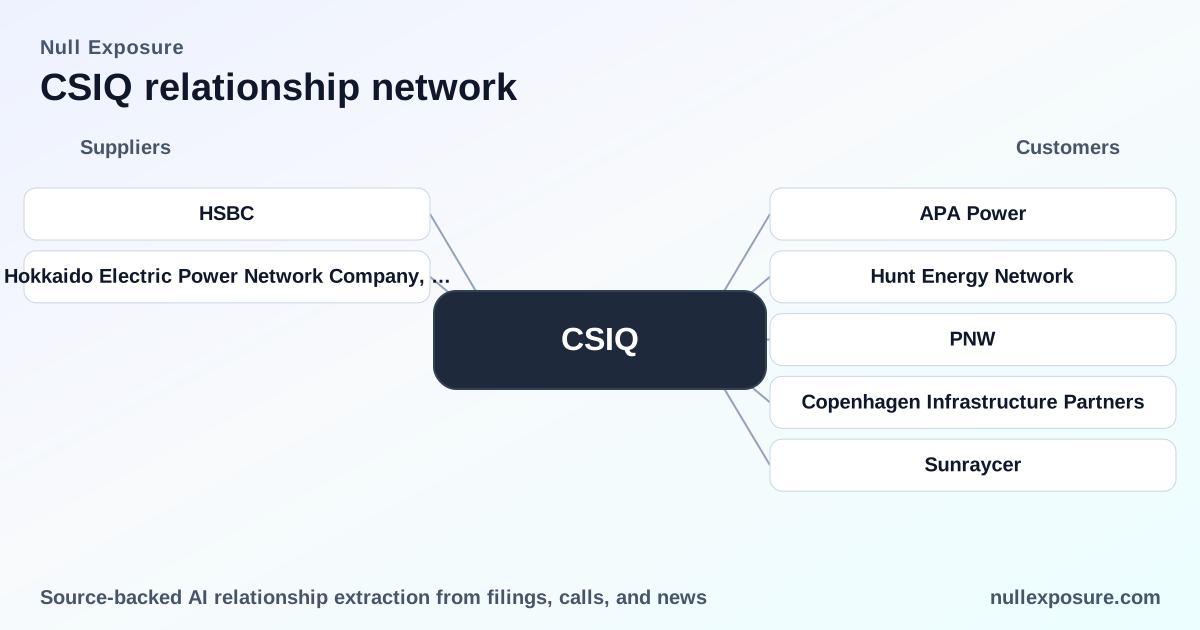
APA Power
Canadian Solar reported signing supply and 20‑year long‑term service agreements with APA Power for the Elora and Hadley projects in Canada, indicating a durable O&M revenue stream tied to those assets. This detail came from the company’s Q3 2025 earnings call where management described the transaction as part of its Canadian project pipeline (Q3 2025 earnings call, March 2026).
Hunt Energy Network (multiple notices)
Recurrent Energy, a Canadian Solar subsidiary, completed the sale of the 200 MWh Fort Duncan battery storage facility to Hunt Energy Network, a cash recycling move that converts developed BESS capacity into liquidity expected to be recognized as revenue in Q1 2026; multiple press reports covered the transaction and its role in the company’s strategic monetization plan (SimplyWallSt and Finviz coverage, March 2026). Additional reporting framed the sale as part of a broader effort to selectively monetize projects for growth capital (Intellectia.ai, March 2026).
Sunraycer (e‑STORAGE cooperation)
Canadian Solar’s e‑STORAGE unit signed a cooperation agreement with Sunraycer to supply and provide long‑term O&M for two standalone BESS projects in Texas (503 MWh total), positioning e‑STORAGE as both equipment supplier and ongoing operator—a combination that supports recurring service revenue and lifecycle margins (SolarBEGlobal and PV‑Magazine USA reports, Feb–Mar 2026).
PNW (project finance backing for Desert Bloom and Apollo)
Management disclosed closing $825 million in construction financing and tax equity for the 600 MWh Desert Bloom storage and 150 MW Apollo solar projects, transactions described as part of a multi‑project partnership with Arizona Public Service; the financing package demonstrates Canadian Solar’s ability to syndicate large project capital packages and de‑risk through third‑party financing (Q3 2025 earnings call, March 2026).
Arizona Public Service (offtake/partnership)
As noted in the same earnings call, the Desert Bloom and Apollo projects are components of a multi‑project partnership with Arizona Public Service, reflecting utility‑level counterparties and likely long‑dated offtake or hosting arrangements that underpin project cash flows (Q3 2025 earnings call, March 2026).
Drax Group (UK BESS supply)
e‑STORAGE will supply 420 MWh AC of battery energy storage systems for two major Drax Group projects in the U.K., a commercial win that expands Canadian Solar’s footprint in European utility‑scale storage and signals cross‑border execution capacity (SolarQuarter, April 2026).
Copenhagen Infrastructure Partners (CIP)
CIP, a major institutional investor in greenfield development, selected e‑STORAGE as preferred supplier for the Summerfield battery storage project in South Australia, indicating institutional investor confidence in Canadian Solar’s technical and contractual capabilities for large regional projects (Energy‑Storage.News, March 2026).
Central Puerto S.A. (CEPU) / Fieldfare Argentina transaction
Central Puerto signed a purchase agreement to acquire 100% of Fieldfare Argentina S.R.L., a local vehicle previously owned by Canadian Solar entities that operates the Cafayate Solar Project (~80 MW); this transaction reflects Canadian Solar’s project divestiture activity in Latin America (NewsfileCorp release, Aug 2025 / reported Mar 2026).
What these relationships collectively tell investors
- Contracting posture: Canadian Solar combines long‑term service agreements (20 years) with discrete asset sales and project finance syndication, creating a mix of durable, contractually backed recurring revenue and near‑term liquidity events.
- Concentration: Counterparties span utilities (Arizona Public Service, Drax), developers (Sunraycer), institutional investors (CIP), and asset buyers (Hunt Energy Network, Central Puerto), signaling diversified customer exposure by sector and geography.
- Criticality: Several engagements include long‑term O&M commitments and large BESS supply contracts, indicating that Canadian Solar often holds critical operational responsibilities that can support aftermarket margins.
- Maturity: The portfolio includes operational projects being sold, financed greenfield projects and long‑dated service agreements—so revenue streams range from immediate recognition on asset sales to multi‑decade service income.
Key takeaways and risk considerations
- Positive: The mix of project monetization and long‑term service contracts supports cash recycling and recurring revenue potential. Large financings (e.g., $825 million) and institutional partnerships validate Canadian Solar’s scale in project execution.
- Risk: Reliance on asset sales and construction financing introduces execution and timing risk—delays in closing or lower sale proceeds would pressure near‑term cash flow. Geographic diversity reduces single‑market exposure but increases complexity and regulatory touchpoints.
- Competitive positioning: Winning supply and O&M agreements with utilities and major investors (Drax, CIP, Arizona Public Service) demonstrates product and commercial competitiveness across markets.
For a deeper operational signal review and to track new relationship developments as Canadian Solar converts projects into cash, consider the Nillexposure research hub at https://nullexposure.com/.
Bottom line
Canadian Solar is executing a hybrid strategy: manufacturing and selling hardware, securing long‑term service contracts, and monetizing developed projects to redeploy capital. The customer relationships summarized here underline an operator capable of closing large project financings and securing institutional buyers—factors that support both short‑term liquidity and longer‑term recurring revenue streams. Investors should monitor execution on project closings and the cadence of asset sales as determinants of near‑term cash flow and valuation realization.