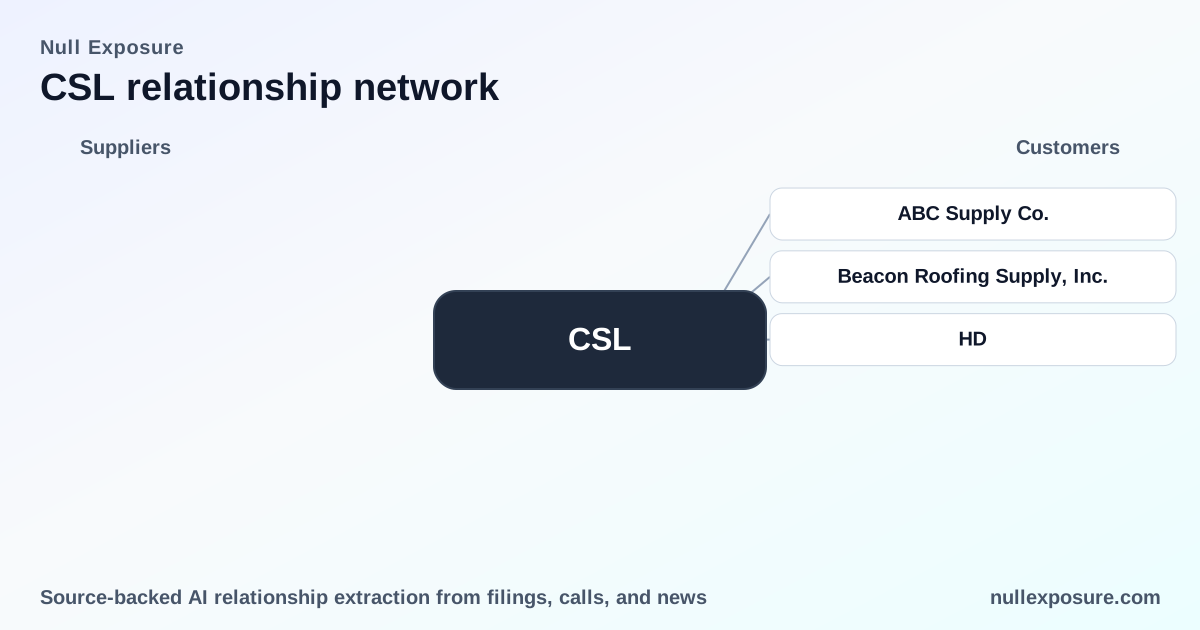
Carlisle Companies (CSL): Customer Footprint, Concentration Risk, and Channel Dynamics
Carlisle Companies is a diversified, industrial manufacturer that monetizes by selling engineered building products through manufacturing-led segments (CCM and CWT) and a network of distributor and retail channel partners. Revenue is recognized predominantly at the point of shipment, so Carlisle’s cash flow profile is closely tied to order flows from wholesalers and big-box retailers; two distributor customers alone represented roughly one-third of consolidated revenue in recent years, making channel volatility a primary investment risk.
Explore more on customer-driven revenue dynamics at https://nullexposure.com/
How Carlisle’s operating model shapes customer risk
Carlisle operates as a manufacturing-centric supplier to construction channels. The company reports that the majority of its revenue is generated when control of goods transfers at shipment — a spot-sale contracting posture that aligns revenue and working-capital volatility with distributor ordering patterns. Carlisle’s revenue geography is highly North American, with roughly 90% of sales delivered to U.S. addresses, so U.S. construction cycles and channel inventory strategies dominate performance.
Carlisle’s customer mix is concentrated and material: the CCM segment disclosed that its two largest customers represented one-third of consolidated revenues in 2024. That concentration translates into high commercial criticality for a small set of distributors and elevates sensitivity to industry consolidation and inventory destocking at channel partners. Finally, Carlisle’s underlying businesses are mature manufacturing franchises—prefabricated metal systems, insulation, and waterproofing—where scale and distribution reach drive margins and strategic advantage.
Customer relationships uncovered (what the filings and calls show)
Beacon Roofing Supply, Inc.
Carlisle’s 2025 Form 10-K identifies Beacon Roofing Supply as one of CCM’s largest customers, with Beacon accounting for approximately 17.8% of consolidated revenues in 2024; the filing notes the loss of such a customer would be material to consolidated revenue and operating income. According to Carlisle’s FY2025 10‑K, Beacon is therefore a strategically important distributor for Carlisle’s roofing and related product lines (FY2025 10‑K).
ABC Supply Co.
ABC Supply is the other distributor named as a material customer, representing about 15.9% of consolidated revenues in 2024; Carlisle’s filings highlight that sales to ABC originate across CCM and CWT segments and that dependence on a few large distributors is a standing commercial risk (FY2025 10‑K).
QXO (distributor channel partner)
Multiple Q1‑2026 earnings-call transcripts reference QXO as a representative channel partner experiencing industry consolidation and inventory destocking, which has driven order volatility for manufacturers like Carlisle; Carlisle’s management discussed this dynamic directly on the Q1 2026 earnings call (May 2026 transcripts in The Globe and Mail and InsiderMonkey).
Sources: Q1‑2026 earnings call transcript coverage on The Globe and Mail and InsiderMonkey (May 2026).
Beacon (as referenced in earnings calls)
Management cited “QXO and Beacon” together when describing initiatives to restore historical order levels, confirming Carlisle’s active commercial engagement with Beacon in the post-consolidation environment (Q1‑2026 earnings-call coverage, Motely/The Globe and Mail, May 2026).
Source: Earnings call transcript coverage (May 2026).
HD (Home Depot shorthand in transcripts)
Carlisle management discussed product lines such as UltraTouch insulation sold through Home Depot while describing integration of acquisitions and category positioning, indicating Home Depot is an important retail channel for certain insulation products (Q4‑2025 earnings-call transcript, March 2026).
Source: Q4‑2025 earnings-call transcript coverage on InsiderMonkey (March 2026).
Home Depot (full retail name)
The company explicitly referenced Home Depot as a retail partner for sustainable insulation solutions—a channel that amplifies product reach but also ties certain product categories to retail inventory cycles (Q4‑2025 earnings-call transcript, March 2026).
Source: Q4‑2025 earnings-call transcript coverage on InsiderMonkey (March 2026).
What these relationships imply for investors
- Concentration risk is real and measurable. Carlisle’s disclosure that two customers accounted for roughly 33% of consolidated revenues in 2024 is a structural feature of the business that increases earnings sensitivity to the purchasing behavior of large distributors (Carlisle FY2025 10‑K).
- Channel consolidation creates order volatility. Management commentary on Q1 2026 ties industry consolidation and distributor destocking directly to near-term revenue variability—this is structural given Carlisle’s point-in-time revenue recognition model and heavy U.S. exposure (Q1‑2026 call transcripts).
- Retail exposure is complementary but different. Home Depot provides broad market access (e.g., UltraTouch insulation), but retail inventory cycles and promotional cadence differ from wholesale distributors and require separate execution discipline (Q4‑2025 call transcript).
- Manufacturing scale and category focus are competitive advantages. Carlisle’s emphasis on integrating acquisitions, capturing synergies, and strengthening positions in prefabricated systems and insulation supports margin resilience, provided channel order normalization occurs (Q4‑2025 call commentary).
Key risk/reward thesis: Carlisle offers a high-quality manufacturing franchise with attractive margins and cash generation, but near-term revenue growth and volatility are channel-dependent, concentrated among a few large distributor accounts, and therefore linked to sector consolidation and inventory cycles.
Explore related customer exposure analysis and monitoring tools at https://nullexposure.com/.
Actionable signals for analysts and operators
- Monitor distributor order patterns from Beacon and ABC Supply on a quarterly cadence; a sustained decline in orders would be the highest-probability driver of revenue downside.
- Track Carlisle’s progress in acquisition integration and cross-sell into Home Depot and other retail channels as a diversification lever against distributor concentration.
- Watch working-capital trends: because most revenue is recognized at shipment, inventory and receivable movements will meaningfully affect near-term cash flow.
Bottom line
Carlisle’s business model is manufacturing-driven, North America-centric, and distributor-dependent. The combination of spot-sale recognition, material customer concentration (Beacon and ABC Supply), and channel consolidation (QXO and peers) creates a clear investor checklist: assess distributor order trends, validate acquisition-driven growth, and quantify working-capital sensitivity to channel destocking. For investors focused on durable industrial franchises, Carlisle offers structural strengths—but its value hinges on successful channel management and rebalancing concentration risk.