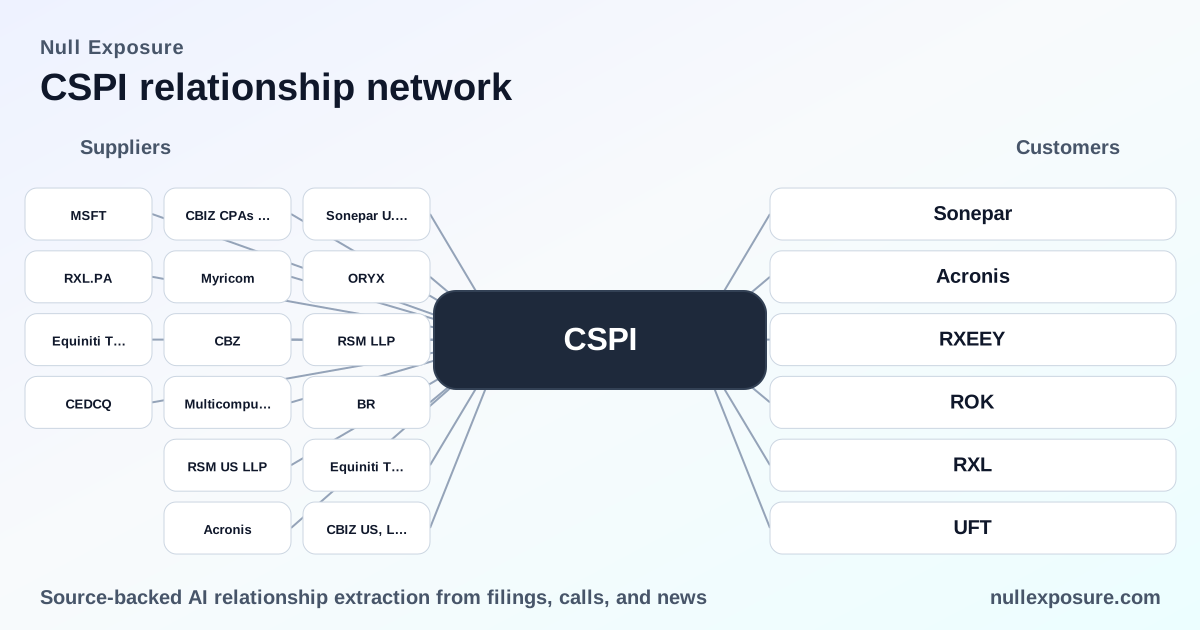
CSP Inc (CSPI) — Customer relationships and commercial thrust that drive the next phase of growth
CSP Inc. sells a hybrid portfolio of software (AZT Protect), recurring managed services, and value‑added hardware/resale to a mix of government, large enterprise and mid‑market customers; it monetizes through software licensing and renewals, managed services subscriptions, and VAR hardware resale with an expanding channel/OEM push to scale distribution. Investors should evaluate CSPI by tracking the channel roll‑out (gold‑star resellers and OEM embeds), the pace of Acronis integration, and revenue mix shifts from one‑time hardware to recurring software and services. For a concise view of CSPI’s broader intelligence platform, visit https://nullexposure.com/.
Channel momentum and the OEM play: why this matters for revenue quality
CSPI’s management emphasizes a deliberate shift toward recurring, higher‑margin services and software licensing while preserving hardware VAR revenues. That commercial posture is contract‑driven: licenses are recognized at the point of grant, while managed services generate recurring recognition over contract terms. Company disclosures indicate financing of goods and services to select U.S. customers when payment terms extend beyond one year, signaling the existence of long‑dated commercial arrangements that lift revenue visibility for certain bookings.
- Key commercial driver: embedding AZT Protect in partners’ platforms expands addressable reach beyond CSPI’s direct sales, converting one‑off sales into a scalable OEM channel.
- Risk concentration: sales are heavily North America‑centric but there is a growing EMEA and APAC presence tied to channel partners and select product lines.
The customers you must watch (every named relationship)
Below I cover every customer mention surfaced in public records and transcripts. Each entry is a plain‑English summary with the source cited in readable form.
Acronis
CSPI is actively integrating its AZT Protect product into Acronis’ Cyber Protect platform as an OEM embed, a move management describes as a scalable route to broaden distribution beyond direct sales. This integration is repeatedly referenced in media coverage of CSPI’s FY2025/FY2026 results and in earnings commentary. (Sources: TradingView coverage of CSPI FY2025/FY2026 commentary, March 2026; InsiderMonkey transcript summaries of Q4 2025 earnings call, March 2026.)
Sonepar
Sonepar is named by management as one of the distributors that has become “more comfortable” with CSPI’s product suite after CSPI closed several meaningful opportunities, illustrating progress in distributor acceptance. (Source: CSPI Q4 2025 earnings call transcript, March 2026.)
Rexel (also reported with tickers RXL / RXEEY)
Rexel is cited alongside Sonepar as a distributor where traction has improved following recent wins, underscoring CSPI’s go‑to‑market via electrical/industrial distribution channels. The relationship shows up in multiple transcript and news transcripts with inferred tickers RXL and RXEEY. (Sources: CSPI Q4 2025 earnings call transcript, March 2026; InsiderMonkey coverage of the Q4 2025 call, March 2026.)
RXEEY (ticker variant)
RXEEY appears as the inferred ticker in transcript matches referencing Rexel or related distributor activity; the repeated presence of RXEEY in automated matches indicates the market is tracking Rexel‑channel momentum as a discrete signal. (Source: CSPI Q4 2025 earnings call metadata and transcript matches, March 2026.)
Rockwell Automation (ROK)
Management explains that CSPI is working through “gold star resellers,” including large Rockwell Automation distributors in North America, positioning Rockwell’s distributor network as a meaningful channel catalyst for AZT Protect and services. Coverage in financial news highlights Rockwell distribution as a strategic vector for scale. (Sources: InsiderMonkey transcript of Q4 2025 results, March 2026; TradingView/analyst notes summarizing FY2025/FY2026 messaging, March 2026.)
ROK (ticker shorthand)
ROK appears repeatedly in news sentiment feeds referencing the same Rockwell Automation channel relationship; the ticker’s recurrence in coverage confirms the market’s linkage between CSPI’s channel strategy and Rockwell’s distribution footprint. (Sources: TradingView and other March 2026 press summaries.)
UFT
UFT is referenced in earnings‑call excerpts as a customer for whom CSPI deployed an initial three‑site implementation to generate case studies — a classic early‑adopter proof point intended to accelerate wider rollouts. This implies CSPI is using targeted pilot deployments to validate solutions ahead of larger contracts. (Source: InsiderMonkey summary of the Q4 2025 earnings call, March 2026.)
Note: several sources repeat the same relationships across earnings transcripts and syndicated financial sites; the duplication reinforces that channel partners and one notable OEM integration (Acronis) are the central customer narratives that underpin CSPI’s near‑term commercial thesis.
What constraints and contract signals tell us about CSPI’s operating model
Company disclosures and the excerpted evidence reveal several company‑level signals about CSPI’s commercial and operational characteristics:
- Contracting posture and revenue recognition: CSPI recognizes software revenue at the point of license grant while managed services revenue is recognized over contract terms, indicating a mixed recognition profile that will translate to a gradual improvement in recurring revenue as renewals scale. (Company disclosures.)
- Contract length and credit posture: evidence of financing for certain U.S. customers where payment terms exceed one year suggests longer payment terms for some customers and selective financing risk on receivables. (Company disclosures.)
- Customer mix and criticality: CSPI sells to government, large enterprise, mid‑market and small business customers, with the company operating as both manufacturer (for specialized security/networking appliances) and reseller/VAR (for third‑party hardware and software). This multi‑role model reduces single‑point dependency but requires managing different sales cycles and procurement processes. (Company disclosures.)
- Geography and concentration: the business remains North America‑heavy, with EMEA and APAC contributing but materially smaller; expansion into APAC and Africa is tied to specific product lines. Geographic concentration creates exposure to U.S. procurement dynamics even as channel partners extend reach internationally. (Company disclosures.)
- Segment mix and margin implications: CSPI reports revenue from hardware resale, software licensing, and recurring services; the strategic aim is to tilt the mix toward software and services to lift gross and operating margins over time. (Company disclosures.)
Investment implications — what to watch and why it matters
- Key upside vector: successful OEM embed with Acronis converts direct sales constraints into scalable distribution and improves revenue multiple due to higher recurring licensing and support revenue. News flow in March 2026 repeatedly highlights this integration as the primary growth lever.
- Margin readthrough: the company’s shift toward services and licensing will improve margin durability if renewals scale; monitor mix metrics and ARR/recurring revenue disclosure in upcoming quarters.
- Channel execution risk: distributor acceptance (Sonepar, Rexel, Rockwell distributors) is improving, but revenue realization depends on repeatable closing through those channels and the conversion of pilot deployments (e.g., UFT) into enterprise rollouts.
- Receivables and financing exposure: selective long‑term financing of customer purchases creates working‑capital sensitivity; investors should track days sales outstanding and credit provisioning in quarterly filings.
Bottom line
CSPI’s commercial story is clear: convert one‑time hardware and project sales into recurring software and service revenue by embedding AZT Protect in partner platforms and scaling through a focused distributor network. The next inflection points for investors are measurable: (1) Acronis integration milestones and OEM licensing revenues, (2) quarter‑over‑quarter acceleration from gold‑star resellers (Rexel/Sonepar/Rockwell channels), and (3) margin expansion tied to services mix. For an ongoing, consolidated view of vendor‑customer relationships and their market implications, explore the platform at https://nullexposure.com/.
Key documents referenced: CSPI Q4 2025 earnings call transcript (March 2026) and March 2026 financial press coverage on TradingView, InsiderMonkey and Finviz summarizing FY2025/FY2026 commentary.