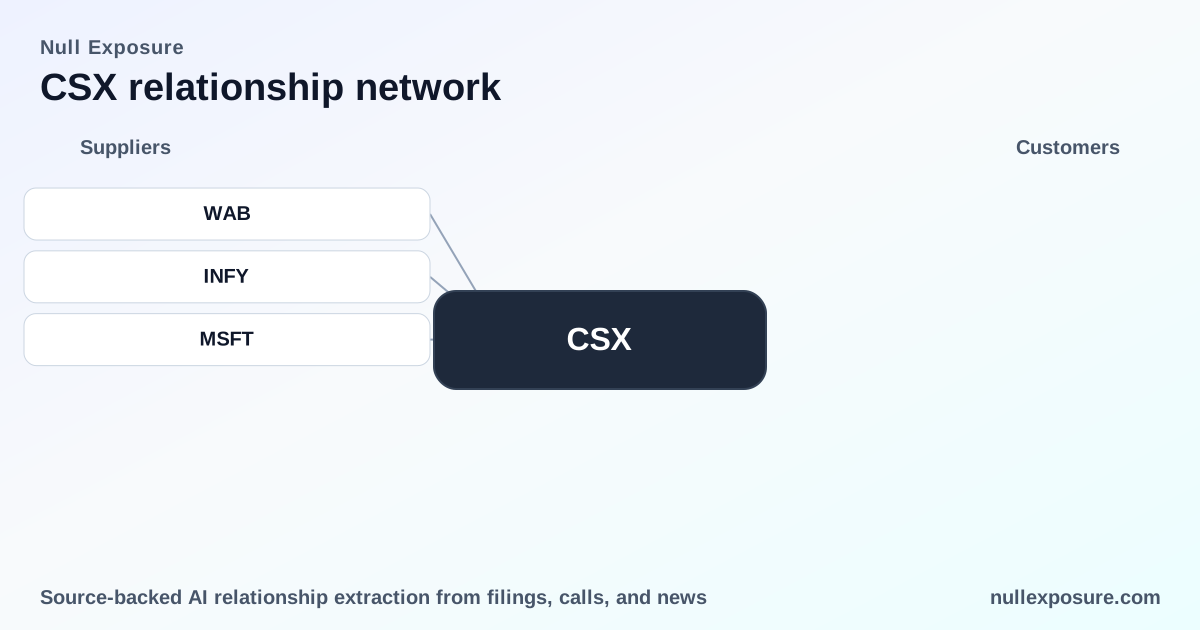
CSX Customer Relationships: Rail-centric revenue, concentrated geography, and operational stickiness
CSX monetizes a continental freight-rail network by charging shippers for transportation services across intermodal, bulk-commodity and carload segments, capturing margins through scale, network density and pricing disciplines. The company sells steady, service-led revenue—rail freight and associated logistics services—across major population centers east of the Mississippi and into Ontario and Quebec, while non-rail lines of business (trucking) are immaterial to consolidated results. For deeper customer intelligence on CSX, visit https://nullexposure.com/.
Why investors should treat customer links as operational leverage
CSX is a service provider with an active, integrated rail network rather than a collection of discrete short-term contracts. Company disclosures describe CSX Transportation (CSXT) as operating roughly 20,000 route miles and serving major population centers in 26 U.S. states plus Ontario and Quebec, which gives the company both geographic breadth and network effects that amplify customer stickiness. The rail operations are analyzed as a single operating segment because of that integration, and the trucking business is not material for separate disclosure—this underscores that rail freight is the core profit engine and the locus of customer dependency.
These firm-level constraints imply several investor-relevant operating-model characteristics:
- Contracting posture: Customers transact with CSX for physically integrated, operationally scheduled freight services that favor durable routing and recurring volumes over spot transactions.
- Concentration and criticality: The network’s geography concentrates flows in the eastern U.S. and parts of Canada, making CSX an indispensable link for shippers in those corridors.
- Maturity and segmentation: CSX’s business is mature and service-centric; it competes on operational reliability and network reach rather than product innovation.
- Relationship stage: The company-level signal classifies customer relationships as active service engagements rather than passive or one-off interactions.
Customer-level readout: who shows up in the public record
Below are every customer-related relationship surfaced in the public reporting and trade press for the period covered. Each item is a concise, plain-English summary with source attribution.
Martin Marietta Materials, Inc. (MLM) — aggregates loading and inbound freight
Martin Marietta is expanding an aggregates loading facility in Florida and is routing inbound granite and aggregate shipments on CSX, signaling a continuing operational freight relationship where CSX moves heavy bulk materials into a site that is scaling up capacity. Source: Martin Marietta Q1 FY2026 earnings call transcript coverage (InsiderMonkey, May 2, 2026) and related earnings call transcript reporting (Benzinga, May 3, 2026).
Canadian National Railway (CNI) — asset sale and traffic realignment
CSX agreed to sell approximately 12.5 track miles in Ontario (between Chatham and Blenheim) to Canadian National, a transaction designed to let CN control trackage that connects into Windsor yards and the Detroit‑Windsor tunnel; the deal will realign regional flows and allow CN to move some traffic that previously used CSX routes. Source: Progressive Railroading reporting on the CSXT-to-CN Ontario line sale (March 9, 2026).
What these relationships imply for revenue, operations and risk
The public mentions of Martin Marietta and CN illustrate two different but complementary dynamics in CSX’s customer book.
-
Martin Marietta exemplifies core freight volume customers whose capital investments (facility expansion) deepen CSX’s route density and raise long-run revenue per customer by creating incremental, repeatable volume. Bulk materials customers like Martin Marietta generate predictable tonnage with high marginal contribution once routing and terminal costs are absorbed.
-
The CN transaction illustrates network- and asset-level dynamics: selling a small stretch of track to a peer railroad reshapes competitive routing and can shift volumes off CSX’s network while simplifying routing for the buyer. These asset transfers are strategic tools that change future traffic patterns and competitive exposure.
Combine those signals with the company-level constraints and you get a clear picture: CSX monetizes recurring, service-oriented freight flows within a geographically concentrated and operationally integrated network. That structure gives CSX pricing leverage and margin resilience, but it also creates exposure to regional traffic shifts, asset sales to rail peers, and customer capital decisions that reallocate flows.
Risk profile tied to customers and network structure
Investors should weigh these customer-driven risks alongside the positives:
- Operational concentration: Serving 26 states and parts of Canada concentrates growth and regulatory exposure in the Eastern corridor; network disruptions or localized demand declines can have outsized effects.
- Customer dependency on facilities: Shipper investments (for example, large loading facilities) increase CSX volume potential but create single-site dependencies that can concentrate cash flow risk if a major customer changes routing.
- Competitive realignment through asset transfers: Selling track segments to other Class I railroads can be accretive from an asset-management standpoint but reduces CSX’s control over future freight patterns in that corridor.
Investor takeaways
- CSX is a service-led, revenue-stable operator: the railroad earns the bulk of its economics from moving freight across a dense eastern network, with trucking immaterial to consolidated performance.
- Customer investments matter: shippers expanding terminal capacity (e.g., Martin Marietta in Florida) directly lift CSX volume potential and strengthen long-term revenue visibility.
- Network actions reshuffle traffic more than they create new demand: asset sales to peers such as CN will change routing and competitive dynamics, so investors should monitor volume migration and regional pricing effects.
- Operational integration is a strength and a constraint: integrated rail operations deliver margins through scale, but they also embed customers into long operational chains that are hard to reroute quickly.
For systematic monitoring of how these and other customer relationships evolve, visit https://nullexposure.com/ for ongoing mapping and investor-ready summaries.
Closing observation
CSX’s public customer signals confirm a classic railroad profile: durable, service-based revenue streams anchored in a geographically concentrated but extensive network, with customer capital projects and inter-railroad asset transactions acting as the primary drivers of incremental volume and competitive dynamics. Investors should focus on changes in shipper capital plans, corridor-level volume trends, and peer railroad transactions as the most actionable indicators of near-term revenue trajectory.