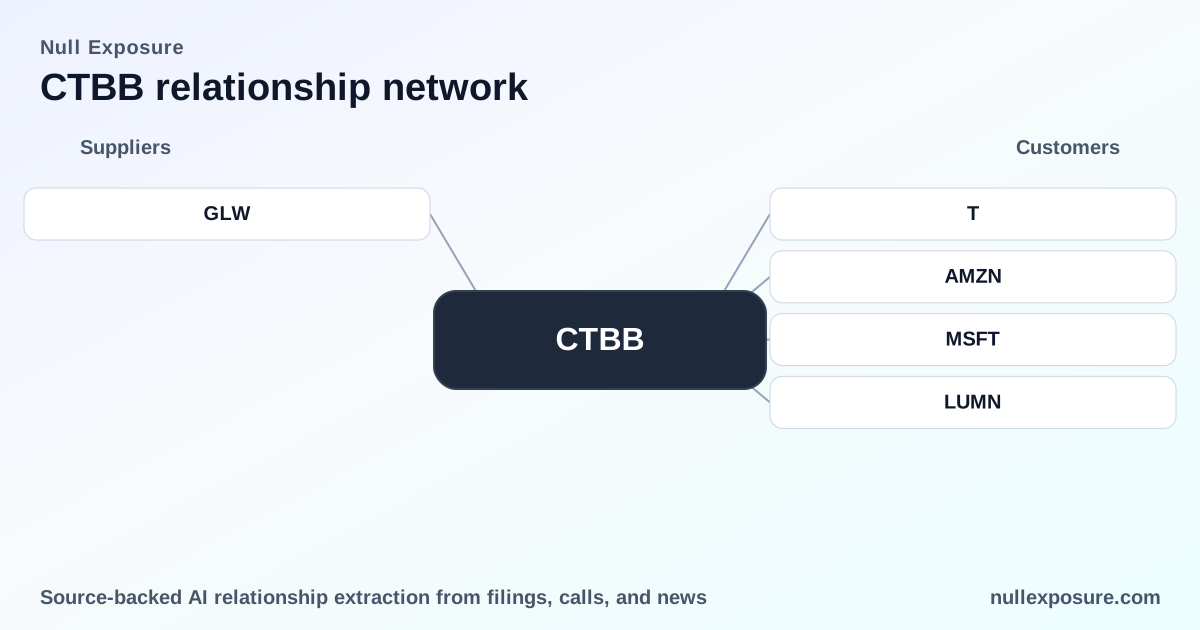
Qwest Corp. NT (CTBB): Customer Relationships That Drive a Network Services Business
Thesis: Qwest Corp. operates as an integrated communications provider that monetizes a mix of long-term capacity contracts and usage-based service billing, selling Ethernet, optical wavelength, transport, and a broad set of voice and data services to government, enterprise and consumer customers across a concentrated U.S. footprint. Revenue is driven by a combination of multi-decade indefeasible rights of use (IRUs) for transmission capacity and arrears-billed usage services, positioning CTBB as a predictable cash generator for long-haul capacity while capturing upside from usage growth. For deeper company signals and relationship-level detail, see https://nullexposure.com/.
Business model in one paragraph Qwest is a network operator that sells both durable capacity and ongoing services: IRU-style long-term leases for fiber and transmission provide durable, low-churn revenue, while Ethernet, broadband and ancillary services are billed by usage and recognized as consumption occurs. The company sells across government, small and mid-sized business and enterprise segments, and also acts as an internal service provider to affiliates—creating a blended revenue mix that combines stability with usage-linked variability.
Key structural features that affect investors
- Contracting posture: A material portion of capacity is sold under long-term IRUs (typical term ~20 years), which locks in cash flows and limits short-term churn risk.
- Revenue volatility: Usage-based billing for ancillary and broadband services creates upside in periods of higher bandwidth demand and downside in cyclical weakness.
- Customer mix and concentration: The company serves government, small business, mid-market and enterprise customers; no single external customer represents more than 10% of consolidated revenue, which limits counterparty concentration risk.
- Geographic footprint: While it markets to global business customers, economic exposure is concentrated in a 14-state U.S. local service area, so macro or regulatory shifts in that region matter more than global trends.
- Relationship maturity: Core offerings such as Ethernet are mature revenue streams; investment-weighted offerings like optical wavelength services are in a ramping phase and represent the company’s growth upside.
- Affiliate flows: Qwest provides similar telecom services to its affiliates and recognizes intercompany revenue, so intra-group economics should be isolated when modeling external growth.
Customer relationships: what the filings and calls disclose This section walks through every counterparty mentioned in the public record and explains what each relationship signals for operators and investors.
Amazon / AWS
Qwest management referenced AWS on the 2025 Q4 earnings call in the context of cloud interconnection and scaling bandwidth for AI workloads, indicating that AWS-related interconnectivity products and previews (such as AWS Interconnect) are part of the ecosystem Qwest addresses. According to the 2025 Q4 earnings call transcript (filed 2026-03-07), management discussed AWS announcements and the relevance of dynamic bandwidth solutions for cloud-intensive customers.
Takeaway: AWS-related demand highlights enterprise cloud-connect use cases and supports higher-margin transport and interconnect services.
AT&T Management stated on the 2025 Q4 earnings call that the company closed a transaction with AT&T “yesterday,” signifying a recent commercial or strategic close with a major carrier customer (filed 2026-03-07). Takeaway: Carrier-to-carrier deals with incumbents like AT&T validate Qwest’s role as a wholesale transport and special-access provider and can underpin IRU or long-term supply arrangements.
Microsoft The 2025 Q4 call referenced a product announcement at Microsoft Inspire—Lumen Defender with Microsoft Sentinel—illustrating product partnerships or joint go-to-market initiatives with Microsoft’s security and cloud tooling (filed 2026-03-07). Takeaway: Integration with Microsoft channel and security products demonstrates an enterprise-focused strategy that pairs network services with managed and security offerings, expanding addressable revenue per customer.
Lumen Technologies A news item summarizing Qwest’s FY2025 SEC 10‑K notes that the company expects future liquidity to come from operating cash flow, amounts due from Lumen Technologies, and potential refinancing of debt securities (TradingView summary published 2026-03-09). Takeaway: Intercompany balances and liquidity planning tied to Lumen Technologies are significant corporate signals—investors should treat affiliate flows and financing as part of the capital structure picture.
Operational constraints and their investor implications The filings provide company-level constraints and signals that shape contract economics and risk.
- Long-term IRUs dominant for capacity: The company periodically sells transmission capacity under IRUs with typical 20-year terms, which creates predictable cash flows and reduces near-term customer churn; this is a structural advantage for monetizing fiber assets.
- Usage-based billing for ancillary services: For broadband and other ancillary services, revenue is recognized as usage or delivery occurs and billed in arrears, introducing variable revenue tied to traffic patterns and enterprise cloud adoption.
- Counterparty breadth across segments: The company serves government (federal, state, local), large enterprise, mid-market, small business and residential customers—this diversification reduces dependency on any single segment, consistent with the public disclosure that no external customer exceeds 10% of consolidated revenue.
- Geographic concentration with global reach: Commercially positioned to sell to global business customers, but operational revenue and assets are concentrated in the U.S. 14-state local service area, making regional economic and regulatory factors top-line drivers.
- Service-provider role to affiliates: Qwest provides both telecommunications and application development/support services to affiliates, and internal revenues are recognized; analysts must separate affiliate revenue when evaluating external growth and margin trends.
- Product lifecycle mix—mature vs. ramping: Ethernet is listed among "nurture" (mature) offerings, while optical wavelength services are in the "grow" bucket—expect stable base cash generation from Ethernet and growth-capex-driven upside from optical deployments.
Risk factors for investors (concise)
- Revenue sensitivity to usage cycles given arrears billing for ancillary services.
- Regional concentration risk because most operating revenue and assets sit inside a defined multi-state footprint.
- Intercompany exposure and liquidity planning tied to affiliate receivables and refinancing plans, as noted in FY2025 commentary.
Conclusion and next steps Qwest’s customer profile blends long-term, IRU-style capacity monetization with usage-billed services that capture network traffic growth. For investors and operators, the story is one of stable capacity cash flows supplemented by growth from optical and cloud-interconnect demand—balanced by regional concentration and intra-group financial flows that require careful modeling. For a full view of relationship-level signals and constraint maps, visit https://nullexposure.com/.
If you want a tailored relationship heat map or a short investment memorandum drawing on these disclosures, reach out via the homepage at https://nullexposure.com/.