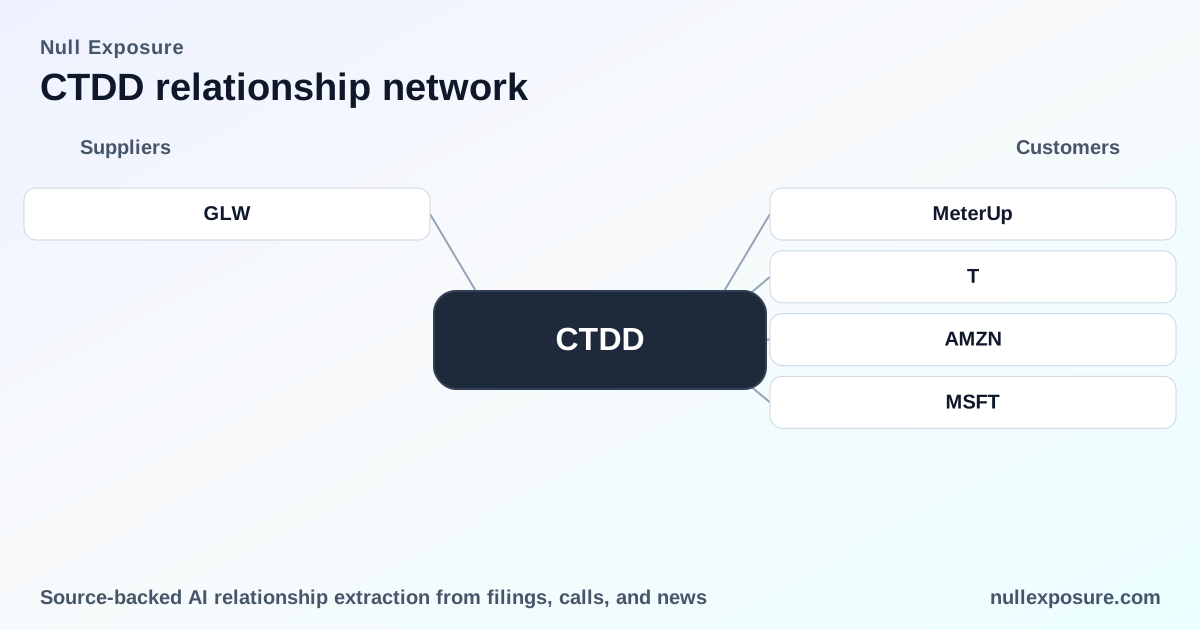
CTDD customer relationships: what the 2025 Q4 call tells investors about partner mix, contract posture and concentration
CTDD operates and monetizes a network and services business that sells long-duration transmission capacity and integrated connectivity solutions to a mix of wholesale, enterprise, mid-market and government customers. Revenue flows from multi-year indefeasible rights of use (IRUs), managed connectivity and partner integrations with hyperscalers and carriers — a capital-intensive model that trades high upfront asset investment for durable, contractually secured cash flows.
For a quick strategic read, visit https://nullexposure.com/ for our broader coverage and data tools.
Executive takeaways for investors and operators
- Business model: CTDD sells long-term transmission capacity and bundled services, generating predictable revenue from IRUs and managed services.
- Contracting posture: Long-term, capital-backed contracts dominate the portfolio (IRUs typically run ~20 years), creating durable cash flow profiles but elevated asset and counterparty risk over contract life.
- Customer mix: The company serves government, large enterprise, mid-market and small business customers, and also integrates with hyperscalers and large carriers.
- Concentration: No single external customer exceeds 10% of revenue (immaterial concentration by customer), but revenue is regionally concentrated in a 14-state local service area, which is material to the company’s revenue mix.
- Partner strategy: CTDD uses strategic integrations with hyperscalers and carriers to monetize connectivity for AI workloads and security services, expanding go-to-market through partners.
What the 2025 Q4 earnings call disclosed about specific customer relationships
Below are the call-derived relationship entries exactly as mentioned on the 2025 Q4 earnings call (filed March 2026). Each entry has a one- to two-sentence plain-English summary followed by the source context.
MeterUp
CTDD launched a joint network management offering with MeterUp to provide customers preferred connectivity solutions and faster time to value. This is positioned as a co-delivery model to accelerate deployments and increase uptake of managed connectivity services. (2025 Q4 earnings call, first seen March 7, 2026)
AT&T
CTDD reported that it closed a transaction with AT&T as part of its strategic activities; the call highlighted the deal as a significant corporate event. The remark signals completed commercial or asset-level activity between CTDD and a major carrier. (2025 Q4 earnings call, first seen March 7, 2026)
AWS
CTDD referenced announcements made at AWS regarding a gated preview for AWS Interconnect to help AI workloads dynamically scale bandwidth while preserving availability and security. This positions CTDD alongside hyperscaler interconnect capabilities that address high-bandwidth, low-latency AI traffic. (2025 Q4 earnings call, first seen March 7, 2026)
AMZN
The company reiterated the same hyperscaler point under the broader Amazon identity: AWS Interconnect preview was cited as part of recent product activity that supports AI workload scaling and high availability. The mention under AMZN confirms engagement on interconnect solutions with Amazon’s cloud business. (2025 Q4 earnings call, first seen March 7, 2026)
Microsoft
CTDD announced Lumen Defender with Microsoft Sentinel at Microsoft Inspire, indicating a security integration that packages CTDD’s network and service controls with Microsoft’s detection and response tooling. This highlights CTDD’s route into managed security services sold in conjunction with Microsoft enterprise offerings. (2025 Q4 earnings call, first seen March 7, 2026)
MSFT
The call repeated the Microsoft point under the MSFT ticker, again noting the Lumen Defender–Microsoft Sentinel collaboration announced at Microsoft Inspire, underscoring the company’s strategic positioning in enterprise security integrations. (2025 Q4 earnings call, first seen March 7, 2026)
T
CTDD again noted the AT&T closure, recorded under the ticker T, confirming the transaction with a major carrier and reinforcing the company’s active commercial relations with incumbent network operators. (2025 Q4 earnings call, first seen March 7, 2026)
Operating-model constraints and what they imply for value and risk
The company-level constraints disclosed in filings and discussed on the call give a clear signal about how CTDD operates and where investor attention should be focused.
- Long-term contracts dominate (IRUs ~20 years). This creates durable, contractually protected revenue streams, reduces churn risk, and increases predictability. It also locks capital into long-lived network assets and raises exposure to long-dated counterparty performance and technological obsolescence.
- Customer diversity across segments. CTDD serves government, large enterprise, mid-market and small-business customers, which supports a broad addressable market and multiple sales motions.
- Regional concentration is material. Although no single external customer exceeds 10% of consolidated revenue (an immaterial single-customer concentration signal), the company generates a majority of revenue from a 14-state local service area, creating geographic concentration risk that is material at the company level.
- Role as service provider to affiliates. CTDD sells the same telecom services internally to affiliates as to external customers, creating operational interdependencies and potential related-party dynamics.
- Services-led segment. The revenue base is primarily services rather than discrete hardware sales, reinforcing subscription-like economics but requiring continuous service delivery investments.
Investment implications and a concise risk checklist
- Upside: Long-duration IRUs provide predictable cash flow and a defendable revenue base; hyperscaler and carrier integrations open pathways to higher-margin managed services and AI-driven bandwidth monetization. Strategic partnerships with AWS, Microsoft and AT&T increase distribution reach and product stickiness.
- Risks: Regional revenue concentration, long asset lives exposing the company to technological change, and counterparty performance over multi-decade IRUs are primary concerns. No single-customer revenue concentration reduces counterparty risk, but geographic concentration raises local macro and regulatory sensitivity.
- Operational focus for management: Maintain IRU underwriting discipline, accelerate partner-driven services that increase recurring revenue, and hedge regional exposure through targeted expansion or wholesale diversification.
For further analysis and a broader view of partner-level signals and contracts, visit https://nullexposure.com/ for our platform insights.
Bottom line
The 2025 Q4 call frames CTDD as a services-first, contract-heavy network operator that monetizes through long-term IRUs and partner integrations with hyperscalers and major carriers. Investors should value the predictability of long-duration contracts while accounting for geographic concentration and the long-tail counterparty risks inherent to multi-decade network agreements.