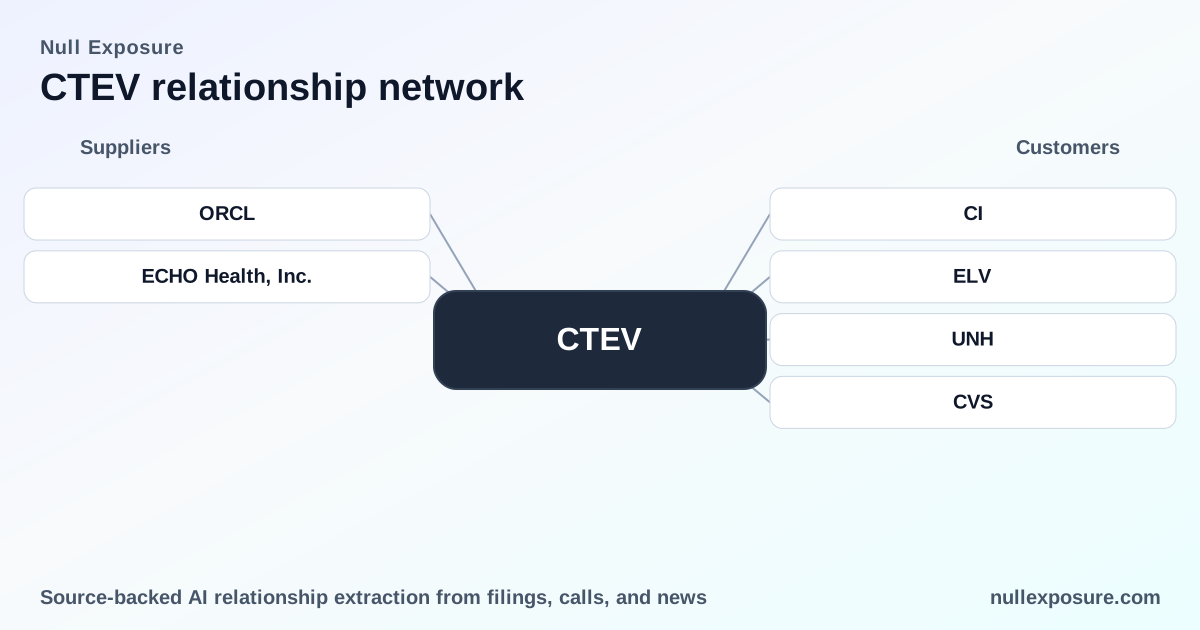
Claritev (CTEV): Payor relationships that define revenue predictability and regulatory risk
Claritev is a technology-enabled services firm that sells out-of-network cost management, payment and revenue-integrity solutions to U.S. payors and plan sponsors. The company monetizes through a blend of subscription and usage-based arrangements — including per-member-per-month licensing, bundled PEPM services, and percentage-of-savings (PSAV) commissions on claim recoveries — with a client base concentrated among large health plans, ASOs/TPAs and government payors. For investors assessing Claritev’s customer franchise, the combination of high enterprise concentration, variable PSAV economics, and multi-year contracting for large clients is the central lens for valuation and risk. Learn more on our homepage: https://nullexposure.com/
How the client footprint drives cash flow and risk
Claritev’s business model intentionally mixes predictable recurring revenue (subscription/PEPM) with variable, performance-linked revenue (PSAV). That structure delivers upside through success-based fees while concentrating operational and audit risk in the variable component. The company reports material customer concentration — two clients accounted for 28% and 16% of 2024 revenue — which amplifies revenue volatility if a large client contract lapses or renegotiates pricing.
Geographically, the business is national: Claritev derives essentially all revenue from U.S. operations and offers services in all 50 states and DC, so regulatory and payor dynamics are U.S.-centric. The client base includes federal and state-sponsored plans in addition to commercial insurers, positioning Claritev as a strategic vendor to both public and private payors.
Contracting posture, maturity and criticality — why it matters for investors
- Claritev uses a hybrid contracting model: large clients typically sign multi-year agreements (three to five years), while mid-to-small accounts often have annual terms with automatic renewals. That structure supports revenue visibility for larger accounts while keeping a broad base of short-term, auto-renewing customers.
- Subscription and licensing revenues increase predictability; PSAV revenue is variable and recognized based on management estimates, which was identified as a Critical Audit Matter by auditors due to judgment around estimating variable consideration.
- The company positions itself as a service provider and transaction processor, not a payer or clinical provider, which constrains regulatory exposure to payment and data governance rather than direct care delivery.
- Operationally, Claritev is highly concentrated toward large enterprise payors and government clients, which strengthens customer stickiness but increases single-counterparty risk.
These characteristics create a clear trade-off for investors: material upside from success-based fees and deep enterprise relationships, counterbalanced by estimation risk, large-client concentration and exposure to legal or payor-conduct developments.
Customer relationships in the public record
Below are every customer-related mention found in public coverage in the provided results, with short plain-English summaries and source citations.
-
Cigna — The Fierce Healthcare litigation coverage references Cigna as one of several insurers involved with platforms that calculate out-of-network rates and negotiate rates with providers; providers in the litigation allege coordination between insurers and platform operators. (Fierce Healthcare, March 9, 2026: https://www.fiercehealthcare.com/payers/judge-denies-multiplan-payers-motions-toss-price-fixing-litigation)
-
Elevance Health — The same Fierce Healthcare article lists Elevance Health among large payors using out-of-network rate-calculation platforms and related negotiation services, which are central to ongoing provider suits alleging rate suppression. (Fierce Healthcare, March 9, 2026: https://www.fiercehealthcare.com/payers/judge-denies-multiplan-payers-motions-toss-price-fixing-litigation)
-
UNH (ticker UNH) — Coverage identifies UnitedHealth Group as a codefendant insurer named in complaints tied to platforms that set out-of-network rates and engage third-party negotiators, illustrating sector-level regulatory and litigation exposure that affects vendors and their relationships with major payors. (Fierce Healthcare, March 9, 2026: https://www.fiercehealthcare.com/payers/judge-denies-multiplan-payers-motions-toss-price-fixing-litigation)
-
UnitedHealth Group — The article repeats references to UnitedHealth Group in describing provider suits against payors and platform operators; this duplication in public reporting highlights that Claritev’s payor clients operate in a highly scrutinized part of the market. (Fierce Healthcare, March 9, 2026: https://www.fiercehealthcare.com/payers/judge-denies-multiplan-payers-motions-toss-price-fixing-litigation)
-
Aetna (CVS) — Aetna is also named among insurers connected to platforms and services that calculate and negotiate out-of-network rates, a focal point for recent antitrust and provider litigation. (Fierce Healthcare, March 9, 2026: https://www.fiercehealthcare.com/payers/judge-denies-multiplan-payers-motions-toss-price-fixing-litigation)
Each of the above mentions comes from the same March 2026 Fierce Healthcare article, which reports on litigation involving rate-calculation platforms and payer relationships; investors should treat these as sector-level signals that inform Claritev’s operating environment rather than direct evidence of contractual disputes between Claritev and these specific payors.
What the constraints and disclosures tell investors
The disclosure-driven constraints give an operational profile you can act on:
- Contract mix: The company explicitly runs both long-term multi-year contracts with large clients and annual contracts with automatic renewals for smaller clients, supporting a layered revenue book that blends visibility and flexibility.
- Pricing mechanics: Subscription and PEPM licensing are a stated growth objective; PSAV arrangements are fully variable and recognized with significant managerial judgment, creating earnings volatility and audit focus.
- Counterparty mix: Claritev serves government payors alongside large commercial insurers and ASO platforms, which increases the strategic importance of the business but also exposes Claritev to public-sector procurement cycles and compliance scrutiny.
- Materiality and concentration: Two clients represented 28% and 16% of 2024 revenue, a concentration that makes contract renewals with those accounts a valuation-sensitive event.
- Service orientation: The company is a technology-enabled services provider and transaction processor, not a clinical care operator; the primary risks are contractual, regulatory, and earnings-estimation related rather than clinical.
Together these signals indicate a business that is mature in its enterprise relationships, strategically critical to large payors, and operationally sensitive to revenue-recognition and legal developments.
Investment implications and risk checklist
- Upside drivers: deep penetration of large U.S. payors, recurring subscription shift that improves predictability, and performance-based fees that scale with cost recovery.
- Principal risks: revenue concentration, PSAV estimation and audit risk, and sector litigation/regulatory activity tied to how out-of-network pricing and negotiation services are structured.
- Financial context: Claritev reported roughly $965 million in trailing revenue with strong gross profitability; investors should focus on contract renewals with the largest clients and the trend toward subscription revenue as key signals for forward valuation.
For a concise view of Claritev’s relationship signals and implications for portfolio modeling, visit https://nullexposure.com/ to access our research tools and relationship analytics.
Bold takeaway: Claritev combines enterprise-grade client penetration with variable, performance-linked economics, creating a profitable but concentration- and estimate-sensitive revenue profile that investors must monitor at the contract and legal-policy levels.