Cantaloupe (CTLP) customer relationships: what operators and investors need to know
Cantaloupe is a payments and software platform that monetizes through a blend of subscription fees, transaction processing revenue, and hardware sales/leases to operators of vending, micro-markets, amusement venues, laundromats, parking, and other unattended retail formats. The company's economics combine recurring revenue from software and cashless processing with equipment-backed finance leases and quick-start rental programs, producing a mixed-margin business that scales with device count and transaction volume. (Explore more at https://nullexposure.com/.)
Business model in plain English: contracts, customers, and why it matters to returns
Cantaloupe sells and leases hardware (card readers, kiosks, POS devices) and bundles those devices with monthly subscription services and usage-based transaction fees. The firm operates across enterprise, mid-market, and small-business channels and serves a global footprint while retaining a U.S. concentration. Its customer base is large and active—34,896 Active Customers and 1.28 million Active Devices as of June 30, 2025—which makes customer success and device uptime directly material to revenue and retention. According to company disclosures, finance receivables and Quick Start leases commonly run sixty months, while a substantial subset of service contracts are terminable on 30 days’ notice, creating a hybrid contracting posture that combines durable lease revenue with short-notice cancellable services. This combination yields predictable recurring cash flows tempered by churn risk in the subscription layer.
- Contracting posture: mix of long-term lease obligations for equipment and short-term, subscription-style service contracts.
- Revenue mix drivers: subscription (monthly billing), transaction fees (usage-based), and equipment sales/leases.
- Customer concentration & criticality: broad base of small and mid customers plus enterprise accounts; relationships are core to platform utility and are presented as the company’s most important asset.
If you’re evaluating customer quality and counterparty risk, these are company-level signals to weigh before modeling retention and lifetime value. For deeper research and relationship mapping, visit https://nullexposure.com/.
Operating constraints that shape customer economics
Several operating characteristics drawn from company disclosures should inform valuation and risk assumptions:
- Dual contract terms: long-term finance leases (60 months) coexist with subscription services that can be terminated on ~30 days’ notice. This implies stable hardware cash flows but more variable software/processing revenue.
- Revenue composition: the firm explicitly bills software monthly and collects usage-based transaction consideration, so forecast models should separate recurring subscription revenue from volume-driven transaction revenue.
- Customer mix and geography: Cantaloupe targets large enterprise, mid-market, and small-business customers and serves markets globally with a heavy U.S. concentration; this diversifies client types while concentrating macro risk in North America.
- Materiality and role: the company defines its customer relationships as critical, operating as both seller of hardware and ongoing service provider for processing, telemetry, analytics, and device management.
- Segment exposure: revenue sources span hardware, software, and services—each with different margins and capital intensity.
These constraints should inform assumptions about churn, capital expenditure for device programs, and working capital tied to lease receivables.
Customer relationships: who’s on the platform and what it means for revenue
Below are every customer relationship surfaced in recent coverage, with a concise plain-English summary and source citation.
Lieberman Companies
Lieberman Companies is using Cantaloupe’s Pulse card reader in amusement and arcade settings; the operator reports that Pulse drives incremental spend of $2–3 per game versus a $1 default, indicating direct transaction lift tied to Cantaloupe’s hardware. Source: PYMNTS coverage of the Pulse product rollout (2025–2026), https://www.pymnts.com/news/payment-methods/2025/cantaloupe-introduces-card-reader-for-arcade-and-amusement-operators/.
Premier Breakroom Solutions
Premier Breakroom Solutions is showcased as an early launch client for Cantaloupe’s Vine Digital Studio initiative, highlighting Cantaloupe’s role in enabling branded digital experiences and channel partner promotion. Source: VendingMarketWatch on Vine Digital Studio (2026), https://www.vendingmarketwatch.com/technology/article/55286456/cantaloupe-inc-cantaloupe-launches-vine-digital-studio-the-next-iteration-of-vendcentral.
Surpass Refreshments
Surpass Refreshments is another early Vine Digital Studio launch, illustrating use of Cantaloupe’s creative and marketing services alongside core device and software offerings. Source: VendingMarketWatch on Vine Digital Studio (2026), https://www.vendingmarketwatch.com/technology/article/55286456/cantaloupe-inc-cantaloupe-launches-vine-digital-studio-the-next-iteration-of-vendcentral.
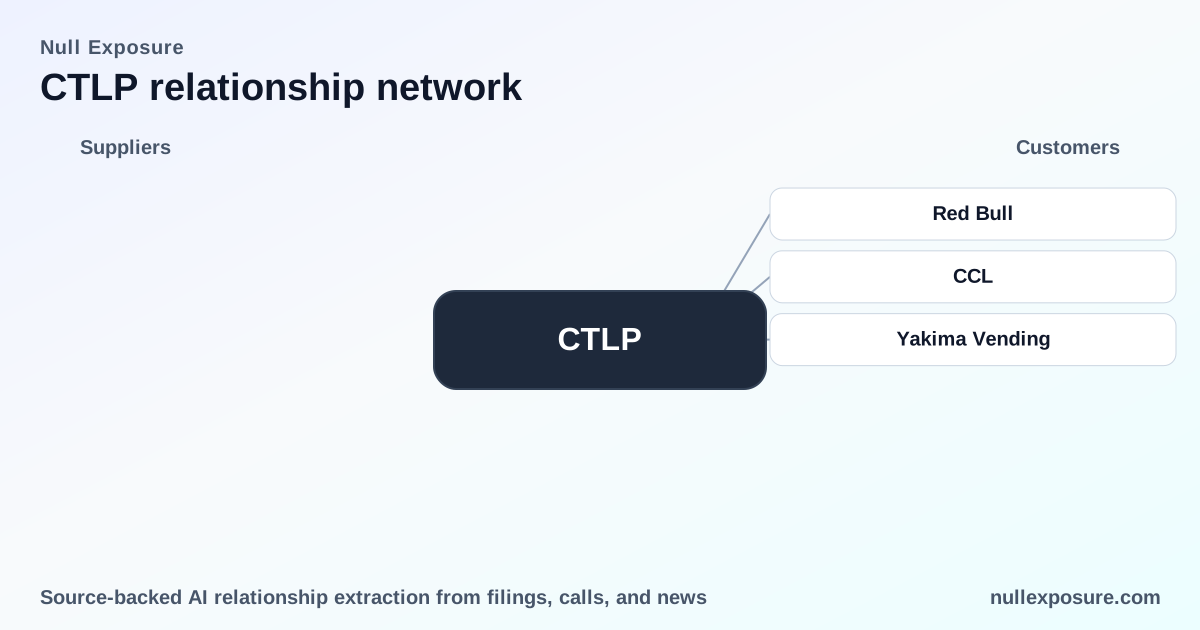
Red Bull
Cantaloupe is running sample Red Bull ads within its smart-store and kiosk demonstrations, indicating ad-serving or branded content opportunities as a non-transactional revenue lever or marketing partnership. Source: VendingMarketWatch video showcase from the 2025 NAMA show (reported 2026), https://www.vendingmarketwatch.com/video-showcase/video/55291541/cantaloupe-inc-smart-stores-micro-kiosks-and-ai-tools-game-changing-vending-tech-from-cantaloupe-live-from-2025-nama-show.
CandyMachines.com
CandyMachines.com has partnered with Cantaloupe to offer Cantaloupe devices as an add-on for claw and prize machines beginning August 15, 2025, expanding Cantaloupe’s hardware distribution via channel partnerships and driving unit sales and recurring fees. Source: VendingTimes press release on the partnership (2025–2026), https://www.vendingtimes.com/press-releases/candymachinescom-expands-cashless-payment-options-through-new-partnership-with-cantaloupe/.
Carnival Cruise Line (CCL)
Carnival Cruise Line is named as a partner for Celebration Key dining and is cited in coverage of Cantaloupe’s Go Micro kiosk launch; these relationships show Cantaloupe’s penetration into large-scale hospitality and entertainment operators where device density and transaction volume are high. Sources: VendingTimes coverage noting partnership mentions and product launches (2026), https://www.vendingtimes.com/news/cantaloupe-to-be-acquired-by-365-retail-markets-in-848m-deal/ and https://www.vendingtimes.com/news/cantaloupe-launches-go-micro-kiosk-for-micro-markets/.
Yakima Vending
Yakima Vending’s owner cites the cost effectiveness of the Go Micro—allowing a micro-market deployment at materially lower upfront cost than traditional installs—highlighting Cantaloupe’s product-market fit for smaller operators seeking faster ROI. Source: VendingTimes coverage of the Go Micro launch (2026), https://www.vendingtimes.com/news/cantaloupe-launches-go-micro-kiosk-for-micro-markets/.
What this customer map implies for investors
- Revenue resilience but mixed predictability: long-term lease receivables provide capital-backed cashflows, while subscription and usage revenues introduce variability tied to transaction volumes and churn.
- Scalable distribution via channels: partnerships with channel sellers like CandyMachines.com accelerate device attach and broaden go-to-market without proportional fixed sales costs.
- Enterprise proof points support margin expansion: deployments with large operators like Carnival demonstrate device density use cases that drive higher transaction volumes and processing revenue per location.
- Concentration and operational risk: majority U.S. customer base and dependency on the active devices metric mean that economic downturns or hardware churn can quickly affect revenues.
Bottom line for owners and analysts
Cantaloupe’s platform is revenue-agnostic across hardware, software, and services, which is a strength when device counts grow but a liability if subscription churn increases or device sales slow. The customer relationships documented above illustrate both ends of this model—enterprise anchor deals and channel-driven SMB adoption—so investors should price in stable lease cashflows with subscription volatility and transaction sensitivity. For a deeper mapping of customers and constraints to support underwriting or portfolio monitoring, visit https://nullexposure.com/.
Bold takeaways:
- Recurring revenue is the backbone; leases smooth cash but subscriptions create churn risk.
- Channel partnerships and enterprise deals both materially lift device attach and transaction volumes.
- Active devices and customer counts are the closest operational leading indicators for near-term revenue.