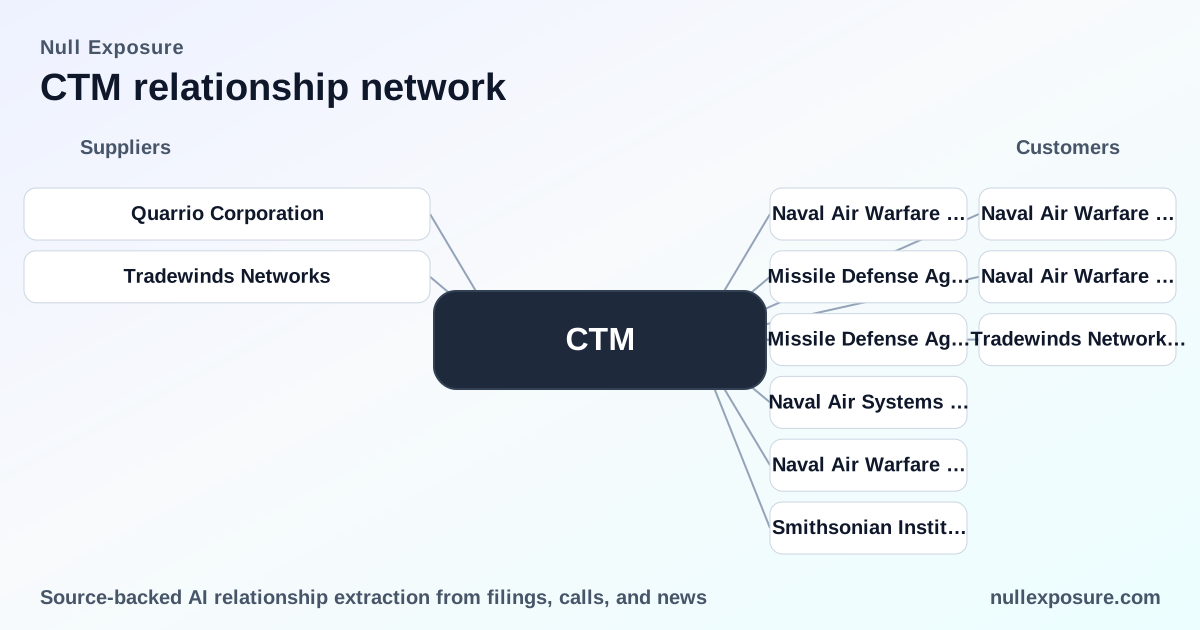
Castellum (CTM): Government-first services firm converting defense awards into a concentrated revenue stream
Castellum, Inc. operates as a service-led cybersecurity and systems integrator focused on U.S. federal defense and civilian agencies; it monetizes by winning prime contracts, task orders, and positions on IDIQ vehicles through its Specialty Systems, Inc. (SSI) subsidiary and mentor–protégé joint ventures, converting backlog into near-term billed services. Revenue is contract-driven, heavily concentrated, and tied to annual or option-based government awards rather than long-term subscription revenue. Learn more about how contract exposure maps to financial risk and opportunity at https://nullexposure.com/.
How Castellum makes money and why that matters to investors
Castellum sells professional services — software engineering, cybersecurity, information and electronic warfare, and program management — largely to U.S. government customers. The business model is a classic federal contractor posture: win awards, staff task orders, and convert labor- and effort-based work into cash receipts. That model generates visible near-term backlog and negotiating leverage around IDIQ positions, but also concentrates revenue and keeps renewal risk high because most contracts are annual or option-year structures.
Key operating characteristics that shape valuation and risk:
- Contracting posture: the company relies on a mix of FFP, CPFF, T&M and IDIQ work that is predominantly annual with options to renew, meaning renewals and recompetes are ongoing cash drivers rather than locked-in multi-year streams. (Company disclosures.)
- Customer concentration: revenue derives primarily from federal customers; the top three contracts represented 49% of revenue in the 2024 year, highlighting concentration risk. (Company disclosures.)
- Criticality: awards are tied to mission-critical Navy and missile defense systems (ALRE, Special Missions, SHIELD IDIQ), giving Castellum technical relevance and program-level stickiness in supply chains.
- Maturity and scale: backlog sits above $100 million, indicating a material pipeline, but EBITDA remains negative and the company is on a growth-through-awards cadence rather than margin saturation.
For a deeper look at contract-level implications and client mapping, visit https://nullexposure.com/.
Customer wins and ongoing relationships you need on your model
Below I cover every customer relationship referenced in public reporting and news coverage, with concise, source-cited summaries.
GOGL
Castellum was referenced as a ship management service provider in connection with GOGL’s operational coverage, suggesting earlier or ancillary maritime support capabilities outside core defense contracts. Source: Royal Gazette coverage of GOGL (Aug 10, 2021).
Naval Air Warfare Center Aircraft Division — Lakehurst (NAWCAD LKE)
Castellum’s SSI subsidiary has secured multiple awards with NAWCAD Lakehurst, including a $66.2 million five‑year logistics/engineering/cyber support contract and a re‑awarded $49.8 million five‑and‑a‑half‑year software support contract focused on Aircraft Launch and Recovery Equipment (ALRE) and related SE systems. These represent repeatable program-level work tied to naval aviation sustainment. Source: GlobeNewswire press releases (Dec 2025; Mar 2026).
Naval Air Warfare Center Aircraft Division — Cyber-SCRM (ALRE)
SSI won an 18‑month, $3.2 million contract to enhance Cyber–Supply Chain Risk Management for ALRE mission systems, illustrating Castellum’s niche in cyber hardening for platform support. Source: GlobeNewswire attachment (May 2026).
Naval Air Systems Command (NAVAIR)
Castellum was reported as the prime on a $103.3 million, five‑plus year Special Missions support contract through Naval Air Systems Command, representing the largest prime award in company history and a meaningful scale step for CTM’s revenues. Source: Investing.com summary and GlobeNewswire corporate update (Dec 2025; May 2026).
Naval Air Systems Command Program Office PMA‑290 Special Missions
The PMA‑290 program awarded Castellum the largest prime contract in company history ($103.3M) to provide Special Missions support, underlining CTM’s ability to win larger, program‑level primes in naval aviation. Source: GlobeNewswire corporate update (Dec 9, 2025).
Naval Air Warfare Center Aircraft Division — Mission Operations & Integration Department (MO&I)
SSI’s $66.2M five‑year award specifically supports the MO&I department at Lakehurst, covering logistics, engineering and cyber support to mission operations and integration. This contract signals operational integration work rather than purely tactical engineering. Source: GlobeNewswire press release (Dec 9, 2025).
Missile Defense Agency (MDA / SHIELD IDIQ)
Castellum, its SSI subsidiary, and associated mentor–protégé JVs were awarded positions on the MDA SHIELD Multiple Award IDIQ, enabling CTM to compete for layered missile defense and cross-domain protection task orders. This provides a credible pathway to higher‑value defense systems work across air, missile, space and cyber domains. Source: GlobeNewswire press release (Dec 8, 2025).
Smithsonian Institution
CTM’s Epic Specialty Systems mentor–protégé JV won a contract to provide PeopleSoft ERP cybersecurity support to the Smithsonian, demonstrating the company’s reach into civilian federal and quasi‑federal IT security work. Source: GlobeNewswire investor update (Dec 9, 2025).
United States Navy
Public financial commentary and corporate releases position the U.S. Navy as a primary operational beneficiary of Castellum’s technologies and services across shipboard systems and aviation support profiles, underscoring recurring Navy-focused demand. Source: Castellum unaudited financial results press release (Mar 4, 2026).
Tradewinds Networks, Inc.
Castellum executed a reseller agreement with Tradewinds Networks, indicating a commercial channel to resell network or cyber products alongside service offerings and potentially accelerate go‑to‑market in niche connectivity solutions. Source: Finviz news item on the reseller agreement (Mar 2026).
How constraints translate into investor-relevant signals
Several company-level signals emerge from public statements and filings that drive financial modeling and risk assessment:
- Short-term contracting posture: Castellum discloses that most federal contracts are annual with options rather than long-term locked multi‑year agreements, creating renew/recompete risk and revenue volatility across fiscal periods.
- Government counterparty concentration: the firm derives the majority of revenue from U.S. federal agencies, so federal budget cycles and program shifting directly drive cash flow and utilization rates.
- Geographic footprint: while primarily North American and U.S.-centric, the company reports intermittent international work, which provides limited diversification but not a material hedge.
- Material concentration: the top three contracts accounted for roughly 49% of revenue in 2024, signaling high client concentration risk that investors must track at the task‑order level.
- Service-first segment: Castellum’s single operating segment is services (with software and engineering elements), so margin expansion depends on capture of higher‑value task orders, labor productivity, and scale.
- Backlog scale: total backlog sits north of $100 million (funded, unfunded, and priced options combined), which provides near-term revenue visibility but requires successful execution and renewals.
Investment takeaways
- Upside: Castellum demonstrates clear program‑level traction with the Navy, NAVAIR PMA‑290, and MDA SHIELD positions; the $103.3M prime and multiple five‑year awards materially expand addressable short‑term revenue and backlog.
- Risk: high customer concentration and annual contracting cadence keep revenue and margin outcomes tied to program recompetes and task‑order wins; the company’s negative EBITDA profile requires continued award conversion and margin improvement.
- Model implications: build sensitivity to renewal rates on large primes and IDIQ task‑order capture rates, and stress test for a 10–20% decline in top‑3 contract receipts given the disclosed concentration.
Castellum is a government-centric services consolidator that converts award flow into immediate backlog but remains exposed to the typical federal-contractor renewal cycle. For a program-level mapping and contract schedule analysis, visit https://nullexposure.com/ for proprietary tracking and detailed relationship matrices.