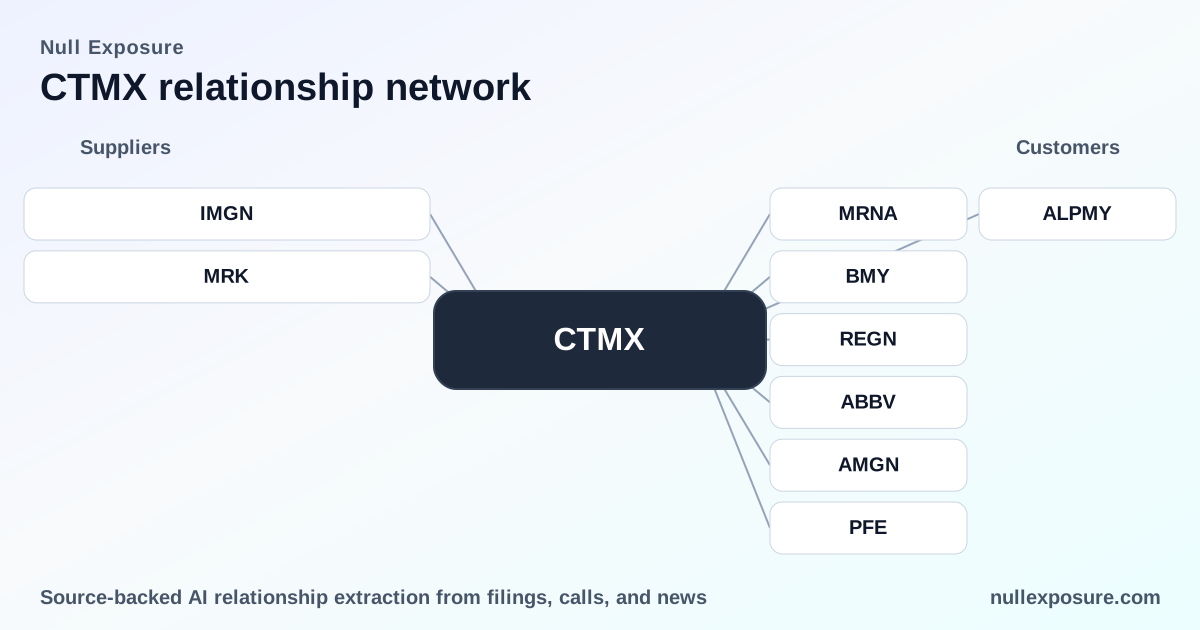
CytomX (CTMX): Partnered asset engine with milestone-driven revenue
CytomX is an oncology-focused biopharmaceutical company that monetizes primarily through collaboration agreements, upfront payments and milestone receipts from large pharma partners, while advancing a proprietary conditional-activation Probody platform across discovery and clinical-stage programs. For investors, the core investment thesis is straightforward: validation and near-term cash flow are tied to big‑pharma partnerships, so the company’s risk/return profile is driven as much by partner behavior as by internal clinical progress. For a concise partner map and implications for revenue durability, read on. For broader relationship intelligence, visit https://nullexposure.com/.
Why partnerships are the business model, not an afterthought
CytomX operates as a platform company that outsources capital-intensive development and commercialization economics through licensing and co-development deals. Upfront payments and milestones historically explain most episodic revenue, while equity investors fund the company between those cash inflection points. The corporate P&L (Revenue TTM: $76.2M; Market Cap: ~$910M per most recent public data) reflects that operating model: lumpier but capital-efficient if partners exercise options and advance programs.
The partner list — concise takeaways you need
Below are every partner relationship referenced in recent coverage, with a plain-English summary and the source of that summary.
Moderna (MRNA)
CytomX struck a collaboration with Moderna to discover and develop conditionally activated mRNA therapies for cancer, with Moderna paying a $35 million upfront package that included $5 million in pre-paid research funding. This deal brings both validation of CytomX’s conditional-activation approach and immediate non-dilutive cash. (Source: BioSpace, March 2026.)
Bristol Myers Squibb (BMY)
Bristol Myers Squibb has been a major historical collaborator but has pruned the alliance: reports document BMS dropping three discovery-stage projects from a previously large $3.6 billion collaboration and at least once walking away from a checkpoint-inhibitor pact—moves that erased roughly $300 million of contingent value from the relationship. This history demonstrates that large partners can materially re‑value and exit programs, creating significant revenue and valuation volatility for CytomX. (Sources: FierceBiotech, reporting FY2019 developments; FierceBiotech coverage, March 2026.)
AbbVie (ABBV)
AbbVie has contributed milestone payments to CytomX, and historical financial reporting shows milestone-driven boosts to quarterly revenue—an example of how partner-triggered payments have materially affected CytomX topline in past periods. (Source: StockTitan news summary of Q1 2020 results noting milestone payments from AbbVie and BMS.)
Pfizer (PFE)
Pfizer historically participated in antibody-drug conjugate collaborations with CytomX but reduced its engagement in some areas; reporting notes Pfizer exited a longstanding collaboration while other big pharma relationships continued to generate upfronts. Pfizer’s strategic withdrawal illustrates the asymmetric downside for CytomX when a cash‑positive partner reprioritizes. (Source: FierceBiotech, FY2019 reporting.)
Amgen (AMGN)
Amgen remains a named collaborator on programs such as the Amgen-partnered CX-904 T‑cell engager; CytomX has publicly stated it is considering the future of the Amgen-partnered CX-904, illustrating active program-level decision points that impact milestone timing and potential future revenue. (Source: FierceBiotech coverage citing a Jan. 6 press release; FY2025 reporting.)
Regeneron (REGN)
Regeneron is listed among CytomX’s ongoing collaborations, reinforcing the company’s strategy of engaging multiple large-cap partners across complementary therapeutic approaches. Regeneron’s involvement adds another channel for milestone and licensing economics. (Source: FierceBiotech, March 2026.)
Astellas (ALPMY)
Astellas is named among CytomX’s ongoing collaborators; like other partners, Astellas provides both validation of the Probody platform and potential milestone upside tied to program advances. (Source: FierceBiotech, March 2026.)
What the relationship mix tells investors about CTMX’s operating posture
-
Contracting posture: CytomX runs a partner‑centric commercialization pathway—its value accrues through bundled research collaborations, licensing fees, and milestone-triggered cash flows. The company’s balance between in-house development and partner-funded programs lowers capital burn when partners exercise options, but makes revenue projection contingent on partner choices.
-
Concentration: The company cultivates many large partners (Amgen, BMS, AbbVie, Moderna, Regeneron, Astellas, historically Pfizer), which reduces single-counterparty concentration, but each partnership can contain program-level concentration risk where the fate of a material milestone payment depends on one program decision.
-
Criticality: Partners are strategic gatekeepers—their prioritization decisions directly affect CytomX’s near-term revenue and long-term valuation, as evidenced by BMS’s previous exits and program cancellations that materially reduced perceived enterprise value.
-
Maturity spectrum: Partnerships span discovery through clinical stages; some deals date back years and have produced milestone receipts (e.g., Q1 2020 revenue bump from partner milestones), while newer collaborations (e.g., Moderna) add recent upfront cash and broaden modality exposure. This mix creates a pipeline with staggered risk-return profiles.
Key investment implications — risks and levers
-
Upside levers: Multiple blue‑chip partners validate the platform and provide episodic cash; recent upfronts (Moderna’s $35M) and historic milestone income show the company can convert partnerships into meaningful revenue. Platform utility across modalities (antibody–drug conjugates, T‑cell engagers, conditioned mRNA) increases optionality.
-
Principal risks: Partner reprioritization is the dominant operational hazard—BMS and Pfizer examples show how quickly contingent value can disappear. Revenue will remain lumpy and concentrated around milestone events, so forecasting requires program-level diligence. Additionally, program cancellations or delays (e.g., CX-188 postponement historically) depress both near-term cash flow and the market’s valuation multiple.
-
Balance sheet and valuation context: CytomX’s market cap and trailing revenue metrics position it as a development-stage platform company where equity value is heavily forward‑looking and partner outcomes are the primary value inflection points.
If you evaluate partnerships as a core investment signal, CytomX’s mix—multiple top-tier pharma collaborators combined with episodic revenue receipts—is exactly the profile that rewards active monitoring of partner press releases and milestone timelines. For enterprise-level relationship intelligence and historical partner tracking, see the full resource hub at https://nullexposure.com/.
Bottom line for investors and operators
CytomX’s business model is partner-driven monetization of a conditional-activation platform. The company’s upside is tied to milestones and co-development advancements with several major pharmas, while the principal downside stems from partner portfolio reprioritization and program cancellations. For investors, the key due diligence is active monitoring of partner press releases, milestone calendars and program-specific decisions—these are the determinative events for CTMX valuation.