Contineum Therapeutics (CTNM): How customer ties shape the clinical-stage story
Contineum Therapeutics is a clinical‑stage biopharma that discovers and advances oral small‑molecule therapies in neuroscience, inflammation and immunology. The company currently generates value through R&D and strategic licensing, most notably an exclusive global license for PIPE‑307 to Johnson & Johnson’s Janssen unit; Contineum has no product revenue and relies on partner advancement and external capital to create commercialization optionality. Investors should value Contineum as a high‑conviction, partner‑dependent story with concentrated counterparty exposures and pre‑revenue balance‑sheet dynamics. For more on how we source relationship intelligence, visit https://nullexposure.com/.
Why the customer map matters for valuation and risk
Contineum’s economics are driven less by direct sales and more by the terms and outcomes of third‑party development and commercialization agreements. The company’s market capitalization (~$529m as of the latest corporate snapshot) and analyst target prices reflect optionality tied to partner execution rather than recurring revenue streams. Key operating model characteristics for investors:
- Contracting posture: Contineum has granted an exclusive, worldwide license for PIPE‑307, which transfers development and commercialization rights to a major pharmaceutical partner — a classic biopharma outsourcing posture that trades upside capture for risk transfer and near‑term non‑dilutive financing potential.
- Customer concentration: The Janssen/Johnson & Johnson relationship creates high customer concentration for PIPE‑307’s commercial prospects and strategic roadmap; partner decisions materially influence Contineum’s program outcomes.
- Criticality: The relationship is strategically critical — the partner controls development decisions for many indications, and Contineum’s near‑term value realization depends on partner clinical decisions and trial progress.
- Maturity: Contineum remains pre‑commercial and development‑stage, so contractual rights and partner milestones, not product sales, will drive de‑risking and valuation inflection points.
These characteristics increase binary outcomes: successful partner trials and advancement unlock considerable upside; partner discretion or delay is the primary downside driver. If you want a consolidated view of related counterparties and their public disclosures, see https://nullexposure.com/.
Customer relationships you need on your model
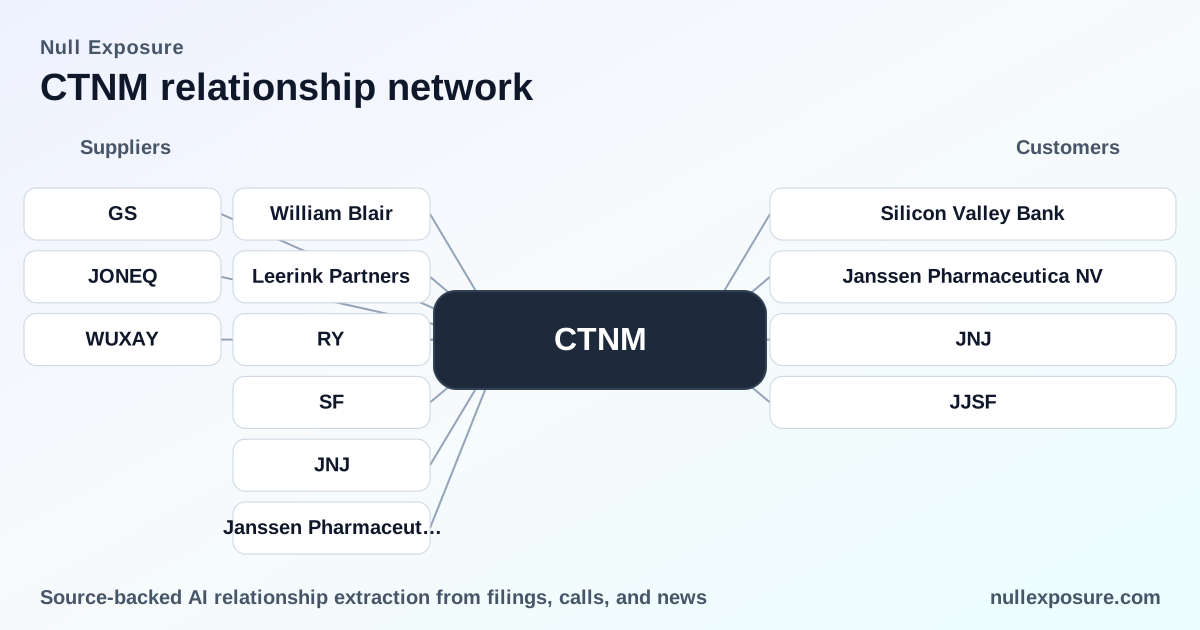
Below are every relationship identified in public filings and company news, with concise investor‑oriented descriptions and source references.
Silicon Valley Bank
Contineum referenced a Loan and Security Agreement with Silicon Valley Bank dated September 1, 2020, indicating a historical credit relationship used to support operations or capital needs. This is documented in Contineum’s FY2024 Form 10‑K. (Contineum FY2024 10‑K).
Johnson & Johnson (JNJ)
Johnson & Johnson is the corporate parent associated with Contineum’s strategic collaboration: JNJ began recruiting patients in December 2024 for a Phase 2 trial (Moonlight‑1) of PIPE‑307/JNJ‑89495120, demonstrating active trial execution under the partnership that drives Contineum’s program milestones. (BioSpace press release on Contineum Q4 2024 results; Markets/FInancialContent coverage of Q3 2025 results).
Janssen Pharmaceutica NV
Janssen — a Johnson & Johnson company — is the direct development and commercialization counterparty under a global license and development agreement; Janssen holds the decision rights to develop PIPE‑307 for indications beyond relapsing‑remitting multiple sclerosis (RRMS) and controls further development decisions after Contineum’s Phase 2 VISTA trial. (BioSpace enrollment press release; Contineum press releases discussing license terms).
JNJ (alternate ticker reference)
Public filings and news often refer interchangeably to the partner as JNJ; investor communications repeatedly note that trial initiation and program decisions have been carried out under the JNJ/Janssen framework, reinforcing that operational control sits with the pharmaceutical partner. (Multiple press releases and investor updates in FY2025).
JJSF (licensor reference in filings)
Contineum’s FY2024 10‑K records that in February 2023 the company entered into a J&J License Agreement granting J&J an exclusive, worldwide license to develop, manufacture and commercialize PIPE‑307 in all indications, a contractual fact that defines Contineum’s commercialization route for this asset. The filing treats J&J as a customer for accounting purposes. (Contineum FY2024 10‑K).
J&J (licensing relationship called out in the 10‑K)
The company explicitly concluded in its financial reporting that J&J represents a customer under ASC 606 and applied that guidance to evaluate accounting for the J&J License Agreement — a formal recognition that the licensing arrangement is the principal commercial relationship supporting Contineum’s revenue recognition and milestone accounting considerations. (Contineum FY2024 10‑K).
Implications for investors and operators
The relationship set above generates a compact set of investment signals:
- Concentrated counterparty exposure. PIPE‑307’s fate is materially dependent on Janssen/J&J decisions; model scenarios should assign significant weight to partner execution timelines and discretionary development choices.
- Licensing as the primary monetization lever. The February 2023 exclusive license is the structural revenue pathway: Contineum captures value through upstream licensing terms, milestone receipts, and potential downstream royalties rather than direct sales.
- Balance‑sheet and financing relevance. Historical credit arrangements such as the SVB loan show Contineum has used external financing tools; expect ongoing capital management needs until partner milestones or product revenue materialize.
- Binary clinical readouts. Active Phase 2 recruitment by J&J (Dec 2024) signals near‑term readouts that will be the major catalysts for de‑risking and repricing.
Risk checklist for financial models
- Partner discretion risk: Janssen/J&J controls further development decisions for PIPE‑307; model implicit probability of continuation or cessation across indications.
- Single‑asset concentration: PIPE‑307 is the material licensed asset; diversification of value drivers is limited while the program is primary.
- Pre‑revenue runway risk: Zero product revenue to date and negative operating margins mean capital markets or partner milestone payments will determine financing dynamics.
Final takeaways and where to go next
Contineum’s commercial profile is partner‑centric and licensing‑driven: the J&J/Janssen license is the core customer relationship and the primary determinant of near‑term valuation inflection points, while historical banking arrangements reflect standard financing behavior for a clinical‑stage biotech. Investors should prioritize partner trial timelines, milestone schedules, and any public updates from Janssen/J&J when modeling upside.
For a consolidated feed of relationship intelligence and primary‑document links that inform these assessments, consult https://nullexposure.com/.