CTNT Customer Relationships: Who Pays the Bills and What That Means for Investors
Cheetah Net Supply Chain Service Inc. operates a dual-track business: it sources and sells parallel-import vehicles into the PRC market while concurrently building a logistics and warehousing services platform after acquiring freight-forwarding and labor-service businesses in 2024. The company monetizes through vehicle sales margins and usage-based logistics fees (storage, freight forwarding and labor services), with recent revenue growth driven by consolidation of Edward Transit Express Group Inc. and TW & EW Services Inc. into the group. For investors focused on customer risk, the headline is clear: revenue concentration and the transition from trading to services define both upside and downside. Learn more at https://nullexposure.com/.
Why customer detail matters: a short investor thesis
CTNT’s operating model has shifted from a pure trading proposition into an integrated services provider. Services revenue is earned on a usage basis (storage days, freight and labor delivered) while vehicle sales remain transaction-driven. That structure delivers higher recurring revenue potential but concentrates counterparty risk: a small number of customers historically account for the lion’s share of revenue, and recent acquisitions have folded new customers into the top-line mix. Investors should value CTNT on a blended basis — trading margin cycles plus recurring logistics revenue — while explicitly pricing customer concentration and execution risk.
The relationships that shape revenue today
Below I cover every relationship surfaced in the public results. Each entry is a concise, plain-English take with the source.
-
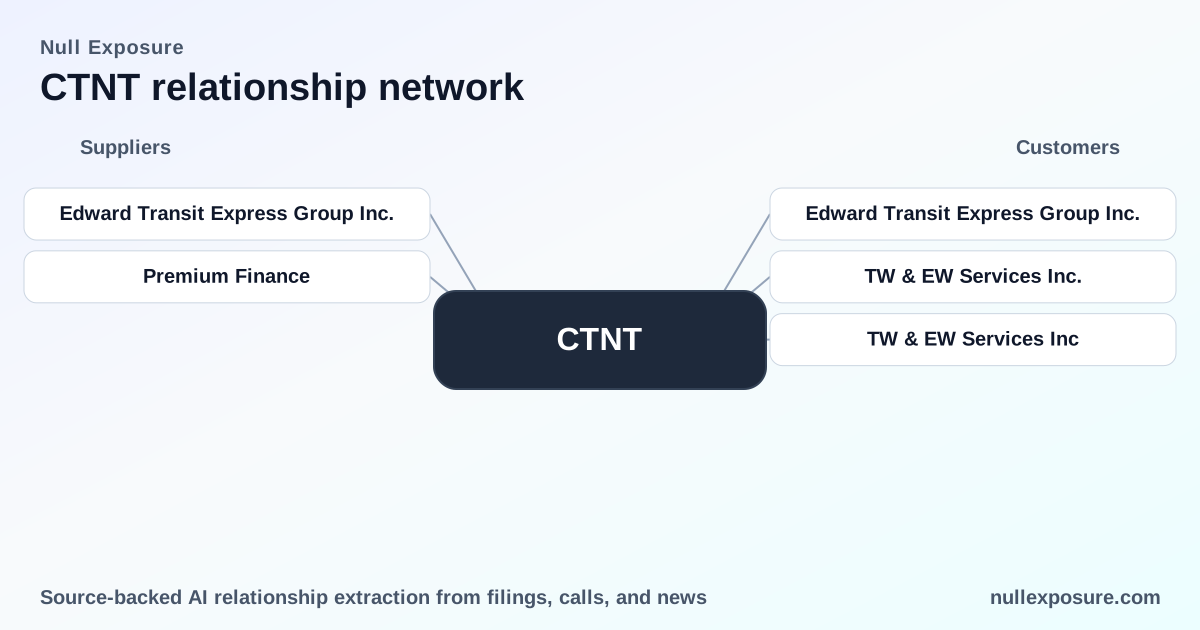
Edward Transit Express Group Inc. — strategic freight customer and acquired business. Edward accounted for $41,935 (11.6%) of CTNT’s logistics and warehousing revenue in Q3 2025 and, on a full-year basis reported in March 2026, contributed $214,810 (16.7%) of total company revenue after its February 2024 acquisition. Source: GlobeNewswire Q3 2025 release (Nov 7, 2025) and full-year 2025 results (Mar 20, 2026) — https://www.globenewswire.com/news-release/2025/11/07/3183967/0/en/Cheetah-Net-Supply-Chain-Service-Inc-Announces-Third-Quarter-2025-Results.html and https://www.globenewswire.com/news-release/2026/03/20/3259946/0/en/Cheetah-Net-Supply-Chain-Service-Inc-Announces-Full-Year-2025-Results-and-Provides-Corporate-Update.html.
- Takeaway: Edward is both a source of freight-forwarding revenue and an acquired operating unit that materially contributes to services revenue.
-
TW & EW Services Inc. (TWEW) — dominant logistics client and acquired labor services platform. TWEW supplied $320,000 (88.4%) of reported logistics and warehousing revenue for the three months ended September 30, 2025, and on a full-year basis for 2025 contributed $1,073,726 (83.3%) of CTNT’s total revenue after acquisition in late 2024. Source: GlobeNewswire Q3 2025 and full-year 2025 releases (Nov 7, 2025 and Mar 20, 2026) and related corrections — https://www.globenewswire.com/news-release/2025/11/07/3183967/0/en/Cheetah-Net-Supply-Chain-Service-Inc-Announces-Third-Quarter-2025-Results.html and https://www.globenewswire.com/news-release/2026/03/20/3259946/0/en/Cheetah-Net-Supply-Chain-Service-Inc-Announces-Full-Year-2025-Results-and-Provides-Corporate-Update.html.
- Takeaway: TWEW is the single largest revenue contributor to CTNT’s services mix, creating both scale benefits and concentration exposure.
-
Rapid Proceed Limited — significant early equity subscriber. In a July 12, 2022 subscription the company issued 1,000,000 shares to Rapid Proceed Limited for $1.8 million, making Rapid Proceed a meaningful shareholder from the company’s capital raises. Source: ADVFN/EDGAR reporting of the subscription agreement (reported 2026) — https://br.advfn.com/noticias/EDGAR2/2026/artigo/98216938.
- Takeaway: Rapid Proceed’s role is equity investor/subscriber rather than a customer; reference here because the public relationship data includes capital transactions that influence ownership and related-party dynamics.
What the constraints tell us about CTNT’s customer economics
The public disclosures and excerpts produce a coherent set of company-level signals that explain how CTNT contracts, where it sells, and where risks concentrate:
-
Contracting posture — predominantly usage-based services. For warehousing, revenue is recognized based on actual storage days; freight-forwarding revenue is recognized when services are delivered. This creates variable, volume-linked revenue rather than locked multi-year contracts, which improves scalability but leaves revenue exposed to volume swings.
-
Geographic profile — APAC focus with U.S. operations. The company’s primary market is PRC while operations are maintained in the U.S., and reported revenue splits show the PRC dominating parallel-import vehicle sales. Revenue generation and customer concentration are geographically concentrated in APAC, with North American activity supporting sourcing and logistics.
-
Concentration and criticality — top customers are critical. Public excerpts identify that two customers accounted for ~100% of parallel-import vehicle revenue in 2024 and the top three accounted for over 90% of receivables. This is a critical concentration signal that elevates counterparty risk and compresses negotiating leverage.
-
Relationship roles — CTNT sells vehicles and provides services. The company functions as seller of parallel-import vehicles and as a service provider (freight forwarding, warehousing, labor) after its acquisitions; parallel-import dealers remain major customers on the vehicle side.
-
Stage and maturity — rapid shift to services and active customer base. Logistics and warehousing revenue commenced in 2024 following the acquisitions and the active services customer base expanded from seven to 24 customers by year-end — indicating early-stage commercial deployment of the services strategy rather than a mature, diversified book.
-
Segment mix — trading plus distribution and services. The company now reports parallel-import vehicle sales (core product) and logistics & warehousing (services/distribution), creating a mixed-margin profile and operational complexity.
Investment implications: upside, risks, and what to watch
-
Upside: Usage-based services can create predictable revenue per unit of activity and margin expansion as fixed-cost utilization improves. The rapid revenue contribution from acquired units demonstrates execution on M&A integration and an immediate scale effect.
-
Key risks: Customer concentration is the primary risk; heavy reliance on a handful of counterparties for the majority of revenue and receivables creates single-counterparty exposure. The usage-based contract model means volumes — and therefore revenue — fluctuate with trade flows and dealership demand. Geographic concentration in APAC concentrates regulatory and market-cycle risk.
-
Operational monitoring: Track customer diversification across the logistics book, the pace of recurring revenue growth, days-sales-outstanding trends for the top receivables, and margin progression in the services segment.
If you want a concise portfolio-grade digest that tracks CTNT’s customer concentration and earnings sensitivity, visit https://nullexposure.com/ for a focused view.
Bottom line
Cheetah Net has successfully pivoted from a parallel-import vehicle seller into an integrated logistics operator through targeted acquisitions. The company generates revenue through transaction-based vehicle sales and usage-based logistics fees, but the business today is highly concentrated among a few counterparties, which creates a binary risk-reward profile: execution and customer diversification scale value quickly; the loss or contraction of a top counterparty would materially impair revenue. Investors should price both the operational leverage of usage-based services and the concentration risk into any valuation.