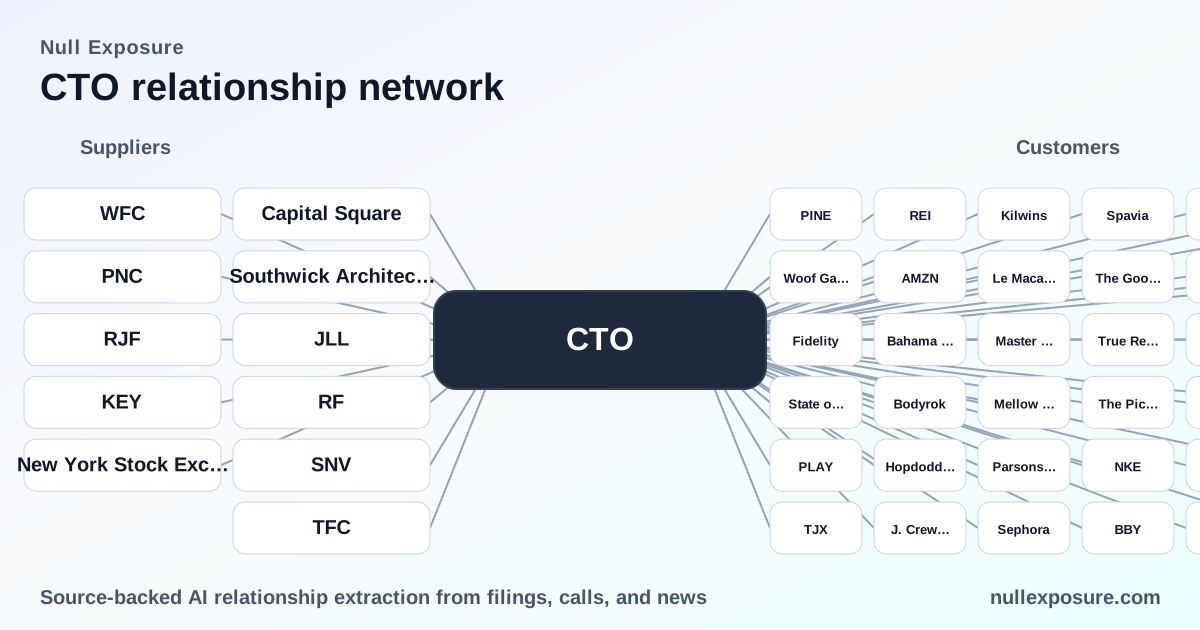
CTO Realty Growth: tenant map and what investor relationships tell you
CTO Realty Growth (NYSE: CTO) is an owner-operator focused on high‑growth open‑air retail centers in the U.S. Southeast and Southwest, monetizing through long‑term lease income from anchored shopping centers and fee income from externally managed REITs. The company combines property-level cash flow with a fee‑based management services business—most notably its management and ownership stake in Alpine Income Property Trust (PINE)—creating two distinct revenue streams that drive valuation and operational leverage. For more detail on CTO’s investor signals, visit https://nullexposure.com/.
How CTO’s customer relationships structure the business model
CTO’s operating model is driven by long‑dated leasing at center and single‑tenant assets (leasing revenue recognized straight‑line over lease lives) while capturing incremental service fees from managing PINE. The firm reports that income properties comprised roughly 88–89% of consolidated revenue in recent years, signaling that tenant cash flow is the company’s economic backbone, while management services provide a fee layer that is material and active. The relationship with Alpine/PINE is contractually explicit—CTO collects a base management fee equal to 1.5% of PINE’s equity—so that partner functions as both customer and revenue generator (service provider role disclosed in CTO’s 2024 10‑K).
- Contracting posture: Predominantly long‑term leases, though the company records occasional spot gains (for example mitigation credit sales in 2024) that are non‑recurring.
- Geographic concentration: Revenue weighted to the U.S. Southeast and Southwest (notably Georgia, Florida, Texas, North Carolina).
- Criticality and maturity: Income properties are material and established; management services are an active, fee‑based business line with historical fee revenue disclosed.
- Concentration risk: Dependence on large anchor tenants and a single externally‑managed REIT increases tenant concentration considerations for credit and valuation work.
If you want a single reference summarizing CTO’s business and customer exposures, CTO’s 2024 10‑K and the company’s Feb–Mar 2026 press releases and earnings transcripts are primary sources.
Relationship roll call — names, roles and sources
Below I list every named customer/tenant relationship surfaced in public filings and media excerpts, with a one‑line plain‑English summary and the supporting source.
- Alpine Income Property Trust / PINE — CTO externally manages PINE and owns a meaningful interest, receiving management fees (1.5% of PINE equity); see CTO 2024 10‑K and Globenewswire (Feb–Oct 2025–2026).
- AMC Theatres — Identified as a key tenant concentration risk and anchor at multiple assets; cited in Q1 2026 earnings call transcript (Investing.com / Benzinga).
- Best Buy — Anchor tenant at Palms Crossing (acquired Mar 2026) and other centers; acquisition disclosure in Finance/Yahoo & QuiverQuant (Mar 2026).
- Burlington / Burlington Coat Factory — Anchor at Palms Crossing and other centers; noted in Palms Crossing acquisition release (Finance/Yahoo, Mar 2026).
- Cooper’s Hawk — New lease signed at Ashley Park (Ashley Park / Ashley Park mention in Q1 2026 call transcript, Investing.com).
- Pottery Barn Kids — Lease signed to fill previously vacant space at Millennia Crossing; cited in Q1 2026 earnings transcript (Benzinga).
- Swig — Drive‑through beverage tenant signed at Marketplace at Seminole Towne Center (Q1 2026 call transcript).
- Williams‑Sonoma (WSM) — Signed lease to occupy former Mattress Firm space at Millennia Crossing; Q1 2026 earnings/earnings transcript (Benzinga).
- Amazon / AMZN / Whole Foods — CTO land sales and developments have included sites occupied by Whole Foods and last‑mile Amazon facilities; historical reporting in News‑Journal (2020) and RichmondBizSense (2025).
- Dave & Buster’s — Tenant in West Broad Village holdings referenced in RichmondBizSense (2025).
- HomeGoods / TJX — Tenant in neighborhood holdings (RichmondBizSense, 2025).
- REI — Tenant in neighborhood holdings (RichmondBizSense, 2025).
- Bahama Buck’s — Announced opening/lease at The Collection at Forsyth; ShoppingCenterBusiness (2024/2025).
- Bodyrok — Boutique fitness tenant signed at The Collection at Forsyth; ShoppingCenterBusiness (2024).
- Hopdoddy Burger Bar — Existing tenant at The Collection at Forsyth; ShoppingCenterBusiness (2024).
- J. Crew Factory — Tenant at The Collection at Forsyth; ShoppingCenterBusiness (2024).
- Kilwins — New location opened at The Collection at Forsyth; ShoppingCenterBusiness (2024).
- Le Macaron — Tenant at The Collection at Forsyth; ShoppingCenterBusiness (2024).
- Master Jewelers — Tenant at The Collection at Forsyth; ShoppingCenterBusiness (2024).
- Mellow Mushroom — Tenant at The Collection at Forsyth; ShoppingCenterBusiness (2024).
- Parsons Gifts — Tenant at The Collection at Forsyth; ShoppingCenterBusiness (2024).
- Woof Gang Bakery — Tenant at The Collection at Forsyth; ShoppingCenterBusiness (2024).
- The Good Feet Store — Tenant at The Collection at Forsyth; ShoppingCenterBusiness (2024).
- Spavia — Tenant at The Collection at Forsyth; ShoppingCenterBusiness (2024).
- F45 Training — Tenant at The Collection at Forsyth; ShoppingCenterBusiness (2024).
- Fidelity — Investment‑grade tenant at Albuquerque office property and referenced in multiple releases as occupying amended space; CityBiz / GlobeNewswire / Yahoo (Dec 2025–Mar 2026).
- State of New Mexico — Increased lease to 98,000 sq ft at Albuquerque property; CityBiz and GlobeNewswire (Dec 2025).
- The Cheesecake Factory — Signed lease at The Collection at Forsyth; CityBiz (May 2026).
- Academy Sports + Outdoors — Anchor tenant at several acquired assets including Atlanta properties; CommercialSearch / ChainStoreAge reporting.
- Dick’s Sporting Goods — Anchor at Ashley Park (acquisition disclosure); ConnectCRE (2025).
- DSW — Tenant noted among anchors at acquired Atlanta mixed‑use (CommercialSearch).
- Barnes & Noble — Anchor at Palms Crossing and other centers; Finance/Yahoo & multiple acquisition notices (2025–2026).
- Regal — Cinema anchor at Ashley Park and other centers; ConnectCRE (2025).
- Dillard’s — Anchor cited for Ashley Park (ConnectCRE, 2025).
- Boot Barn — Grand opening at Marketplace at Seminole Towne Center; QuiverQuant (Dec 2025).
- Ross Dress for Less — Anchor at Pompano Citi Centre and other centers; Finance/Yahoo (2025).
- TJ Maxx — Anchor at Pompano Citi Centre; Finance/Yahoo (2025).
- Nordstrom Rack — Anchor at Pompano Citi Centre; Finance/Yahoo (2025).
- J.C. Penney — Anchor at Pompano Citi Centre; Finance/Yahoo (2025).
- Warby Parker — Signed lease at The Collection at Forsyth; CityBiz (May 2026).
- Target / TGT — Shadow‑anchored asset noted at Marketplace at Seminole Towne Center; QuiverQuant press release (Dec 2025).
- Marshalls — Anchor/tenant referenced at Marketplace at Seminole Towne Center; QuiverQuant (Dec 2025).
- Nike / NKE — Anchor tenant at Palms Crossing (98% leased); Palms Crossing acquisition release (GlobeNewswire / QuiverQuant / Yahoo, Mar 2026).
- General Dynamics / GD — Single‑tenant office property in Reston, VA leased to General Dynamics for $18.5M; cited in CTO 2024 10‑K.
- Berkshire Hathaway HomeServices Georgia Properties — Signed lease at The Collection at Forsyth; CityBiz (May 2026).
- Kimley‑Horn — Signed lease at The Collection at Forsyth; CityBiz (May 2026).
- Ted’s Montana Grill — Tenant at acquired Atlanta mixed‑use roster; ChainStoreAge / CommercialSearch (2023 reporting).
- Carrabba’s Italian Grill — Tenant at acquired Atlanta mix; ChainStoreAge (2023).
- Talbot’s — Tenant at acquired Atlanta mix; ChainStoreAge (2023).
- Pure Barre — Tenant at acquired Atlanta mix; ChainStoreAge (2023).
- Jos. A. Bank — Tenant at acquired Atlanta mix; ChainStoreAge (2023).
- Children’s Healthcare of Atlanta Urgent Care Center — Medical tenant at The Collection at Forsyth; CommercialSearch (2023).
- Regus — Office tenant at The Collection at Forsyth; CommercialSearch (2023).
- Party City / PRTY — Former occupant replaced by Boot Barn; QuiverQuant (Dec 2025).
- Trader Joe’s — Land sale uses produced distribution center occupied by Trader Joe’s; News‑Journal historical reporting (2020).
- B. Braun — Distribution center occupant from CTO land sale activity; News‑Journal (2020).
- Buc‑ee’s — Large convenience/gas project from CTO land sales referenced historically; News‑Journal (2020).
- Tanger Outlets — Part of land sale developments from CTO’s portfolio activity; News‑Journal (2020).
- The Picklr — Grand opening at The Collection at Forsyth (GlobeNewswire, Nov 2025).
- The Picklr (pickleball concept) — See above: grand opening noted in company release (GlobeNewswire, Nov 2025).
- PANDY / Pandora — Retail tenant at The Collection at Forsyth; ShoppingCenterBusiness (2024).
- Boot Barn (duplicate press) — See Boot Barn entry (QuiverQuant Dec 2025).
- Regal (duplicate) — See Regal entry (ConnectCRE 2025).
What investors should take from the relationship map
- Stable cash flows anchored to long‑term leases: The bulk of revenue is leasing‑driven and geographically concentrated in growth Sunbelt states, supporting income stability and predictable coverage metrics. Evidence: 2024 10‑K revenue breakdown and lease revenue recognition language.
- Fee income as diversification: Management revenues from Alpine/PINE are explicit, contractual and material (management fee schedule disclosed), providing a recurring service margin beyond rent. See CTO 2024 10‑K and multiple Globenewswire releases.
- Concentration and tenant mix risk: Large national anchors (Best Buy, Nike, AMC, Target shadow anchors, major department and discount anchors) drive visitation but create credit concentration points; management commentary flagged tenant concentration (earnings call transcript, Q1 2026).
- Active leasing and value‑add thesis: Recent acquisitions (Palms Crossing, Ashley Park, Collection at Forsyth) and a steady stream of new leases demonstrate an operational play to increase NOI via lease‑up and merchandising mix improvements (acquisition press releases, Mar–May 2026).
If you want a consolidated view of CTO’s customer exposures and their implications for credit and valuation, the company filings and the Q1 2026 earnings call transcript are the principal references. For an investor‑grade product that monitors these relationship dynamics continuously, visit https://nullexposure.com/.
Bottom line
CTO combines property cash‑flow economics with a fee‑based management franchise; investors should value the predictability of long‑term retail leases while actively monitoring anchor concentration and the economics of the PINE management arrangement. The public filing record and recent press releases provide a clear trail for modeling rental cash flows and management fee sensitivity across the tenant set.