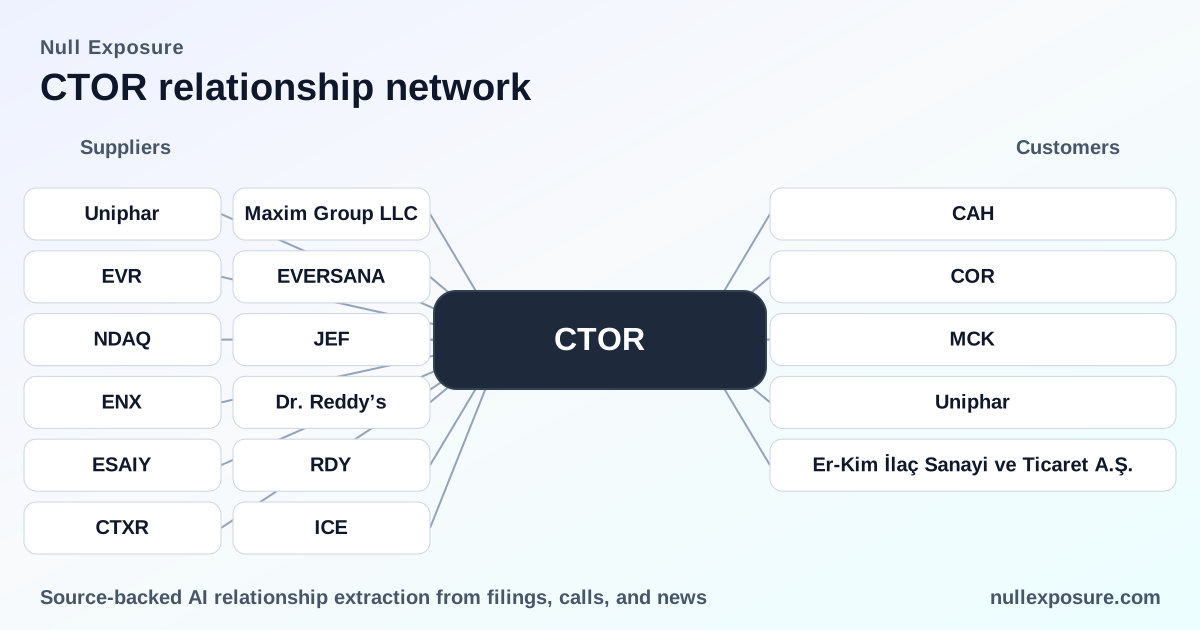
Citius Oncology (CTOR): Commercial Partnerships and Distribution Footprint — What Investors Should Know
Citius Oncology is transitioning from a clinical-stage operator to a commercial-stage specialty oncology company by monetizing its lead product, LYMPHIR™ (denileukin diftitox-cxdl), through direct U.S. commercialization and selective international distribution partnerships. The company supplies finished product into major U.S. pharmaceutical wholesaler networks and has signed exclusive arrangements for European and Middle Eastern markets, positioning product availability while preserving the option to capture manufacturing and sales margin. For a concise relationship map and ongoing monitoring, visit https://nullexposure.com/.
Executive thesis: how CTOR captures value today
Citius Oncology’s near-term revenue model is straightforward: manufacture or source finished LYMPHIR, place inventory with national wholesalers for U.S. distribution, and rely on exclusive regional distributors for international commercialization. That model converts clinical-stage assets into product sales without building a global salesforce or logistics network from scratch. The company also retains optionality through capital raises that funded an initial inventory buffer—enough to supply the market while commercial operations scale. This is a capital-efficient way to bridge from regulatory approval to revenue recognition, but it also concentrates fulfillment risk in a few distribution partners.
The distribution backbone: wholesalers plus selective regional partners
Citius deployed finished goods into the warehouses of three major U.S. wholesalers—Cardinal Health, Cencora, and McKesson—to enable immediate market access and pharmacy/clinic fulfillment. For non-U.S. markets the company is using exclusive distributors (notably Uniphar for Europe and Er‑Kim for Turkey and several GCC countries) to accelerate regulatory access and payer conversations without a full local infrastructure. This hybrid approach balances speed to market against margin sharing and partner concentration.
For investors focused on operational exposure, note the company entered FY2026 with an 18‑month inventory positioned in wholesaler warehouses, a deliberate inventory strategy designed to avoid stockouts during the initial commercialization runway (MarketMinute, reporting on the FY2025 10‑K, March 2026).
Company-level constraints and what they signal about risk and maturity
- Contracting posture — seller with strategic partners. Citius states it will commercialize products independently in the U.S. and partner to market products outside the U.S., signaling a mixed direct/partner go‑to‑market posture that reduces near‑term operating leverage required for a global roll‑out (company filing language summarized in the FY2025 10‑K).
- Product concentration — revenue driven by a single core product. LYMPHIR is explicitly referenced as the lead product for recurrent CTCL, indicating single-product commercial concentration until additional pipeline assets progress to market.
- Criticality and maturity — finished product inventory in place but early commercial stage. The presence of an 18‑month finished‑goods inventory is a commercial readiness signal; however, distribution agreements and exclusive regional deals place CTOR in an early-stage commercial maturity where sales execution and partner performance will determine revenue ramp.
- Counterparty concentration risk. Using three wholesalers for U.S. distribution concentrates logistics and fulfillment dependency; international exclusives concentrate regional access risk into single partners per geography.
- Operational implication for investors and operators. Expect working capital demands tied to inventory cycles and partner-managed demand forecasting; monitor replenishment cadence, wholesaler sell‑through, and distributor uptake as primary operational KPIs.
Relationship-by-relationship: what each partner delivers
Cardinal Health (CAH)
Cardinal Health is one of three national wholesalers where Citius positioned finished LYMPHIR inventory to support U.S. commercialization and immediate fulfillment. Source: market reporting on Citius’ FY2025 10‑K and MarketMinute coverage (published March 9, 2026).
Cencora (COR)
Cencora is listed alongside Cardinal Health and McKesson as a warehouse partner for finished goods, providing national distribution reach and pharmacy channel access for the LYMPHIR launch. Source: company 10‑K summaries reported by MarketMinute and TradingView (March 2026).
McKesson Corporation (MCK)
McKesson is the third major U.S. wholesaler with finished product storage, completing a U.S. distribution triad that facilitates order fulfillment to hospitals, clinics, and specialty pharmacies. Source: Citius’ FY2025 10‑K as summarized in TradingView and MarketMinute coverage (March 2026).
Uniphar
Citius signed an exclusive distribution agreement with Uniphar to expand access to LYMPHIR across selected European countries, a commercial shortcut that leverages Uniphar’s regional market access and payer relationships. The agreement was announced in February and covered both Western and Eastern Europe. Source: multiple press reports including FinViz and Yahoo Finance reporting on the February 11 announcement (March 2026 coverage).
Er‑Kim İlaç Sanayi ve Ticaret A.Ş. (Er‑Kim)
Citius expanded LYMPHIR distribution to Turkey and six Gulf Cooperation Council countries—including Saudi Arabia and the UAE—through an exclusive agreement with Turkish distributor Er‑Kim, under which Citius will supply finished product and provide support for local commercialization activities. Source: PR Newswire and Investing.com coverage of the distribution agreement (announced in early 2026, reported May 2026).
Key implications for investors and operators
- Inventory-first launch reduces immediate commercial risk but shifts exposure to wholesaler sell‑through. The 18‑month inventory buffer gives CTOR time to build demand, but revenue realization depends on wholesalers’ throughput and hospital/pharmacy adoption.
- Single-product concentration amplifies outcome sensitivity. LYMPHIR’s commercial performance will largely determine revenue trajectory and valuation re‑rating in the near term.
- Partner selection favors speed and market access over margin retention. Exclusive regional distributors accelerate market entry but share economic upside and concentrate execution risk.
- Operational focus areas: monitor wholesaler and distributor sell‑through, reimbursement decisions in key geographies, and replenishment orders as the earliest meaningful commercial signals.
For deeper relationship mapping and ongoing alerts around these counterparties, see our coverage at https://nullexposure.com/.
Bottom line
Citius Oncology has constructed a pragmatic, capital‑efficient route to commercialization: retain U.S. commercialization control while outsourcing international market access to experienced distributors, and preload the supply chain via major wholesalers. This strategy converts regulatory progress into near‑term commercial optionality but concentrates execution risk around a small number of partners and one core product. Investors and operators should prioritize monitoring partner sell‑through, reimbursement wins, and inventory replenishment cadence as the clearest leading indicators of commercial success.