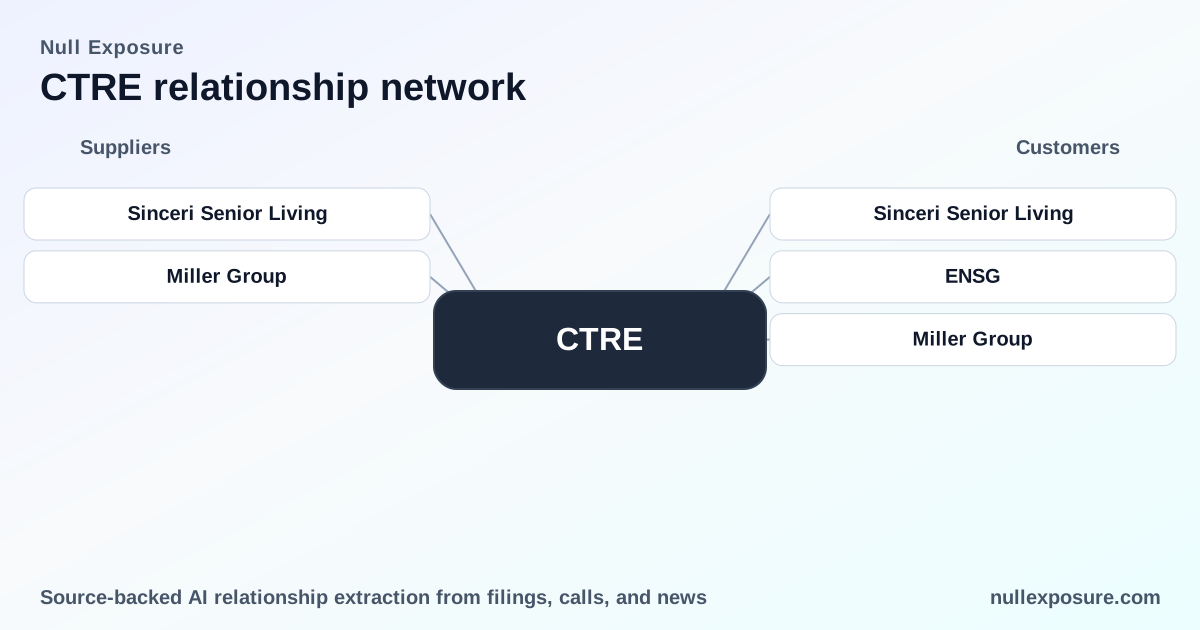
CareTrust REIT (CTRE) — customer relationships and what they mean for investors
CareTrust REIT operates and monetizes as a self-managed healthcare real estate investment trust: it acquires, finances and owns skilled nursing, senior housing and other healthcare real estate and leases those assets to third‑party operators under primarily long‑term, triple‑net arrangements. Revenue derives from contractual rent and secured mortgage lending, while balance‑sheet activity includes portfolio acquisitions, sale‑leasebacks and selectively structured loans to operators. For investors, the important levers are lease tenor and structure, operator credit and concentration, geographic exposure (including the U.K.), and recent high‑ticket investments that drive cash yield and leverage. For a deeper counterparty map, visit https://nullexposure.com/.
How CareTrust structures operator relationships — the operating model in plain English
CareTrust’s commercial posture is asset‑owner / licensor rather than operator: the company signs long‑dated lease contracts and transfers operational responsibility to third‑party healthcare operators. The corporate record explicitly documents 15‑year base lease terms with two five‑year renewal options and predominantly triple‑net lease structures that push maintenance, insurance, taxes and utilities to the operator. Those contract features create predictable rental cash flow and lower landlord operating volatility, but they also make property cash flows dependent on tenant operational performance and reimbursement regimes.
Geographically, CareTrust is diversified but concentrated: it owns properties in 32 U.S. states and the U.K., with the highest rental-income concentration in California, the U.K., Texas and Tennessee. The company reports near‑complete rent collection (100% and 99.7% collection for the quarter and year ended December 31, 2025, respectively), which signals current cash collection resilience even as industry reimbursement and regulatory risk remain material. At scale, CareTrust moves in large dollar transactions — for example, a $260 million mortgage loan and a ~$95.7 million sale‑leaseback portfolio transaction announced in 2024 — demonstrating both capital markets access and exposure to sizeable single‑counterparty wins or losses.
Key operating characteristics investors should track:
- Contracting posture: Long‑term, triple‑net leased assets — landlord collects rent, operator carries operating cost risk.
- Concentration: Revenue concentrated by state and meaningful U.K. exposure that creates cross‑border tax and regulatory considerations.
- Criticality: Tenants are specialized healthcare operators whose reimbursement and staffing cycles directly influence rent coverage.
- Maturity and liquidity: Active portfolio with large individual transactions and evidence of strong rent collection through FY2025.
Operator relationships in play — who CTRE is partnered with now
Sinceri Senior Living
CareTrust announced an operating partnership with Sinceri Senior Living in the Q4 2025 investor call, noting the operator will manage newly acquired communities for the REIT. This is an active operating relationship tied to recent transactions and documented by management in the Q4 2025 earnings call transcript published March 8, 2026. According to the Q4 2025 earnings call (March 2026), “We are excited to partner with Sinceri Senior Living, who will help manage those communities for us.”
The Ensign Group (ENSG)
The Ensign Group is described in market coverage as one of CareTrust’s major tenants and operator partners, and is referenced as part of the company’s core operator diversification and capital markets positioning. A March 2026 market note highlighted relationships with major tenants such as The Ensign Group while also flagging sector risks like reimbursement exposure and rising leverage. A Finviz discussion of CareTrust’s FY2026 outlook cited operator diversification and relationships with The Ensign Group as a key strength in the company’s positioning (March 9, 2026).
Miller Group
Management disclosed a new operating partner in the Mid‑Atlantic identified publicly as Miller Group in the Q4 2025 call and subsequent press coverage; the group is not affiliated with other peer announcements and was discussed in the company’s March 2026 transcript release. In the Q4 2025 earnings transcript published via press outlets on March 9, 2026, management confirmed a recently announced Mid‑Atlantic operating partner known as Miller Group and distinguished it from other market transactions.
How these relationships change the investment case
These operator partnerships illustrate CareTrust’s dual playbook: lease income stability from long tenors and selective operator diversification via targeted management partnerships. The presence of large, named operators like The Ensign Group adds credibility and occupancy scale, while newer partners such as Sinceri and Miller Group reflect active portfolio reshaping.
However, two structural facts dominate valuation risk:
- Lease dependence on operator economics. Triple‑net leases transfer capex and operating expense risk to operators, but tenant solvency is directly tied to third‑party reimbursement regimes and operational execution. That creates a single‑tenant credit sensitivity for large assets.
- Large-ticket exposures are material. The company’s public filings document significant single transactions (a $260 million mortgage loan and a $95.7 million sale‑leaseback), which both boost yield and elevate counterparty concentration risk if an operator underperforms.
Net: CareTrust trades on predictable contractual cash flow and active portfolio deployment, but investors must underwrite operator credit, the company’s ability to replace or re‑lease properties at term, and macro reimbursement trends.
Risk and upside themes investors should watch next
- Upside: Continued successful sale‑leasebacks and mortgage placements can compound yield while preserving the REIT model; operator diversification reduces single‑operator concentration on a portfolio basis.
- Downside: Regulatory or reimbursement shocks affecting skilled nursing operators, concentrated revenue states, or a major operator distress event would pressure rent coverage and potentially require asset‑level interventions.
- Balance sheet watch: Rising leverage was flagged in market commentary; large loan and acquisition activity implies active capital deployment that should be reconciled with covenant exposure and liquidity buffers.
For more granular counterparty mapping and to track relationship changes in real time, visit https://nullexposure.com/.
Bottom line
CareTrust is a cash‑flow oriented healthcare property REIT that monetizes through long‑term, predominantly triple‑net leasing and selective mortgage lending and sale‑leaseback activity. Its operator relationships — including The Ensign Group, Sinceri Senior Living, and Miller Group — reflect a mix of established large tenants and newly onboarded regional partners, which together drive the company’s income stability and portfolio execution risk. Investors should prioritize operator credit assessment, geographic concentrations (including U.K. exposure), and the implications of large individual transactions when modeling CTRE’s forward cash flow and capital structure.