Centuri Holdings (CTRI): Customer Relationships, Revenue Mechanics, and What Investors Should Know
Centuri Holdings monetizes a capital- and labor-intensive utility infrastructure model by contracting with regulated electric and gas utilities across North America to perform construction, maintenance, and pipeline services. Revenue is driven largely through long‑term master service agreements (MSAs) and a mix of fixed‑price contracts and bid work, with specialized subsidiaries executing projects for corporate and municipal customers; working capital is supported in part by receivables financing arrangements. For investors, the company’s cash flows reflect a service‑provider profile with high customer concentration among investment‑grade utilities, recurring field operations, and modest operating margins relative to peers. Learn more at the Centuri customer intelligence hub: https://nullexposure.com/.
Business model snapshot
- Centuri operates as a service provider to utility customers, delivering recurring local distribution and urban transmission services under framework agreements and MSAs.
- The company reports substantial revenue concentration: the top 20 customers accounted for roughly 67% of revenue in fiscal 2024, indicating both predictable backlog and client concentration risk.
- Centuri captures revenue via mixes of long‑term MSAs, fixed‑price multi‑year contracts, and shorter bid contracts, and supports operations with receivables financing in structured arrangements.
Key financial framing Centuri reported roughly $2.98 billion in trailing revenue and EBITDA of approximately $241 million (TTM), with operating margin near 4.6% and a profit margin under 1%—a profile consistent with large staffing and project execution costs in regulated utility infrastructure work. These metrics frame why management emphasizes MSAs and receivables solutions to stabilize cash flow and execution risk.
How Centuri contracts and the company-level constraints you should evaluate Centuri’s public disclosures describe a contracting posture that is predominantly long‑term and framework-based, with roughly 80% of 2024 revenue tied to MSAs and 49 fixed‑price contracts originally longer than one year. This operating model produces several investment-relevant characteristics:
- Contracting posture: Predominantly long‑term MSAs and framework agreements that provide recurring revenue but generally do not guarantee volumes; MSAs can be terminated on notice.
- Concentration and counterparty quality: Top customers are mainly investment‑grade utilities; this concentrates revenue but reduces credit risk per counterparty.
- Geographic focus and maturity: Operations are North America‑centric and described as mature, delivering local distribution and transmission services rather than sporadic megaprojects.
- Role and criticality: Centuri is a strategic service provider to regulated utilities; services are mission‑critical for utility maintenance and modernization.
- Contract mix: A minority of engagements are short‑term bid contracts; the business retains exposure to project timing and seasonal execution.
These constraints are company-level signals drawn from Centuri’s FY2024 disclosures and should frame how investors evaluate customer stability, working capital needs, and execution risk.
Customer relationships: what the filings and press show Below I cover each named relationship disclosed in the available records and what it implies for Centuri’s revenue and operations.
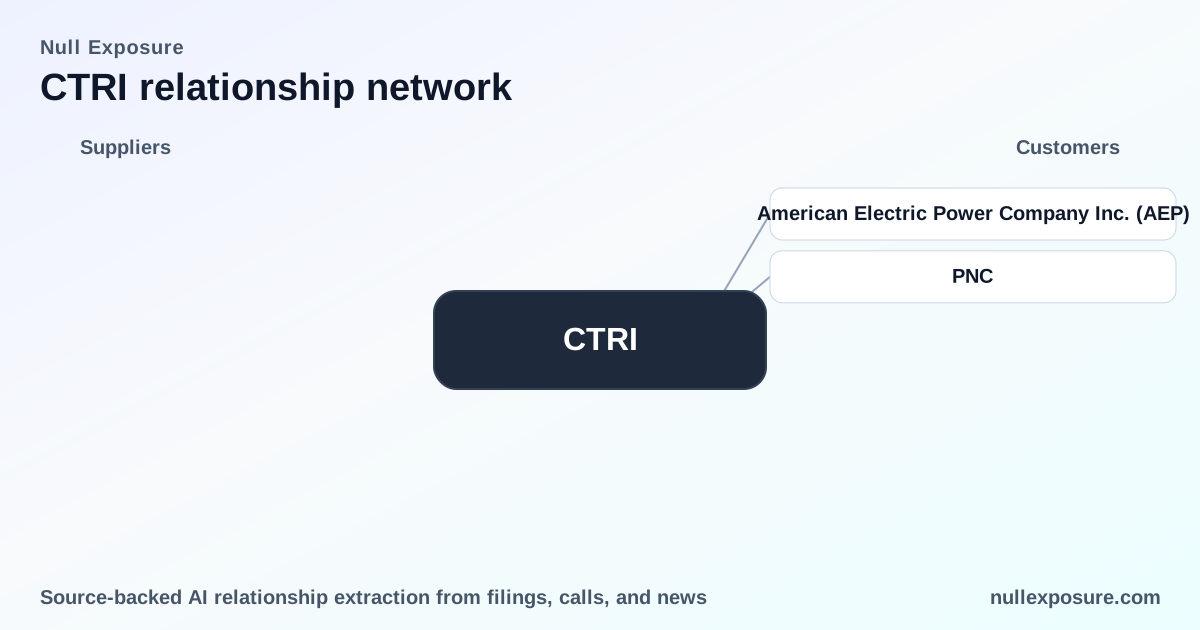
American Electric Power Company Inc. (AEP) Centuri reported $143.7 million of revenue from AEP in fiscal 2024, identifying AEP as one of its current customers and demonstrating meaningful single‑customer revenue contribution. According to Centuri’s 2024 Form 10‑K, this level of revenue from AEP reflects the company’s role as a service provider to large, regulated electric utilities. (Source: Centuri 2024 10‑K, fiscal year ended December 29, 2024.)
PNC (receivables financing via SPE) Centuri uses a special purpose entity arrangement that transfers ownership and control of accounts receivable to PNC to support cash collection and payment processing under the agreed terms. The 2024 10‑K describes this structure as part of Centuri’s working capital and receivables financing strategy, indicating active use of external bank financing to smooth operating cash flow. (Source: Centuri 2024 10‑K, fiscal year ended December 29, 2024.)
AMTX (Praj/Aemetis project via NPL Construction Co., a Centuri subsidiary) A news report covering advanced fuels projects notes that NPL Construction Co., a subsidiary of Centuri, is executing project work for AMTX, indicating Centuri’s participation in renewable fuels and industrial construction contracts outside traditional utility customers. This demonstrates the company’s ability to deploy subsidiary resources into project execution for non‑utility industrial clients. (Source: Chemical Engineering Online coverage of Praj and Aemetis, March 2026.)
What these relationships collectively imply for investors
- Large utility customers drive scale. The disclosed AEP relationship and the company’s admission that the top 20 customers delivered 67% of revenue in fiscal 2024 confirm a revenue base concentrated among regulated utilities—which supports predictable demand but creates client concentration risk.
- Receivables financing is strategic. The PNC SPE arrangement shows Centuri actively manages receivables through third‑party financing to mitigate cash‑conversion cycles inherent in construction and seasonal work.
- Subsidiaries expand addressable markets. Execution by NPL Construction Co. on AMTX‑related projects highlights Centuri’s ability to compete on industrial and alternative energy infrastructure work beyond core utility contracts.
Risk and upside considerations
- Execution and margin pressure: Centuri’s operating margin (~4.6% TTM) and thin profit margin require disciplined field execution and tight cost control on fixed‑price contracts; cost overruns and labor constraints will directly compress profitability.
- Concentration risk is real but partially mitigated by customer credit quality. Top customers are largely investment‑grade utilities; this reduces counterparty credit risk but leaves Centuri exposed to volume and scheduling swings from a small set of buyers.
- Working capital dependency: The use of receivables financing with PNC is an explicit signal that cash flow timing matters materially to operations and capital planning.
Investor takeaways and where to look next
- Focus on MSA exposure, fixed‑price contract backlog, and the composition of the top 20 customers when modeling forward revenue and downside scenarios. Centuri’s reliance on MSAs provides recurring revenue potential but not volume guarantees.
- Monitor receivables financing arrangements and any changes in securitization or credit terms with banking partners, as these directly affect liquidity.
- Watch subsidiary project flow (for example, NPL Construction Co.) as a source of revenue diversification into industrial and decarbonization projects.
For deeper customer intelligence and ongoing monitoring on Centuri and its client relationships, visit https://nullexposure.com/ for rolling documentation and structured summaries.