Castor Maritime (CTRM): What its disclosed customer links reveal for investors
Castor Maritime is a Cyprus-headquartered dry bulk shipping operator that monetizes primarily through vessel charters and related marine services, supplemented by opportunistic asset acquisitions and financial transactions. Recent disclosures show the company extending its cash-generating footprint through an acquired services subsidiary and completing a sizable preferred-share redemption funded by a third party, signals that transform Castor from a pure-play voyage operator into a company with meaningful ancillary service and capital-structure activity. For investors focused on customer relationships, these disclosures clarify where revenue is coming from and how financing events are being executed. For a concise hub of the underlying relationship evidence, visit https://nullexposure.com/.
Quick read: the business model in one paragraph
Castor Maritime owns and operates dry bulk vessels and sells shipping capacity and services to charterers; it augments that core model with acquisitions of service businesses and targeted balance-sheet maneuvers to finance fleet moves and shareholder capital returns. Revenue now includes direct services generated by an acquired subsidiary and capital structure activity—specifically the purchase/redemption of preferred shares—has been executed via a third-party buyer, both of which materially influence cash flow and strategic flexibility.
What the relationship signals actually are — the raw relationships
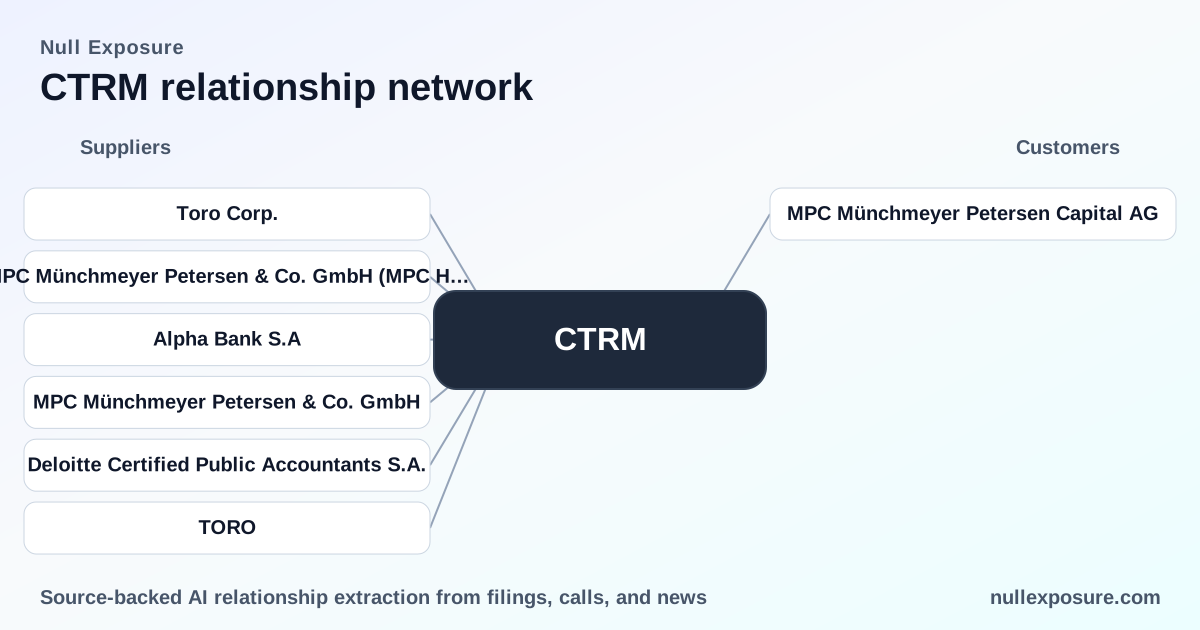
This dataset identifies two specific, material customer/transaction relationships disclosed in public reporting and press coverage: MPC Münchmeyer Petersen Capital AG (MPC Capital) and Toro Corp. Each relationship below is summarized in plain English with source attribution.
-
MPC Münchmeyer Petersen Capital AG: Castor reported that $9.0 million of services revenue for the three months ended March 31, 2025 was earned from the subsidiary acquired in late 2024, MPC Münchmeyer Petersen Capital AG. This confirms that the acquisition immediately contributed recurring services revenue in Q1 2025. Source: Castor Maritime Q1 2025 press release on GlobeNewswire (filed March 2025) — https://www.globenewswire.com/news-release/2025/08/11/3130996/0/en/Castor-Maritime-Inc-Reports-First-Quarter-Results-for-2025.html.
-
Toro Corp.: Castor completed the full redemption of its Series E Preferred Shares, selling those shares to Toro Corp. for $60 million, a transaction that both retired a class of preferred equity and delivered substantial liquidity through a third-party purchaser. This is disclosed in secondary reporting on corporate financing activity. Source: TipRanks report on Castor Maritime corporate actions (October 2025 reporting) — https://www.tipranks.com/news/company-announcements/castor-maritime-secures-50m-loan-and-redeems-preferred-shares.
Why these two items matter to investors
Both announcements change the composition of Castor’s cash flows and balance-sheet optionality. The MPC Capital acquisition converts part of Castor’s topline toward fee-based services, introducing a revenue stream separable from voyage rates. The Toro transaction is a discrete capital solution that removed preferred equity and replaced it with immediate cash consideration, improving liquidity and simplifying the capital stack.
- Revenue diversification: The $9.0 million of services revenue tied to the MPC Capital acquisition indicates Castor is supplementing voyage-related income with service fees that should be less cyclical than spot charter rates.
- Balance-sheet engineering: The $60 million purchase of Series E preferred shares through Toro Corp. is a large cash event that materially affects leverage and shareholder claims on assets.
For an expanded view of how these relationship dynamics integrate into Castor’s broader customer and financing posture, see NullExposure’s portal at https://nullexposure.com/.
Operating model constraints and company-level signals
The relationship records contain no explicit contractual constraint excerpts; that absence itself is instructive and should be treated as a company-level signal rather than a relationship-specific finding.
- Contracting posture: The public disclosures suggest an acquisitive, active contracting posture—Castor purchased a services subsidiary (MPC Capital) and executed a negotiated sale of preferred shares—indicating management prefers strategic transactions to organic-only growth.
- Concentration: Only two material counterparties are visible in the current relationship set, signaling limited public evidence of broad customer concentration but also highlighting that a small number of sizeable transactions can significantly influence cash flow.
- Criticality: Both relationships are material: services revenue tied to the acquired subsidiary is a definable revenue source, while the preferred-share redemption delivered a large, one-time liquidity movement; each relationship is therefore critical to near-term financial flexibility.
- Maturity and stability: The MPC Capital revenue is immediate post-acquisition income, suggesting early-stage integration rather than a long-matured customer contract; the Toro transaction is a discrete financing event rather than recurring business.
These signals together describe a company in active structural transition—adding fee-based services and revising capital structure—rather than a static shipping fleet operator.
Investment implications and risk profile
Investors should place a premium on governance disclosures and future reporting cadence because these transactions change the risk/return profile:
- Upside: Fee-based services provide revenue diversification versus freight-rate volatility; removing preferred claims potentially improves earnings available to common equity depending on how the proceeds are deployed.
- Downside: Acquisition integration risk and execution of capital redeployments are immediate concerns; a single large counterparty transaction can overstate sustainable revenue if it is transactional rather than recurring.
Monitor next quarterly filings for: (1) how MPC Capital revenues trend after initial reporting, (2) whether proceeds from the Toro transaction are used for deleveraging, fleet investment, or one-time distributions, and (3) any additional counterparties disclosed in future relationship reporting.
Practical next steps for research teams
- Validate recurring nature: Determine whether the $9.0 million services line is a recurring contract flow or a transitional integration item reported in Q1 2025.
- Follow cash deployment: Track the use of the $60 million proceeds from the Toro-related preferred-share redemption to assess leverage and capex strategy.
- Demand counterparty detail: Require the company to supply counterparty counts and revenue concentration metrics in investor communications to reduce transparency risk.
Bottom line
Castor Maritime is executing a strategy that combines traditional dry bulk operations with deliberate acquisitions and targeted capital-structure transactions; investors evaluating CTRM’s customer relationships should treat the MPC Capital services revenue and the Toro-funded preferred redemption as material events that alter both revenue composition and balance-sheet flexibility. For a consolidated view of these relationship signals and to monitor future updates, visit NullExposure at https://nullexposure.com/.