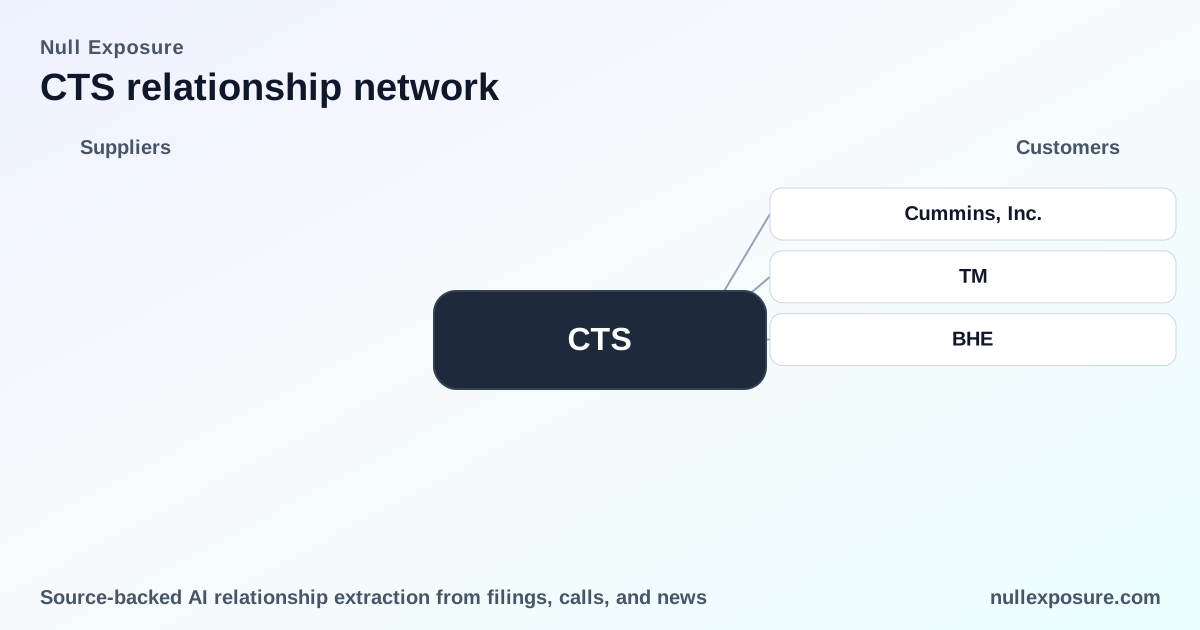
CTS customer relationships: practical intelligence for investors and operators
CTS Corporation manufactures sensors, actuators and connectivity components and monetizes primarily through the sale of hardware to OEMs, tier‑one suppliers and government customers, supported by a small licensing revenue stream. Its business is driven by long production programs, concentrated top customers, and a geographically diversified manufacturing footprint, which together create defined opportunity and measurable operational risk. For deeper counterparty intelligence on CTS and comparable suppliers, see https://nullexposure.com/.
The compact thesis: product sales, program economics, concentrated customers
CTS is a classic industrial components play: revenue is product-led and tied to platform life cycles rather than recurring software or services. The company reports licensing and royalties at less than 1% of net sales, while independent distributors account for a modest share of volume (about 6% in 2024). Two customers alone accounted for roughly a quarter of revenue in FY2024, which concentrates exposure to order variability from a small set of OEMs. Geographic diversification across North America, Asia and Europe supports resilience but does not eliminate customer concentration risk.
For a snapshot of CTS's market positioning and counterparty exposure, visit https://nullexposure.com/.
What the filings and press list as CTS customer relationships
Cummins, Inc.
Cummins is reported as a material customer, accounting for 11.7% of CTS's net sales in FY2024, per CTS’s 2024 Form 10‑K. This places Cummins among the handful of partners whose order patterns have outsized influence on CTS top‑line performance (CTS 10‑K, FY2024).
TM (inferred symbol)
The records include an inferred mapping to the ticker TM, which corresponds to Toyota Motor Corporation and is flagged in the same FY2024 10‑K disclosure. The entry reflects the same substantive disclosure recorded elsewhere in the filings (CTS 10‑K, FY2024).
Toyota Motor Corporation
Toyota is the single largest named customer in CTS’s disclosure set, representing 12.2% of net sales in FY2024 according to the company’s FY2024 Form 10‑K. Toyota’s proportion makes it a top-tier revenue driver for CTS and a focal point for supplier performance and program delivery (CTS 10‑K, FY2024).
Benchmark Electronics
CTS publicly divested its Electronics Manufacturing Solutions business to Benchmark Electronics in 2013 for $75 million, a transaction chronicled in industry press and company histories. The divestiture removed an EMS line of business and reflects strategic portfolio sharpening away from contract electronics manufacturing (Manufacturing‑Today, profile recounting FY2015 coverage of the 2013 sale).
BHE (inferred symbol)
An alternate entry maps Benchmark to the ticker BHE; the referenced press account repeats that the EMS business was sold to Benchmark for $75 million in 2013. This mirrored entry confirms the historical transaction and symbol mapping in third‑party coverage (Manufacturing‑Today, FY2015 recounting the 2013 sale).
Operating model constraints that shape commercial relationships
The company filings and evidence point to a set of operating characteristics that are critical to understand for any counterparty or investor assessment:
- Contracting posture: CTS sells into platform‑driven markets with long‑term program structures and purchase orders tied to vehicle/platform lifecycles, which create multi‑year demand profiles and program volume estimates.
- Revenue mix: Product sales dominate; licensing and royalty income is negligible (under 1% of net sales in 2024), so earnings are closely correlated to manufacturing volumes and margin on hardware.
- Customer concentration and criticality: A small number of OEMs account for a large portion of revenue (Toyota 12.2%, Cummins 11.7% in FY2024), making CTS sensitive to order swings from those partners. This is a structural exposure—positive when programs scale, negative when they contract.
- Channel composition: Independent distributors represent around 6% of net sales, indicating that CTS primarily sells direct to OEMs and tier‑ones rather than relying on broad channel distribution.
- Counterparty diversity: The customer base includes government and defense OEMs, alongside industrial and medical markets, adding contract and compliance complexity typical of suppliers that service regulated end markets.
- Geographic footprint: Manufacturing and sales span North America, APAC and EMEA, which mitigates single‑market shocks but brings currency, logistics and regional demand dynamics into operational planning.
- Business segment and maturity: CTS is a hardware‑manufacturing business operating as a single reportable segment; product life cycles and capital intensity are core to earnings variability.
These constraints are company‑level signals drawn from CTS’s own disclosures and industry reporting; they define how CTS negotiates program terms, manages working capital and allocates capital to manufacturing capacity.
Investment implications and risk checklist
Investors and operators should prioritize the following when evaluating CTS exposure:
- Concentration risk is real: With two customers representing roughly 23% of revenue, order volatility from OEMs drives quarter‑to‑quarter outcomes.
- Program economics matter more than short‑term demand signals: Long program lifecycles can produce predictable revenue ramps but also extend downside when programs end.
- Low licensing diversification: With licensing income under 1% of sales, CTS lacks a material recurring royalties stream to smooth product cycle swings.
- Geographic diversity is a mitigant, not a cure: Multiple regions reduce single‑market dependence but introduce operational complexity and foreign‑exchange exposure.
- Balance‑sheet sensitivity to manufacturing scale: Capital deployment into capacity and supply chain resiliency will be a continuing cash use as CTS supports OEM programs.
Bottom line
CTS is a manufacturing‑centric supplier whose value is driven by platform wins and program execution, with material revenue concentration among a small set of OEMs and a largely product‑sale business model. The 2013 sale of its EMS unit to Benchmark Electronics is a deliberate strategic narrowing toward core components manufacturing. For actionable counterparty and customer intelligence on CTS and peers, consult the integrated intelligence at https://nullexposure.com/.