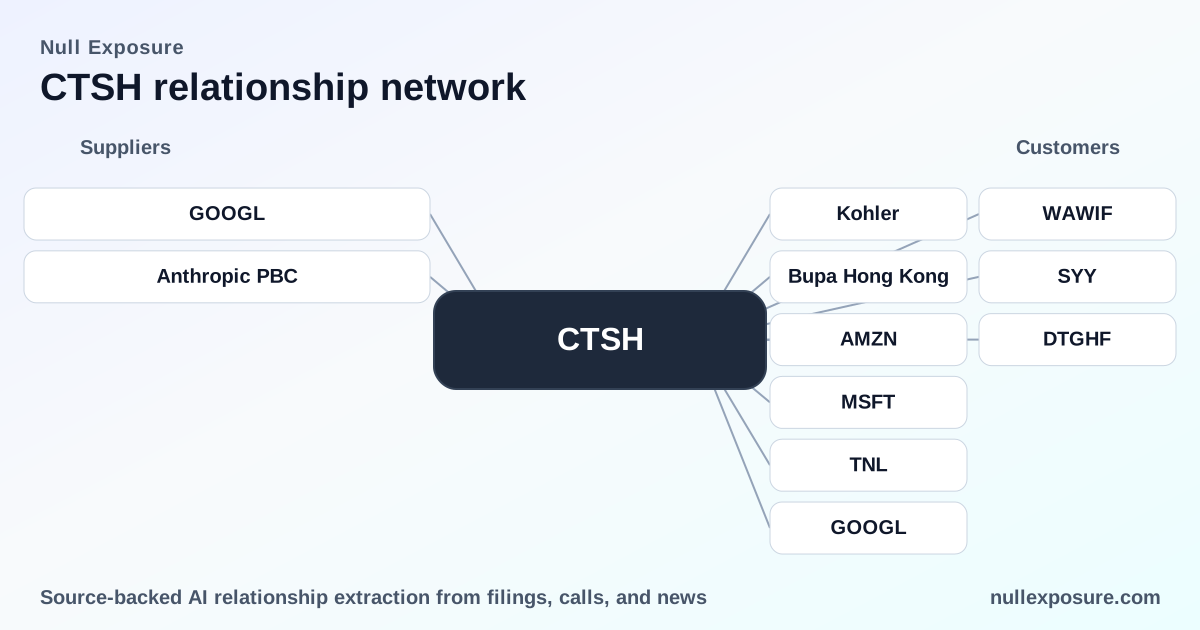
Cognizant (CTSH) — Customer Relationships That Drive Revenue and Execution Risk
Cognizant is a global professional services company that monetizes through long-term services contracts—consulting, application development, systems integration, infrastructure and security, and business process outsourcing (BPO)—with large enterprises and platform partners. Revenue comes from a mix of recurring managed services, program- and project-based fees, and expanding GenAI/BPO engagements that convert technical capability into multi-year contractual revenue streams.
For deeper customer relationship analytics, visit https://nullexposure.com/.
How Cognizant’s customer mix informs valuation and downside exposure
Cognizant’s operating model is built around industry-led, account-based selling and service delivery. The company routinely signs multiyear deals that become semi-anchored revenue streams; these contracts are service-heavy rather than product-licensed, which implies slower churn but also longer transition costs if a client leaves. The constraints on the data highlight several company-level signals:
- Geographic concentration: North America and Europe (EMEA) are the dominant revenue sources, creating exposure to regional economic cycles and regulatory shifts. Evidence in filings shows material revenue attribution to these regions.
- Seller role and services orientation: Cognizant acts as a seller of professional and managed services across consulting, applications, infrastructure, and BPO—this underpins predictable recurring revenue but requires sustained delivery capability.
- Mature contract posture and criticality: Services provided to large clients are frequently critical to operations and require extended transition periods, creating stickiness that supports revenue stability but raises execution risk if service quality degrades.
- Contract concentration and operational execution: Large enterprise and platform partnerships concentrate revenue and execution risk; dependence on a limited set of global clients and cloud partners amplifies both opportunity and vendor risk.
These characteristics justify a valuation that rewards stable cash flow from managed services but penalizes execution risk tied to client concentration and delivery quality.
Management-reported customer interactions — the primary evidence
Below I cover every customer mention pulled from the public results, with a concise summary and the source context.
-
Kohler — Management announced a multiyear expansion with Kohler, extending a five-year partnership into a broader engagement focused on kitchen and bath products modernization. Source: 2025 Q4 earnings call (March 8, 2026).
-
Bupa Hong Kong — Cognizant disclosed a new strategic collaboration to scale GenAI-led BPO for claims and fraud, waste and abuse detection, described as the company’s largest BPO win in the region. Source: 2025 Q4 earnings call (March 8, 2026).
-
AMZN (AWS) — Management stated that Cognizant maintains a partnership with AWS, reflecting cloud platform alignment that underpins multiple delivery models. Source: 2025 Q4 earnings call (March 8, 2026).
-
AWS — The same earnings-call comment reiterated the partnership with AWS, underscoring cloud provider dependence for infrastructure and solution delivery. Source: 2025 Q4 earnings call (March 8, 2026).
-
MSFT (Microsoft) — Cognizant confirmed an active partnership with Microsoft as part of its cloud and enterprise platform relationships. Source: 2025 Q4 earnings call (March 8, 2026).
-
Travel + Leisure Co. (TNL) — Cognizant renewed a strategic collaboration with Travel + Leisure on January 28, focusing on accelerating the client’s digital transformation and modernizing infrastructure; press coverage characterizes the deal as multi-million-dollar. Source: InsiderMonkey and Finviz reporting on the January 28, 2026 renewal (FY2026 news).
-
Microsoft (duplicate entry) — Management reiterated the Microsoft partnership during the same earnings call, confirming ongoing platform-level cooperation. Source: 2025 Q4 earnings call (March 8, 2026).
-
CNO Financial Group (CNO) — A Cognizant press release (Feb 22, 2024) announced an expanded technology operations partnership with CNO to enhance cloud, digital, and AI capabilities for CNO’s insurance operations. Source: Cognizant press release (Feb 22, 2024).
-
Pegasystems (PEGA) — Market coverage notes Pegasystems’ growing reliance on system integrators such as Cognizant to deliver and extend its platform capabilities, indicating Cognizant’s role as a go-to implementation partner. Source: TradingView / Finviz news summaries (FY2026).
-
Google Cloud (GOOGL) — Management noted active work with Google Cloud, signaling multi-cloud engagement and platform diversification. Source: 2025 Q4 earnings call (March 8, 2026).
-
Google Cloud (duplicate entry) — The earnings-call repeat confirms the Google Cloud engagement. Source: 2025 Q4 earnings call (March 8, 2026).
-
Travel + Leisure Co. (TNL duplicate) — Additional media outlets repeated the January 28 renewal coverage and emphasized the modernization focus of the extended collaboration. Source: InsiderMonkey / Finviz (FY2026).
-
Citizens Financial Group (CFG-P-E) — Public commentary (LinkedIn/analytics media) described Citizens selecting Hyderabad for a Global Capability Centre launched in collaboration with Cognizant, indicating local delivery and offshore capability deployment. Source: LinkedIn/Analytics India Magazine coverage (FY2025).
-
Wallenius Wilhelmsen (WAWIF) — A February 17, 2026 news release reported Cognizant providing strategic technology services covering core applications and infrastructure to support the shipping/logistics company’s integrated supply chain objectives. Source: SahmCapital news release (Feb 17, 2026).
-
Wallenius Wilhelmsen (duplicate) — Same SahmCapital item repeated; it reinforces the global logistics services relationship. Source: SahmCapital (Feb 17, 2026).
-
Cisco (inferred SYY) — Management referenced a transformation engagement, stating they are transforming a complex customer interaction ecosystem for Cisco into what they call "agentic capital," indicating a strategic CX and automation program. Source: 2025 Q4 earnings call (March 8, 2026).
-
Sysco (SYY inferred)** — The earnings-call excerpt used a phrase associating Cisco as “the global leader in food distribution,” creating an inferred mapping to SYY in the dataset; regardless, management described large-scale customer interaction modernization work. Source: 2025 Q4 earnings call (March 8, 2026).
-
Daimler Truck (DTGHF) — A February 24, 2026 announcement identified Cognizant as selected for a global AI-driven workplace services transformation for Daimler Truck, focused on AI, automation, human-centric design and governance. Source: SahmCapital news release (Feb 24, 2026).
-
Daimler Truck (duplicate) — The duplicate item reiterates the same global workplace transformation engagement and scope. Source: SahmCapital (Feb 24, 2026).
What investors should take from this relationship map
- Cloud partnerships are structural revenue multipliers and concentration risks: repeated references to AWS, Microsoft and Google Cloud show Cognizant leans on major cloud platforms to deliver services, which scales GTM but concentrates technical and commercial dependencies on those providers.
- Large-enterprise and BPO deals are compounding revenues: renewals (Travel + Leisure), expansions (Kohler, CNO), and major regional BPO wins (Bupa Hong Kong) demonstrate the company’s ability to extend and deepen accounts—supporting forward revenue visibility.
- Delivery execution is the gating factor: the company-level signal that services are critical and transitions are costly implies that operational lapses would have outsized revenue and reputational consequences.
- Geographic and client concentration elevate macro sensitivity: heavy exposure to North America and EMEA increases vulnerability to regional slowdowns or regulatory shifts.
Bottom line and next steps
Cognizant’s customer footprint combines sticky, mature services contracts with strategic cloud and platform partnerships that materially scale addressable revenue—but also concentrate execution risk in a handful of global clients and cloud providers. Investors should value Cognizant for stable managed-services cash flow while actively monitoring delivery metrics, renewal cadence, and concentration trends.
For a systematic view of customer relationships and updates, visit https://nullexposure.com/.
Bold takeaway: CTSH’s valuation premium should be driven by demonstrated renewal and delivery execution across its largest cloud and enterprise accounts; any deterioration in service quality or a material geopolitical shock in North America/EMEA will be evident quickly through changes in renewal behavior and contract disclosures.