Cytosorbents (CTSO): Commercial Relationships and What They Mean for Investors
Cytosorbents monetizes a single core medical device platform—CytoSorb, a blood‑purification cartridge—by selling devices through a mix of direct sales and exclusive distributor agreements around the world. Revenue is recognized at shipment, the commercial model is concentrated on one product line and on EMEA markets, and growth depends on scaling international distributor partnerships while rolling out new indications and products such as DrugSorb‑ATR. For deeper company profiling and relationship analytics, visit https://nullexposure.com/.
How Cytosorbents makes money — the operating model in plain English
Cytosorbents runs a classic medical‑device commercialization model: design and regulatory development are centralized, while selling and distribution are outsourced where local market access is strongest. The company is the product seller—shipping devices to hospitals and to an international network of distributors—and recognizes revenue when goods ship. That structure produces several predictable characteristics:
- Contracting posture: spot purchase orientation. The company fulfills orders on receipt and relies largely on purchase orders rather than long‑term revenue contracts, which limits backlog but accelerates cash conversion.
- Geographic concentration in EMEA with global reach. A significant portion of revenue flows from Europe (Germany highlighted in filings), while the product is distributed in more than 70 countries.
- Single‑product revenue concentration and maturity profile. CytoSorb represents substantially all product sales today, so commercial performance is tightly coupled to adoption in ICU and cardiac settings.
- Go‑to‑market ramping for new products. Management has signaled a staged direct sales build for DrugSorb‑ATR in North America, indicating a controlled, early‑stage commercialization posture.
These structural signals translate into high operational leverage to international distribution partners and sensitivity to single‑product demand and regulatory progress.
Direct and distributor relationships: the on‑the‑ground partners
Below are the active customer/distributor relationships surfaced in public reporting and press coverage. Each relationship is summarized in plain English with source references.
Terumo — exclusive cardiac procedure pack distribution in parts of Europe
Terumo holds exclusive rights to distribute the CytoSorb procedure pack for cardiac surgery in France, Sweden, Denmark, Norway, Finland and Iceland, establishing a focused channel for cardiac surgery applications in those markets (BioPharmaDive, FY2016: https://www.biopharmadive.com/news/cytosorbents-pushes-into-european-cardiac-market/427635/).
Takeaway: This exclusive arrangement secures targeted access into Nordic and French cardiac units via a recognized device distributor.
Aferetica Srl — long‑standing exclusive distributor in Italy
Cytosorbents renewed an exclusive distribution agreement with Aferetica Srl in Italy, extending a partnership that has lasted more than a decade and underpins Italian market coverage (Finviz news report covering ISICEM 2026 announcements, FY2026: https://finviz.com/news/338743/cytosorbents-announces-hotswap-launch-renewed-aferetica-partnership-and-new-clinical-evidence-at-isicem-2026).
Takeaway: Italy remains a stable revenue geography through a durable exclusive distributor relationship, reducing near‑term market risk there.
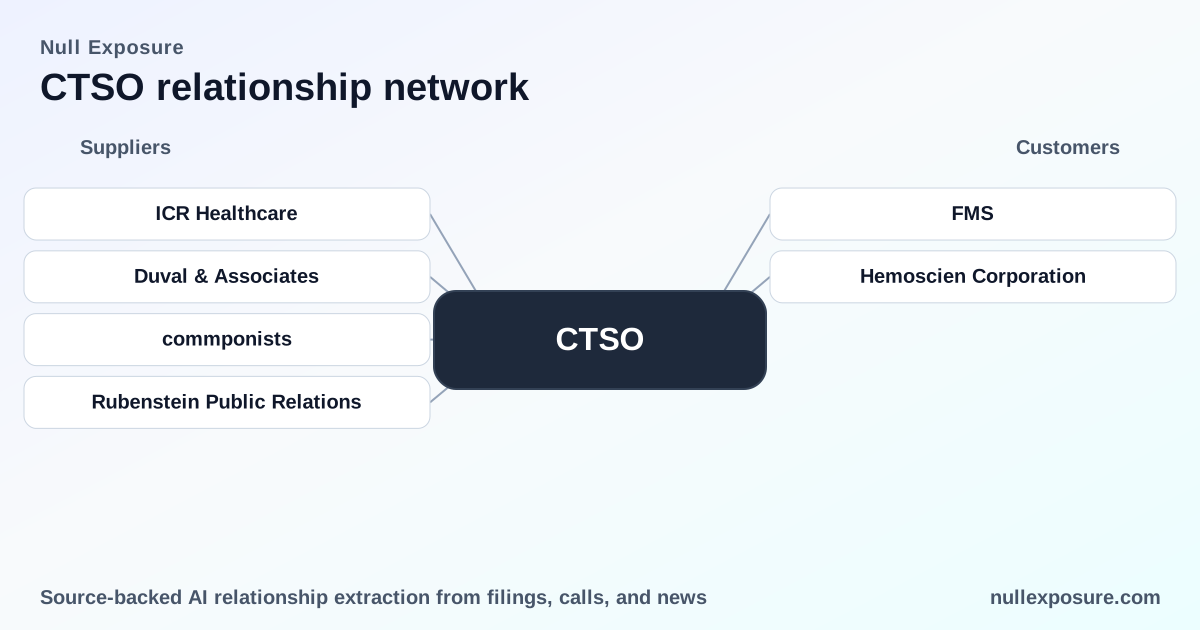
FMS — co‑marketing and sales leverage
Cytosorbents announced that new direct sales teams will leverage product registrations and co‑market alongside Fresenius Medical Care (FMC), with FMS called out in reporting as a partner in joint commercial efforts across several territories (PrincetonInfo, FY2019: https://www.communitynews.org/princetoninfo/business/fastlane/cytosorbents-expands/article_7f07f130-13dc-5800-b06e-8c37fbc3a247.html).
Takeaway: The FMS/FMC collaboration provides amplified field presence through co‑marketing rather than pure reseller arrangements, aiding adoption in targeted critical‑care markets.
Fresenius Medical Care — exclusive distributorship and co‑marketing in select countries
Fresenius Medical Care acts both as a co‑marketing partner and, in certain territories, an exclusive distributor (Czech Republic); it also focuses on France and Finland and is pursuing larger commercial opportunities in Mexico and Korea as part of joint efforts (PrincetonInfo, FY2019: https://www.communitynews.org/princetoninfo/business/fastlane/cytosorbents-expands/article_7f07f130-13dc-5800-b06e-8c37fbc3a247.html).
Takeaway: A relationship with a global dialysis and critical‑care player like Fresenius materially extends market access in core geographies and creates scale potential where Fresenius has existing hospital relationships.
Hemoscien Corporation — Taiwan distribution
CytoSorb is distributed throughout Taiwan by Hemoscien Corporation, giving Cytosorbents dedicated coverage in the Taiwanese market and a point of presence in Asia (Yahoo Finance press release, FY2024: https://finance.yahoo.com/news/cytosorbents-announces-regulatory-approval-cytosorb-110000859.html).
Takeaway: Local distribution in Taiwan supports penetration in APAC markets and diversifies geographic concentration modestly outside EMEA.
(For a consolidated view of these customer relationships and ongoing updates, visit https://nullexposure.com/.)
What this network implies for investors: risks and levers
- Channel concentration creates both leverage and vulnerability. The company’s reliance on exclusive distributors and co‑marketing partners accelerates access but concentrates counterparty risk; a small number of partners can significantly affect revenue flows in key countries.
- Spot contracting reduces backlog risk but increases revenue volatility. Filings indicate orders are fulfilled on receipt and purchase orders are the typical contract form, which means no significant sales backlog and revenue that is responsive to short‑term demand swings.
- Product concentration raises dependency on adoption and approvals. CytoSorb has driven nearly all product sales historically; the company’s growth depends on broader clinical acceptance and successful rollouts of adjacent products like DrugSorb‑ATR, which management plans to ramp in a controlled manner.
- EMEA is the commercial engine, with global expansion incremental. Public filings highlight Europe—Germany in particular—as a major revenue source, while device registration in 70+ countries gives a path to diversify, albeit slowly.
- Financial profile amplifies operational execution. Latest trailing twelve‑month revenue is roughly $37.1M with gross profit of $26.5M, but the company remains unprofitable on an operating basis (negative operating margin), underscoring the need for scalable sales productivity and disciplined expense control before profitability stabilizes.
Bottom line for investors and operators
Cytosorbents’ commercial strategy is distribution‑centric, EMEA‑anchored, and product‑focused. The network of exclusive distributors and co‑marketing partners—Terumo, Aferetica, FMS/Fresenius Medical Care, and Hemoscien—delivers targeted access into cardiac and critical‑care channels but concentrates commercial risk. Investors should weigh the upside of low‑cost geographic expansion through partners against the downside of spot contracts and single‑product dependence.
For ongoing coverage of CTSO customer relationships and comparable company commercial footprints, see our analysis hub at https://nullexposure.com/.