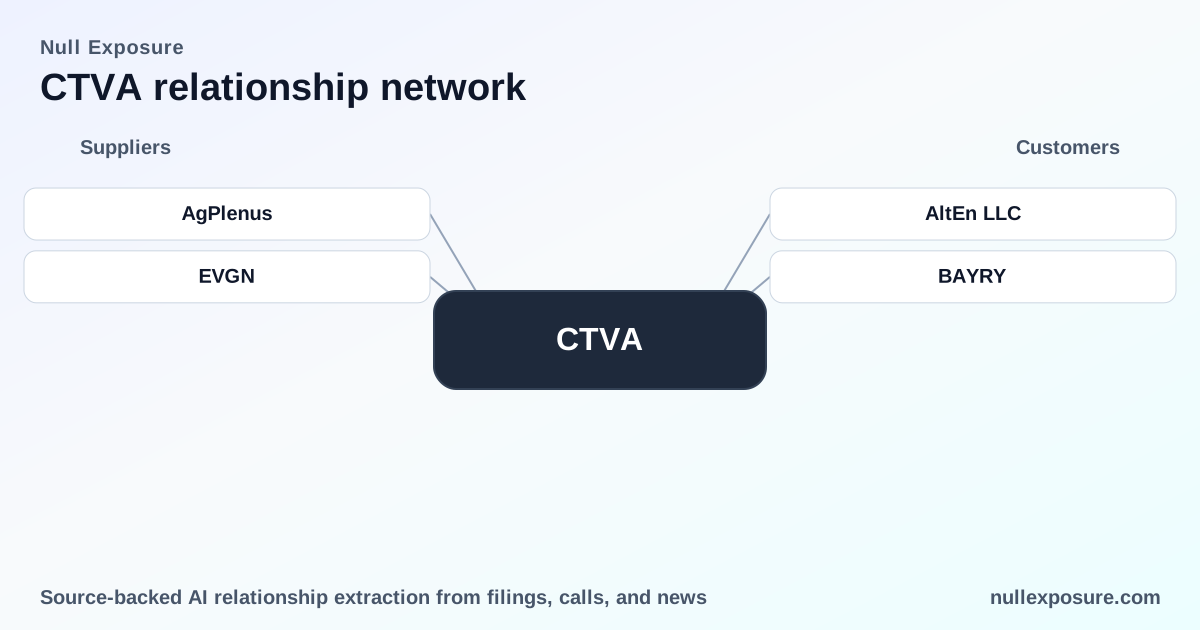
Corteva Inc (CTVA): Customer relationships that shape revenue and risk
Corteva is a global seeds and crop protection company that monetizes through product sales to farmers, distributors and manufacturers, and through intellectual-property licensing that generates sales-based royalties. The business is vertically broad—core seeds and crop protection drive the bulk of revenue while digital tools and out-licensing supplement margins—giving investors exposure to commodity cycles, royalty economics, and a diversified geographic footprint. For a structured view of Corteva’s customer ties and counterparty risk, see NullExposure.
Why commercial relationships matter for Corteva’s valuation
Corteva’s income statement is dominated by physical product sales but licensing and royalties are accelerating as a second, high-margin growth vector, altering the cashflow profile and forward multiple dynamics. Product revenue flows through classic short-term trade terms—orders to delivery within a year—while strategic licensing deals stretch revenue visibility beyond single seasons. The company’s global sales mix (North America ~52%, Latin America ~22%, EMEA ~18%, APAC ~8%) concentrates commercial risk in major grain and oilseed markets, so counterparty exposures in regions such as Brazil and Argentina are economically meaningful.
- Contract posture: The company operates both short-term transactional contracts for seed and crop inputs and multi-year licensing arrangements that produce recurring royalty streams, as described in Corteva’s 2025 Form 10‑K.
- Concentration & scale: Accounts payable and accrued discounts/rebates (>$1.3bn component) show large-scale supplier and channel settlement activity, implying individual counterparty spend can exceed $100m across the supply chain.
- Criticality & maturity: Seed and crop protection products are core to farmer operations—this is a mature, mission-critical relationship model that translates to sticky demand in key geographies.
- Product mix: Core physical products remain the revenue engine, while digital solutions and IP licensing are strategic complements that lift margins and create royalty upside.
If you want a deeper mapping of customer relationships and supplier concentration, visit NullExposure for structured analysis tools.
The counterparties listed in Corteva’s disclosures
Below I cover every relationship flagged in the public results for Corteva’s customer scope. Each entry is a concise, plain-English take with the supporting source noted.
AltEn LLC — remediation-party customer relationship
Corteva is named as one of six seed companies that were customers of AltEn LLC and participated in the Nebraska Department of Environment and Energy’s Voluntary Cleanup Program to address interim remediation at the AltEn site, indicating a shared environmental remediation responsibility among seed-sector customers. This disclosure is in Corteva’s 2025 Form 10‑K filing (FY2025) and highlights legacy remediation exposure tied to a third‑party contractor relationship. (Source: Corteva 2025 Form 10‑K, filed FY2025.)
Bayer (BAYRY) — licensing partner delivering royalty income
Market reporting described a transformative Bayer licensing agreement that accelerates Corteva’s royalty income and improves 2026 visibility, positioning royalties and operating leverage as key earnings drivers for the year. News coverage highlighted record EBITDA growth and margin expansion, crediting the Bayer licensing arrangement for strengthening forward revenue streams. (Source: news analysis on Tikr, March 9, 2026.)
What those counterparties imply for investors
- Environmental and reputational risk is shared among seed-sector customers: The AltEn remediation note is not a supplier‑payment line item; it is a joint cleanup program that creates contingent obligations and reputational scrutiny across seed companies that were customers at the site. The remediation framework suggests multi-party cost‑sharing and regulatory oversight as the resolution path (company 10‑K).
- Licensing deals change the revenue profile: The Bayer arrangement is emblematic of Corteva’s strategic push to monetize IP through licensing, converting product capabilities into recurring, royalty‑style cash flow with higher margin characteristics (news and company licensing disclosures).
Operating-model constraints that shape customer risk
These are company-level signals drawn from Corteva’s own disclosures that influence how counterparty relationships behave:
- Licensing is material: Corteva explicitly states it enters into IP licensing arrangements and that most IP license revenue is sales-based royalties, which ties licensing income to partner sales performance (company 10‑K).
- Short- and long-term contracts coexist: The company treats standard product sales as short‑term performance obligations (order to satisfaction within one year) while maintaining some multi-year contracts for strategic relationships and licensing (company 10‑K).
- Global footprint drives region-specific exposure: The company attributes sales across North America, Latin America, EMEA and APAC with North America being ~52% of net sales—this concentrates economic exposure in a few geographic markets and creates outsized sensitivity to agricultural cycles in those regions (company 10‑K).
- Role diversity across the value chain: Corteva operates in multiple relational roles—seller, manufacturer, distributor partner, licensor and licensee—so counterparty risk must be evaluated both as customers and channel partners (company disclosures).
- Scale of trade liabilities signals large counterparty spend: Reported accounts payable and accrued rebates in the billions imply counterparty spend bands frequently exceed $100m, making major customers and suppliers material to working capital dynamics (company 10‑K).
Investor takeaways and monitoring checklist
- Royalty acceleration is a structural positive: If licensing income continues to scale—especially through large partners such as Bayer—expect margin upside and multiple expansion driven by recurring revenue characteristics.
- Monitor remediation and contingent liabilities: The AltEn participation underscores environmental remediation as a non-operational but material factor; track regulatory filings and cleanup cost allocations.
- Watch regional crop cycles: With more than half of sales in North America and significant exposure to Latin America, crop yields, planting intentions and regional policy shifts will move near-term revenue and royalties.
- Track accounts payable trends and rebate accruals: Quick changes in trade liabilities can signal pressure in channel economics or shifts in discounting and rebate programs that affect net realized pricing.
Final thought
Corteva combines a large, defensible product business with an increasing stream of licensing royalties, creating a hybrid operating model that benefits from both commodity exposure and recurring IP income. For investors assessing counterparty and customer risk across those revenue streams, the company’s 2025 filings and recent licensing announcements provide the primary signals you need to model upside and downside scenarios. Further breakdowns and counterparty maps are available at NullExposure.