CTW Cayman: Content distribution operator turning partner titles into recurring monetization
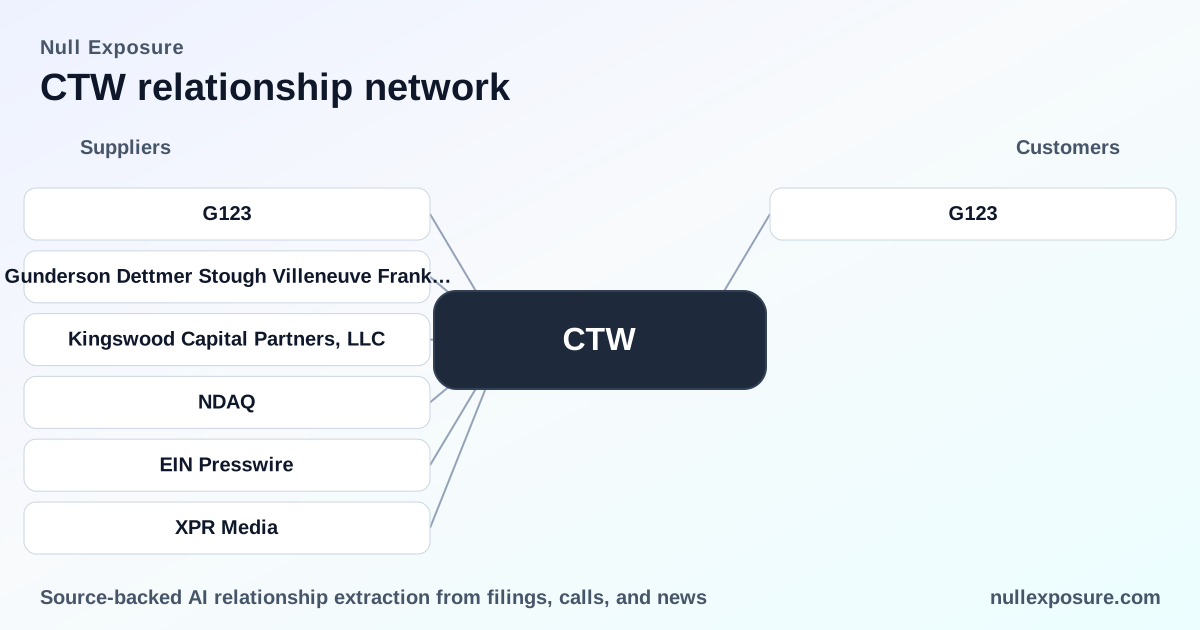
CTW Cayman (CTW) operates as a content publisher and distributor through its Tokyo subsidiary CTW Inc., monetizing primarily by launching third‑party game titles on its platform and capturing revenue from player spend, distribution fees, and platform economics. Repeated launches of G123 titles across FY2025–FY2026 position CTW as a strategic localized publisher for that partner, while corporate ownership structure and limited public float concentrate control. For institutional readers evaluating customer relationships, the following is a focused read on CTW’s G123 engagement and what it signals about the company’s operating and financial posture. Learn more at https://nullexposure.com/.
How CTW’s operating model converts partner content into revenue
CTW’s business model is content‑centric: the company signs publishing and distribution arrangements with game studios and platforms, localizes and markets titles, and captures a share of in‑game transactions and subscription or ad revenue. Revenue is therefore tied to the cadence and commercial success of partner launches rather than legacy telecom cash flows. Financials show modest scale—Revenue TTM roughly $90.4m with gross profit of $68.3m—but operating margin and EBITDA are constrained (negative operating margin TTM and an EV/EBITDA multiple that implies elevated valuation vs. cash profitability). These metrics reflect a company still monetizing growth through content rollouts rather than stable operating cash flow.
The G123 relationship: repeated launches, single partner concentration
CTW’s customer-scope feed identifies multiple announcements tied to a single counterparty: G123. The pattern is explicit — CTW Inc. repeatedly launches G123 titles on its distribution channels across FY2025 and FY2026. Each item below is presented with a plain-English summary and the original source.
My Status as an Assassin Obviously Exceeds the Hero's Shadow Break — launch announcement
CTW Inc. publicly launched G123’s game "My Status as an Assassin Obviously Exceeds the Hero's Shadow Break" as promoted by G123, indicating CTW handled distribution for the title in the Japanese market. Source: G123 press release, March 9, 2026 (g123.jp/news/article/293126).
Demon Lord, Retry! R Reborn — title rollout
CTW Inc. announced it had launched G123’s "Demon Lord, Retry! R Reborn," reinforcing CTW’s role as a recurring publisher for G123 games on its platform and marketing channels. Source: G123 press release, March 9, 2026 (g123.jp/news/article/263174).
Miss Kobayashi's Dragon Maid Fantasia — scheduled and then launched
G123 communicated that CTW Inc. would launch — and subsequently launched — "Miss Kobayashi's Dragon Maid Fantasia" (official launch noted for 2026/01/30), showing CTW’s involvement in both scheduling and executing title rollouts. Source: G123 press releases, January 30 and March 9, 2026 (g123.jp/news/article/413081 and g123.jp/news/article/413078).
Doraemon Comic Traveler — MarketScreener pickup with lock‑up note
A MarketScreener article dated May 2, 2026 reported CTW Inc. announced "Doraemon Comic Traveler" coming soon to G123 CI and also referenced a lock‑up covering 48,000,000 Class A ordinary shares that expires on February 2 (reported context within the same article). This item signals both another G123 deployment and public attention to share supply dynamics. Source: MarketScreener news pickup, May 2, 2026 (marketscreener.com/news/...).
These five items collectively show a concentrated, repeatable commercial relationship with G123 spanning at least FY2025–FY2026 and multiple title classes (licensed IP, anime tie‑ins, and new IP).
What the G123 pipeline implies about contracting posture, concentration, criticality, and maturity
- Contracting posture: The cadence of launches suggests CTW executes partner publishing agreements and short‑to‑medium term title launches rather than one‑off distribution experiments. This is a service‑driven, commercial contracting posture focused on go‑to‑market execution and title monetization.
- Concentration: The feed is dominated by a single partner (G123). Content concentration creates upside if titles succeed, but also dependency risk if a partner shifts distribution strategy.
- Criticality: For CTW’s revenue profile, partner launches are core drivers; content deals with G123 are operationally critical because they populate CTW’s revenue pipeline and user engagement funnels.
- Maturity: Repeated launches over consecutive reporting periods indicate an established operational relationship rather than an ad‑hoc trial; this suggests CTW has built repeatable localization, marketing, and deployment processes for the partner’s titles.
Note: the customer‑scope constraints feed returned no explicit contractual constraints to parse; company‑level signals below supplement that absence.
Company‑level signals investors should weigh
- Ownership and float concentration: Insider ownership is extremely high (reported ~95.24% insiders) with essentially negligible institutional ownership (0.032%). Control is tightly held and public float is limited — governance and liquidity considerations are material for large investors.
- Valuation vs. profitability: Trailing PE is around 47.3 while EV/EBITDA sits over 40x with negative operating margin. The market prices growth and title pipeline execution rather than stable EBITDA.
- Scale and growth: Revenue TTM ~$90.4m with year-over-year top‑line growth flagged in the overview; gross profit is strong relative to revenue but operating leverage is not yet realized.
- Share dynamics: Public reporting picked up a significant lock‑up (48m Class A shares expiring on Feb 2 as noted in MarketScreener), a factor that compresses available liquidity pre‑expiry and can influence supply dynamics upon release.
Investment implications — concise takeaways
- Signal of a core commercial partner: The G123 relationship is a repeatable revenue source and operational priority for CTW; investors should model revenue sensitivity to the performance and release cadence of G123 titles.
- Concentrated counterparty exposure: The visible customer feed shows concentration risk — a change in the G123 relationship would have outsized impact on near‑term content flow and monetization.
- Liquidity and control risk: Extremely high insider ownership and a small public float combined with reported lock‑up coverage create liquidity constraints and governance concentration that are relevant to position sizing and exit planning.
- Valuation reflects growth expectations: Current multiples imply the market expects continued successful title launches; given negative EBITDA, those expectations must be validated by future monetization outcomes.
If you want a structured, repeatable view of CTW’s customer relationships and how they affect risk/return, review the raw relationship timeline and lock‑up context on our platform: https://nullexposure.com/.
Final view
CTW is executing a content‑distribution playbook: it monetizes partner titles and has established a visible pipeline with G123 across FY2025–FY2026. That positioning creates clear upside if titles scale, but investors must underwrite counterparty concentration, tight insider control, limited float, and a valuation premised on future title success. For analysts and operators building revenue scenarios, model both title success probabilities and governance/liquidity constraints before sizing exposure.