CubeSmart (CUBE): Customer Relationships Drive a Service-First Self‑Storage Model
CubeSmart operates and monetizes as a self-administered, self-managed real estate investment trust focused on owning, operating, developing and managing self‑storage properties across the United States. The company generates recurring revenue primarily through month‑to‑month rental contracts and management fees, and supplements cash flow with selective property dispositions and joint‑venture partnerships where CubeSmart provides operating expertise. For investors assessing counterparty risk and operating leverage, CubeSmart’s customer base is highly diversified and short‑term in nature, while its third‑party partnerships reflect a conscious capital‑light expansion strategy. Learn more at https://nullexposure.com/.
The investment thesis in one line
CubeSmart is a service‑oriented REIT that converts a high‑touch retail offering—individual, month‑to‑month storage rentals—into predictable, fee‑dense cash flow and scales its platform by managing third‑party capital and co‑investment vehicles where management fees and operating margins capture value.
How CubeSmart’s customer relationships shape the business model
CubeSmart’s operating model is defined by a few clear characteristics that matter to investors:
- Short‑term contracting posture: Rental contracts are predominantly month‑to‑month, which produces resilient but variable cash flow and requires active customer acquisition and pricing management.
- High customer diversity and low concentration risk: No single tenant dominates revenue, so top‑line risk is distributed across thousands of individual lessees.
- Service criticality and platform leverage: CubeSmart’s operating platform—on‑site operations, pricing, and asset management—is the core product sold to partners in JV structures, making the company a critical service provider to investment partners.
- Mature, active relationships with institutional partners: CubeSmart increasingly monetizes management capabilities through joint ventures with institutional asset managers, a semi‑mature strategy that supports fee growth and asset recycling.
These operating constraints translate into a business where same‑store revenue and operating margins depend more on pricing and occupancy dynamics than on long‑term lease lock‑ins, and where management fees provide higher‑margin, countercyclical revenue in partnerships.
Who CubeSmart is transacting with — the relationship map
Below I cover every relationship surfaced in public reporting and media referenced in the results set, with a concise, investor‑oriented takeaway and a source.
Artelo Biosciences (ARTL)
CubeSmart is referenced as the vehicle through which Bartosz Lipiński will provide technical advisory and partnership services for Artelo’s Solana treasury strategy, indicating Cube’s use beyond real estate into digital treasury activities. This linkage is disclosed in a GlobeNewswire release from March 2026 announcing Artelo’s treasury initiative. (GlobeNewswire, March 2026)
Mangoceuticals (MGRX)
Mangoceuticals signed a Master Services Agreement to access Cube’s digital asset platform—specifically an MPC wallet—and to receive discretionary management of Solana tokens for a subsidiary, showing Cube operates a digital‑asset service line in addition to storage operations. (TradingView report, March 10, 2026)
NXDT‑P‑A (reference to Extra Space Storage and CubeSmart)
A financial news summary citing EDGAR filings lists CubeSmart alongside national operators such as Extra Space Storage when describing property management for self‑storage assets, underscoring CubeSmart’s market role as an industry operator and manager. (ADVFN/EDGAR summary, originally reported 2022; cited May 2026)
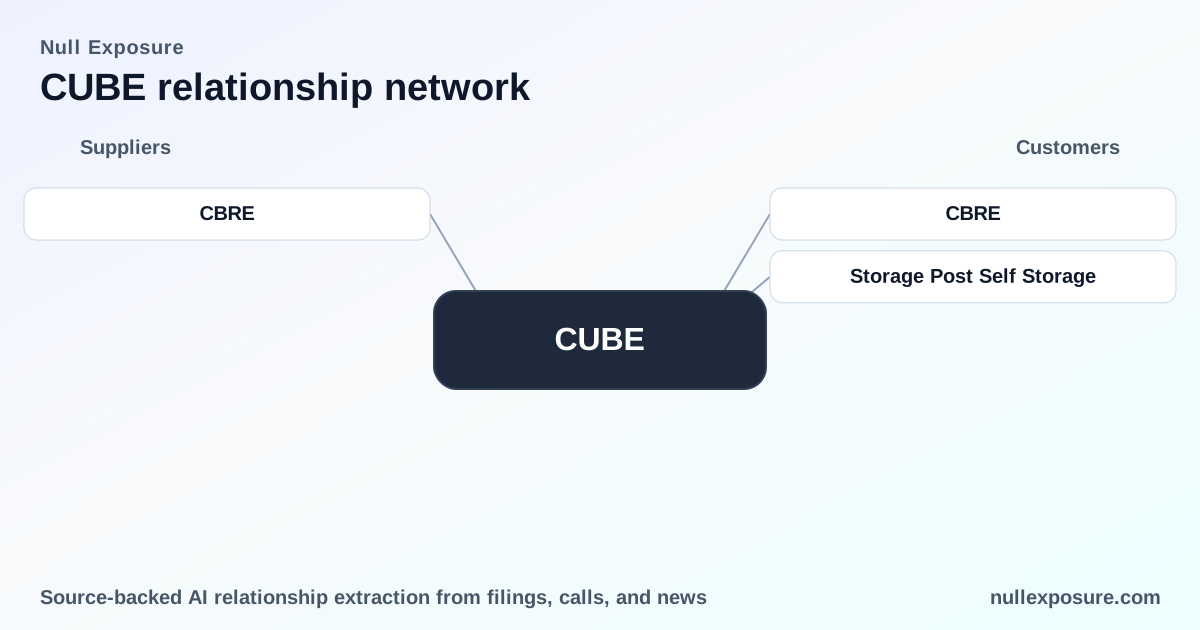
CBRE
CubeSmart formed a strategic joint venture with CBRE Investment Management to acquire self‑storage assets and will manage those properties on behalf of the venture, revealing an institutional partnership that scales CubeSmart’s operating platform without requiring full equity ownership of all assets. The JV’s first acquisition was a Phoenix property as the opening investment of a US$250 million venture. (GlobeNewswire press release, February 3, 2026; MyChesco coverage, March 2026)
CBRE Investment Management
As the capital partner in the new joint venture, CBRE Investment Management provides third‑party equity while CubeSmart supplies operational management; CubeSmart’s Q1 2026 earnings confirmed the JV acquired a store for $13.6 million and that CubeSmart will manage the stores on behalf of the venture. This relationship highlights CubeSmart’s capital‑efficient growth strategy through fee income and realized operating efficiencies. (CubeSmart Q1 2026 results, April 30, 2026; GlobeNewswire, February 2026)
Storage Post Self Storage
Storage Post acquired a Plainview, New York facility from CubeSmart, indicating CubeSmart continues to execute property dispositions as part of portfolio optimization and recycling capital back into higher‑growth or JV opportunities. (MarketScreener note, March 2026)
What these relationships mean for investors
CubeSmart’s public relationships fall into two clusters: retail end‑users (individual lessees) that deliver recurring rental revenue, and institutional partners that buy scale and operational expertise from CubeSmart. The first cluster drives occupancy and short‑term revenue volatility; the second converts CubeSmart’s operational advantage into higher‑margin, recurring management fees and a vehicle for asset recycling.
- Contracting posture: Month‑to‑month leases create revenue elasticity—advantageous in inflationary pricing regimes but requiring active yield management.
- Concentration and materiality: Revenue is highly fragmented across individual customers, so counterparty concentration is immaterial at the company level.
- Criticality: CubeSmart’s platform is mission‑critical to JV partners; its ability to operate and scale properties is the proximate source of management fees and performance incentive earnings.
- Maturity of relationships: CubeSmart has both mature retail operations and developing institutional partnerships, demonstrating a dual revenue stream that balances retail stability with fee expansion.
If you want a concise dashboard of relationship exposure and the underlying operating signals, visit https://nullexposure.com/ for a structured investor view.
Key takeaways for active investors
- Platform‑led growth: CubeSmart’s path to enhanced margins is through scaling management agreements and joint ventures where it captures operating upside without full balance‑sheet exposure.
- Revenue resilience with operational risk: Short‑term tenant contracts provide pricing flexibility but necessitate active operational execution to preserve occupancy and yield.
- Capital recycling visible in dispositions: Sales such as the Plainview transaction demonstrate disciplined portfolio management that funds JV participation and targeted acquisitions.
CubeSmart’s customer and partner mix positions it as a service‑driven REIT that leverages operational expertise to monetize both individual customers and institutional capital, and investors should evaluate occupancy trends and JV fee growth as the primary drivers of near‑term performance.