Cue Biopharma: Partnered Revenues and Strategic Licensing Define Near-Term Value
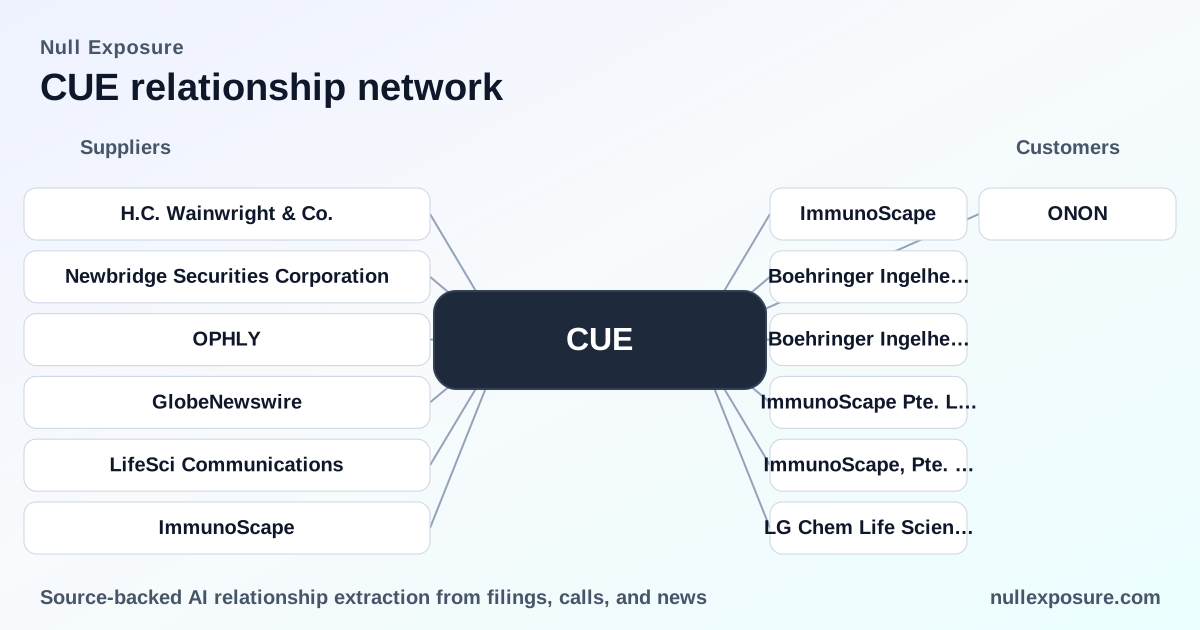
Cue Biopharma develops immune-engaging biologics and monetizes through strategic collaboration and license agreements that deliver upfront payments, research funding, and milestone receipts tied to partner development decisions. Revenue visibility is partner-driven rather than product-sales driven, with recent deals—most notably with Boehringer Ingelheim and ImmunoScape—providing near-term cash inflows and validation of Cue’s Immuno-STAT platform. For a focused look at partner exposure and how it shapes Cue’s operating risk, see our platform: Null Exposure homepage.
Why partners are the engine of Cue’s financial runway
Cue operates as a clinical-stage biotech whose commercial economics hinge on third-party collaborations. Upfront fees, equity stakes and milestone payments substitute for product revenues while clinical assets mature. That model concentrates counterparty credit and milestone timing risk but also accelerates de-risking if partners exercise options or select leads. Cue’s public disclosures and press releases over 2025–2026 confirm this partner-centric cash strategy.
Boehringer Ingelheim — a commercial-scale license and milestone stream
Cue signed a strategic research collaboration and license with Boehringer Ingelheim to develop CUE-501 for autoimmune diseases, under which Cue received a $12 million upfront payment and research support in 2025 and is eligible for further milestones. Most recently, Boehringer triggered a $7.5 million preclinical milestone following selection of a compound for lead optimization, demonstrating the deal’s near-term cash contribution. (GlobeNewswire press release, April 14, 2025; company press release and coverage, April–May 2026.)
ImmunoScape — equity stake plus phased upfronts for oncology work
Cue granted ImmunoScape exclusive licenses to certain Immuno-STAT molecules for oncology and received a $15 million total upfront arrangement plus a 40% equity stake in ImmunoScape as part of a seed-and-boost approach combining Cue’s CUE-100 series with ImmunoScape’s TCRs. Cue collected $9.5 million net of withholding taxes in Q4 2025 and remains entitled to an additional $5.0 million in November 2026, marking ImmunoScape as a strategically material partner that also ties Cue to equity upside. (GlobeNewswire announcement, November 6, 2025; Cue 2025/Q4 financial disclosures, March 2026.)
Ono (ONON) — previous collaboration affecting revenue timing
Cue’s Ono Collaboration and Option Agreement influenced revenue recognition between 2024 and 2025, with management citing timing differences in collaboration revenue as a driver of year-over-year changes reported in Q3 2025 results. This indicates Cue’s revenue volatility is sensitive to when partner milestones and billings occur. (GlobeNewswire: Q3 2025 financial results, November 12, 2025.)
LG Chem Life Sciences — trial conductorship and global development linkage
LG Chem Life Sciences obtained FDA clearance for a Phase 1 study of CUE-102, with Cue acting as the U.S. trial partner conducting the clinical work on specified solid tumors, which ties Cue operationally to a third-party sponsor’s program progression. This relationship signals Cue’s role as an executing partner on externally sponsored trials, exposing it to clinical execution responsibilities and related timelines. (Korea Economic Daily / KEDGlobal coverage, May 2022.)
How these relationships aggregate into a corporate operating posture
No explicit contractual constraints were provided in our source set; therefore treat the following as company-level operating signals:
- Contracting posture: Cue’s agreements emphasize licensing, research funding and milestone payments rather than co-commercialization or manufacturing obligations, reflecting a partner-funding model that preserves capital but cedes certain downstream economics in exchange for near-term cash.
- Concentration: A small set of large collaborations—Boehringer Ingelheim and ImmunoScape in particular—drive material revenue and cash receipts, creating concentration risk if either partner delays decisions.
- Criticality: Partners are critical to Cue’s near-term liquidity, since milestone payments and upfronts account for the bulk of non-dilutive financing into reported periodic results.
- Maturity: Agreements are early- to mid-stage: research licenses and preclinical/lead optimization milestones dominate, so value realization is binary and event-driven over the next 12–24 months.
What each partner relationship implies for investors
- Boehringer Ingelheim: The $12M upfront plus the subsequent $7.5M milestone demonstrates a tiered, performance-linked revenue stream; positive partner decisions materially improve Cue’s cash position and validity of its autoimmune program. (GlobeNewswire/press coverage, 2025–2026.)
- ImmunoScape: The combination of upfront cash, staged payments and a 40% equity stake aligns Cue to both near-term receipts and potential upside from ImmunoScape’s program success; this is strategic diversification into oncology with retained upside through ownership. (GlobeNewswire and company filings, late 2025–Q4 2025.)
- Ono: Historical revenue timing from Ono underscores quarterly revenue volatility and dependency on partner billing schedules rather than recurring product sales. (Q3 2025 financial report, GlobeNewswire.)
- LG Chem Life Sciences: Serving as the clinical partner for CUE-102 trials connects Cue operationally to sponsor-driven trial timelines and regulatory sequencing in international programs. (KEDGlobal, 2022.)
Midway through an evaluation of Cue’s partner profile, investors typically want actionable monitoring signals — milestone notices, cash receipts, and partner option exercises are the most relevant. For an ongoing feed of partner-event signals and exposure mapping, visit Null Exposure homepage.
Risk calibration and investment implications
Cue’s partner-led model produces high event sensitivity: capital runway and headline results depend on partner-triggered cashflows and licensing decisions. That translates into a binary return profile where positive partner actions (milestones, exercised options) de-risk the equity rapidly, while delays increase cash burn and potential dilution. Investors should track each partner’s decision calendar and the company’s disclosed receipts closely.
Bottom line
Cue Biopharma is not a traditional product-commercializing firm; it is a collaboration-first clinical-stage biotech whose near-term valuation drivers are partner agreements and milestone events. Boehringer Ingelheim and ImmunoScape constitute the most consequential relationships for revenue and strategic positioning, while Ono and LG Chem illustrate the company’s revenue timing and clinical execution exposures. For investors focused on event-driven biotech opportunities, Cue’s profile offers concentrated upside that is directly convertible into balance-sheet improvements as partners meet development milestones.