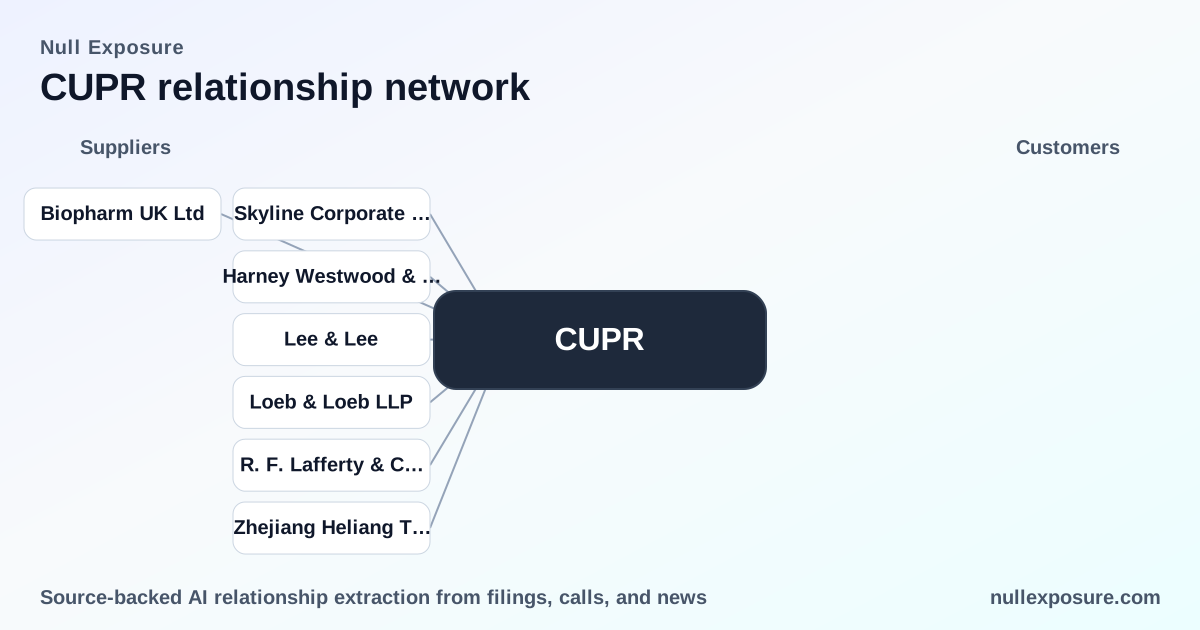
Cuprina Holdings (CUPR): a small medical-waste play with exploration-stage commercial ties
Cuprina Holdings develops and commercializes wound-management and medical-recycling technologies and monetizes through product sales and strategic integrations of its recycling technology into waste-management workflows. The company trades at a micro‑cap valuation relative to negligible trailing revenue and carries significant execution risk until pilot integrations convert to recurring contracts. For a concise source of tracked customer relationships and signals on counterparties, visit https://nullexposure.com/.
The investor thesis in one paragraph
Cuprina is an early‑stage healthcare technology company that sells wound-care products and licenses a medical-waste recycling process intended for integration with existing waste‑treatment operators. Revenue to date is limited and loss-making: trailing twelve‑month revenue is roughly $49.9k with negative EBITDA, so near‑term valuation is driven by optionality around commercialization of its recycling technology rather than current cash flows. Investment upside requires successful, contractual rollouts of the recycling solution with industrial waste handlers; downside stems from limited scale, dependency on pilot conversions, and tight capital markets access.
Why the SBS memorandum matters for CUPR’s commercialization path
Cuprina’s public disclosure highlights a strategic step of converting technology into an industrial workflow rather than merely selling hardware. The disclosed Memorandum of Understanding (MOU) with a Singapore medical‑waste treater signals a route to operational validation in a regulated environment, which would accelerate sales cycles if the partner transitions from MOU to paid implementation. An MOU is not a revenue contract: it establishes intent and technical collaboration but does not guarantee recurring income.
Documented customer relationships (every recorded result)
-
Cuprina announced a Memorandum of Understanding with Singapore Biowaste Solutions Pte Ltd (SBS) to explore integrating Cuprina’s medical‑waste recycling technology into SBS’s waste‑management facility in Singapore, indicating an exploration-stage commercial relationship. Source: GlobeNewswire press release, December 9, 2025 (English/France feed) — https://www.globenewswire.com/fr/news-release/2025/12/09/3202369/0/en/Cuprina-Holdings-Cayman-Limited-Announces-Financial-Results-for-the-Six-Months-Ended-June-30-2025-and-Strategic-Initiatives-for-2026-Growth.html.
-
The same GlobeNewswire announcement was distributed via a German feed that repeats the MOU disclosure with SBS; this duplicate coverage confirms the company’s public communication strategy to promote the SBS collaboration to multiple regional audiences. Source: GlobeNewswire press release, December 9, 2025 (German feed) — https://www.globenewswire.com/de/news-release/2025/12/09/3202369/0/en/Cuprina-Holdings-Cayman-Limited-Announces-Financial-Results-for-the-Six-Months-Ended-June-30-2025-and-Strategic-Initiatives-for-2026-Growth.html.
Operational and business‑model signals investors should weigh
- Contracting posture: exploratory. The relationship with SBS is formalized as an MOU rather than a binding procurement contract or service agreement, which signals early‑stage technical integration and feasibility work rather than immediate revenue conversion.
- Concentration and runway: acute. Cuprina’s commercialization path centers on a handful of strategic integrations and product channels; trailing revenue of ~$49.9k and negative EBITDA indicate a limited internal runway and strong dependence on external partnerships to scale revenue.
- Criticality to buyer: conditional. The recycling solution has operational value for waste handlers if it reduces disposal costs, improves compliance, or generates recoverable materials, but the value is contingent on regulatory acceptance and proof of process reliability in industrial contexts.
- Maturity: pre‑commercial for recycling technology. Public disclosures describe exploration and integration rather than full deployments, which places the recycling business in a pilot phase.
- Geographic focus: Singapore first. The disclosed partner is a Singaporean operator, making the island‑state regulatory environment and local market adoption materially relevant to near‑term traction.
These items are company‑level signals derived from public financials and the form of disclosed partner engagement rather than constraints tied to a specific counterparty.
Financial context that changes the risk/return calculus
Cuprina’s market capitalization is listed at roughly $5.6 million while trailing twelve‑month revenue is ~$49,890, producing an extremely high price‑to‑sales ratio (reported at ~112x) that reflects investor pricing of future potential rather than current earnings. The firm reports negative operating margins and negative return on assets and equity, which underscore execution and financing risk: the company needs either successful commercial rollouts or additional capital to sustain operations. For an operational partner conversion to materially change the valuation case, the company must demonstrate repeatable, contracted revenue streams and margin improvement.
What this means for operators and corporate partners
- For an industrial waste handler, Cuprina offers a technology integration option that could augment waste‑management capabilities, but the partner must evaluate regulatory compliance, capex requirements, and expected payback from resource recovery or disposal-cost reduction.
- For investors, the SBS MOU is a positive signal of business development activity but not a revenue inflection until a commercial contract is executed and scaled. Treat the MOU as a proof‑of‑concept milestone, not a cashflow event.
Bottom line and recommended next steps
Cuprina positions itself at the intersection of wound care and medical‑waste recycling with a clear strategic path to monetize through partnerships with waste‑management operators. The SBS MOU is a constructive step toward commercialization but remains an exploratory engagement; investors should require demonstration of paid pilots or binding service agreements before re‑rating the company’s valuation. Operators evaluating partnerships should prioritize technical, regulatory, and economic validation before committing to rollout.
For ongoing monitoring of Cuprina’s partner conversions and to access curated relationship signals for due diligence, visit https://nullexposure.com/.