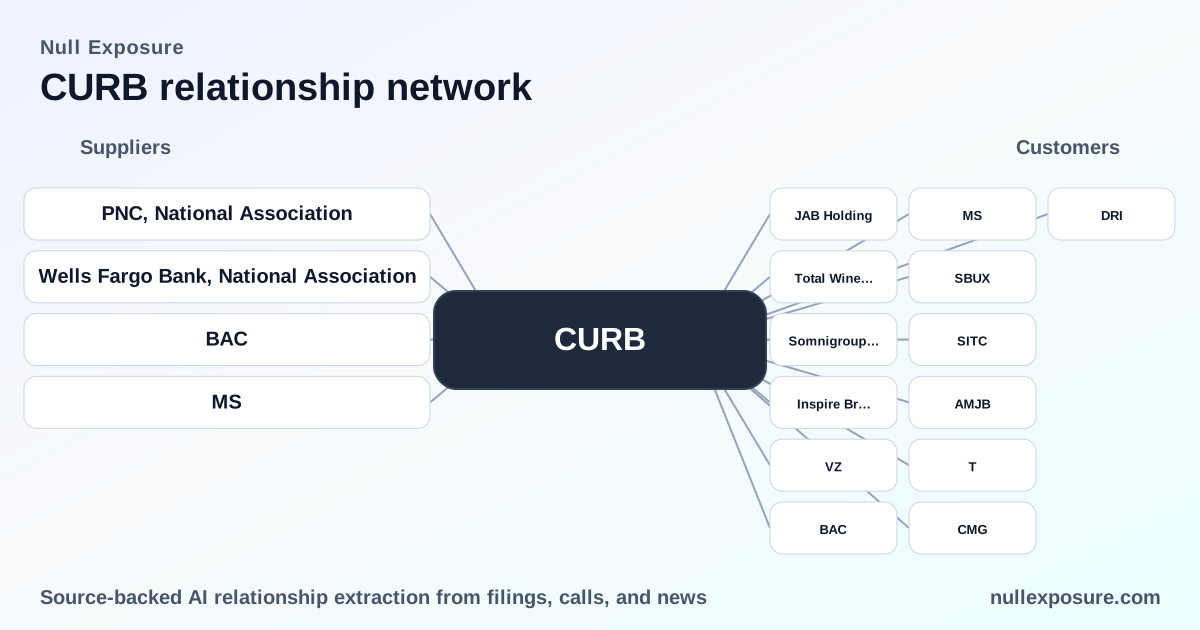
Curbline Properties (CURB) — tenant mix and counterparty map for investors
Curbline Properties operates and monetizes as a niche convenience‑shopping center REIT: it acquires, repositions and leases primarily service‑ and restaurant‑oriented retail properties across the U.S., generating recurring income through annualized base rents (ABR) and selective asset dispositions. The company’s revenue engine is a high‑occupancy, nationally‑anchored tenant base plus opportunistic capital markets activity (equity offerings and forward sales) to fund growth and portfolio rotation. For an institutional investor, the question is simple: stable cash rents from national tenants, balanced against relatively short lease lives and active capital markets use. Learn more at https://nullexposure.com/.
What investors need to know up front
Curbline’s portfolio is highly concentrated in national, large‑enterprise tenants, with over 70% of ABR from national tenants and public companies representing more than 29% of ABR, while no single tenant exceeds ~2% of total ABR — a profile that delivers diversification across many marquee brands but also exposes cash flow to the retail and service cycle. Occupancy and rent productivity are strong (94.1% occupancy; ABR per occupied sq ft $34.52 as of 12/31/2025), yet approximately 61% of ABR expires within five years without assumed renewals, which underlines roll‑through risk and the importance of leasing execution. The company also uses forward equity sales with major banks as a near‑term financing tool.
Key structural signals: long‑running Shared Services arrangements, U.S. geographic concentration, tenant mix dominated by service and restaurant operators, and active use of equity forwards to manage liquidity.
Capital markets counterparties and financing behavior
Curbline executed a common stock offering supported by forward sale agreements with major banks, signaling active equity market access rather than debt refinancing dependence.
- BofA Securities — Curbline entered forward sale agreements with BofA Securities as a forward purchaser in connection with an 8,000,000‑share sale announced in February 2026, showing direct capital markets engagement with a top global underwriter (press release via FinancialContent/BizWire, 2026‑02‑11).
- Morgan Stanley — Morgan Stanley acted alongside BofA as a forward purchaser with respect to the same 8,000,000 share forward sale, confirming competent access to institutional equity placement (press release via FinancialContent/BizWire, 2026‑02‑11).
How the tenant roster underpins cash flow
Curbline’s highest‑rent contributors are national retail and service names. The 2025 Form 10‑K publishes the largest tenants by ABR for investors to model lease concentration and re‑let risk.
- Starbucks (SBUX) — Starbucks represented 2.6% of shopping center base rental revenues and 1.4% of company GLA as of Dec. 31, 2025, making it the single largest tenant line item disclosed in the 2025 10‑K (CURB 2025 10‑K).
- Verizon (VZ) — Verizon accounted for 1.7% of shopping center ABR and 1.3% of GLA per the 2025 10‑K, confirming telecom’s role as a stable, footprinted tenant (CURB 2025 10‑K).
- Inspire Brands — Inspire Brands was disclosed at 1.4% of shopping center base rental revenues and 1.2% of GLA in the 2025 10‑K, reflecting quick‑service restaurant exposure (CURB 2025 10‑K).
- Somnigroup (Mattress Firm) — Mattress Firm contributed 1.2% of base rental revenues and 1.1% of owned shopping center GLA in FY2025, per the company’s 10‑K roster (CURB 2025 10‑K).
- JAB Holding — JAB Holding was listed at 1.2% of base rental revenues and 1.0% of GLA, indicating exposure to JAB‑owned retail concepts (CURB 2025 10‑K).
- Chipotle (CMG) — Chipotle represented 1.2% of shopping center ABR and 0.9% of GLA according to the 2025 10‑K, demonstrating food‑anchored tenancy (CURB 2025 10‑K).
- Total Wine & More — Total Wine & More was disclosed at 0.9% of base rental revenues and 1.0% of GLA in the 2025 10‑K (CURB 2025 10‑K).
- Darden (DRI) — Darden accounted for 1.0% of base rental revenues and 1.1% of GLA, providing exposure to full‑service dining operators (CURB 2025 10‑K).
- JPMorgan Chase (listed as AMJB) — JPMorgan Chase represented 1.0% of shopping center ABR and 0.7% of GLA, indicating financial services footprint in centers (CURB 2025 10‑K).
- AT&T (T) — AT&T was recorded at 1.1% of base rental revenues and 1.0% of GLA in the 2025 10‑K, another telecom tenant contributing recurring rent (CURB 2025 10‑K).
- SITE Centers (SITC) — The company reported amounts receivable from SITE Centers in its FY2025 results (reported in Q4/2025 release coverage), evidencing a commercial and operational linkage between the entities (press coverage summarizing FY2025 results, March 2026).
(For press summaries that list major tenants collectively, see TradingView coverage quoting the company’s 10‑K that highlights Starbucks, Verizon, and Inspire Brands as major tenants, March 2026.)
Operational constraints and company‑level signals investors should weigh
Curbline’s public filings and disclosures communicate a set of operating constraints that inform underwriting and portfolio stress testing:
- Contract duration dynamic: the company maintains both shorter convenience‑property leases — with ~61% of ABR expiring within five years without renewal assumptions — and explicit multi‑year shared services arrangements (company 10‑K disclosures).
- Counterparty profile: national and public company tenants account for the majority of ABR, a credit‑quality anchor that reduces single‑tenant risk but creates sector concentration in service and restaurant operators.
- Geography and addressable market: all properties are U.S.‑based and diversified across several regions (Southeast, Mid‑Atlantic, Southwest, Mountain and Texas), supporting liquidity in the private market for convenience retail.
- Relationship roles: Curbline is primarily a lessor and buyer of income‑producing assets, also acting as a seller when rotating assets; it documents a Shared Services Agreement that names SITE Centers as a service provider counterparty (10‑K and related disclosures; the Shared Services paragraph explicitly references SITE Centers).
- Portfolio health: high occupancy (94.1% at 12/31/2025) signals active portfolio management, but high near‑term lease expirations require sustained leasing performance to preserve ABR.
Quick reference: what each counterparty represents
- Starbucks (SBUX) — Largest disclosed tenant by ABR at 2.6% (1.4% GLA) in the 2025 10‑K, a core breakfast/coffee anchor for many centers (CURB 2025 10‑K).
- Verizon (VZ) — National telecom tenant at 1.7% of ABR (1.3% GLA) in FY2025 disclosures (CURB 2025 10‑K).
- Inspire Brands — Quick‑service franchise grouping at 1.4% of ABR (1.2% GLA) per the 2025 10‑K (CURB 2025 10‑K).
- Somnigroup / Mattress Firm — Specialty retail tenant at 1.2% of ABR and 1.1% GLA in the 10‑K listing (CURB 2025 10‑K).
- JAB Holding — Owner of branded retail concepts representing 1.2% of ABR (1.0% GLA) in the 10‑K tenant schedule (CURB 2025 10‑K).
- Chipotle (CMG) — Fast‑casual restaurant exposure at 1.2% of ABR and 0.9% GLA, per the 10‑K (CURB 2025 10‑K).
- Total Wine & More — Beverage retail anchor at ~0.9% of ABR in FY2025 disclosures (CURB 2025 10‑K).
- Darden (DRI) — Full‑service restaurant tenant at ~1.0% of ABR, noted in the 10‑K table (CURB 2025 10‑K).
- JPMorgan Chase (AMJB) — Financial services tenant contributing ~1.0% of ABR (CURB 2025 10‑K).
- AT&T (T) — Telecom tenant at ~1.1% of ABR (CURB 2025 10‑K).
- SITE Centers (SITC) — Operationally linked through receivables and a named Shared Services Agreement; the company discloses amounts receivable from SITE Centers and the management services agreement in its filings and earnings commentary (FY2025 results and related disclosures, March 2026).
- BofA Securities (BAC) — Forward purchaser in an 8,000,000‑share forward sale tied to the company’s February 2026 equity financing (press release via FinancialContent/BizWire, 2026‑02‑11).
- Morgan Stanley (MS) — Co‑forward purchaser with BofA in the same 2026 equity transaction (FinancialContent/BizWire, 2026‑02‑11).
Investment takeaways
Curbline offers predictable, rent‑driven cash flows supported by national tenant credit, but investors must underwrite near‑term lease expirations and active equity financing as integral to the company’s growth strategy. The tenant roster provides stable diversification across service and restaurant operators; the corporate ties to SITE Centers for shared services and the use of forward equity sales are central operational and financing levers to monitor.
For more structured counterparty mapping and actionable risk signals for institutional due diligence, visit https://nullexposure.com/.