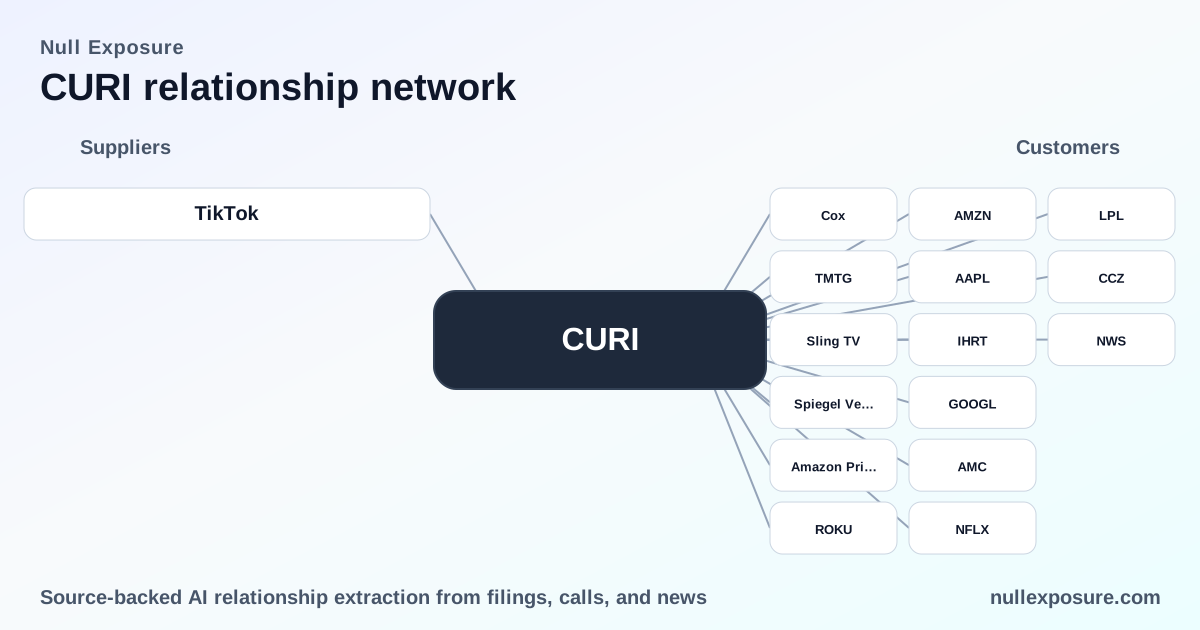
CuriosityStream (CURI) — Customer relationships that underwrite a niche factual streaming play
CuriosityStream monetizes through a three-pronged model: direct-to-consumer subscriptions, content licensing to linear and pay/virtual MVPD partners, and ad/sponsorship and transactional revenue from FAST, YouTube, TVOD and branded integrations. The company combines a subscription core with partner distribution deals that scale reach and licensing income; investors should evaluate both recurring D2C metrics and the concentration and commercial depth of partner license arrangements. For a concise view of CuriosityStream’s partner footprint, see https://nullexposure.com/.
Why partners matter to the investment thesis
CuriosityStream’s economics are subscription-first but distribution-dependent. The 10‑K and recent earnings commentary show Direct Business drives the majority of revenue by dollars, while license fees and FAST/partner placements amplify distribution, advertising inventory and one-off licensing receipts. This hybrid monetization lowers single-channel execution risk but increases commercial reliance on large platform partners for audience scale and ad monetization.
- The company reports direct subscriptions as the primary revenue source and recognizes license fees from MVPDs and vMVPDs.
- CuriosityStream also generates usage-based TVOD receipts and sells ad/sponsorship inventory across FAST channels and social platforms.
If you want a partner-level summary for commercial diligence, Null Exposure tracks these relationships in one place: https://nullexposure.com/.
All reported customer relationships — plain-English summaries and sources
Spiegel Venture
CuriosityStream reported license fee revenue of $0.2 million in FY2024 from Spiegel Venture, down from $1.1 million in 2023, showing a modest but disclosed licensing relationship in the 10‑K (FY2024 10‑K).
Amazon Prime
CuriosityStream lists Amazon Prime as a vMVPD partner that contributes license fee revenue, confirming Prime is a distribution outlet for CuriosityStream’s content in FY2024 (FY2024 10‑K).
TMTG
CuriosityStream cited multifaceted agreements with TMTG in its Q3 2025 earnings call as part of the company’s expanding partner program, signaling new commercial or content distribution arrangements (Q3 2025 earnings call).
Cox
Cox is identified among MVPDs that pay license fees to CuriosityStream, indicating traditional pay‑TV carriage in the company’s FY2024 disclosures (FY2024 10‑K).
Sling TV
Sling TV is listed as a vMVPD source of license revenues, demonstrating CuriosityStream’s presence on over‑the‑top pay platforms in FY2024 (FY2024 10‑K).
AMZN
The ticker AMZN shows up in earnings commentary confirming extensions with Amazon as a growth support point in Q3 2025, consistent with broader Prime/Prime Video commercial activity (Q3 2025 earnings call).
Amazon
Earnings call references to Amazon reiterate platform extensions and distribution activity that support CuriosityStream’s growth trajectory reported in Q3 2025 (Q3 2025 earnings call).
ROKU
CuriosityStream announced launches of FAST channels on Roku during Q3 2025 commentary, reflecting channel distribution and FAST monetization on that platform (Q3 2025 earnings call).
Roku
Roku is separately referenced in the same Q3 2025 call as a destination for CuriosityStream’s U.S. Hispanic and flagship FAST channels, highlighting platform breadth (Q3 2025 earnings call).
Prime Video
News coverage in FY2025 documented CuriosityStream launching as an add‑on subscription on Prime Video in Australia and New Zealand, expanding its international retail channel placement (press release reported on Silicon.co.uk, FY2025).
Apple Books
CuriosityStream’s Curiosity Audio Network has collaborative distribution with Apple Books for audio content, as described in a WorldScreen report about content partnerships (WorldScreen, FY2025).
iHeartMedia
iHeartMedia is a named collaborator on the Curiosity Audio Network, indicating audio distribution and branded content partnerships beyond video (WorldScreen, FY2025).
IHRT
The IHRT ticker entry mirrors the iHeartMedia relationship noted in press coverage of the company’s audio initiatives (WorldScreen, FY2025).
Netflix
CuriosityStream disclosed a major series premiere on Netflix in FY2025 press/earnings commentary, confirming traditional licensor activity to the global streamers (investing.com transcript, FY2025).
AMC
CuriosityStream lists AMC among traditional broadcaster and streamer licensing partners, demonstrating continued content sales into linear and premium cable channels (Q3 2025 earnings call).
GOOGL
CuriosityStream describes using Google platforms to deliver advertising and display inventory (including YouTube) as part of its advertising and sponsorship strategy in FY2026 company commentary (MarketScreener, FY2026).
YouTube
YouTube is explicitly identified as a distribution channel for ad‑supported content and digital display ads, supporting CuriosityStream’s ad revenue initiatives (MarketScreener, FY2026).
A FY2024 news item alleges CuriosityStream used the Meta pixel for web tracking, raising privacy and compliance questions with respect to Facebook data sharing (ClassAction.org, FY2024).
Prime Video Channels
CuriosityStream reported retail launches with channel partners such as Prime Video Channels in FY2025, confirming another Prime distribution vector for D2C and partner subscribers (investing.com earnings transcript, FY2025).
Audible
Audible is cited as a collaborator on the Curiosity Audio Network, extending the company’s licensed audio footprint into audiobook/podcast platforms (WorldScreen, FY2025).
LG
CuriosityStream confirmed its FAST channels launched on LG platforms in Q3 2025, indicating presence in connected TV app ecosystems beyond Roku and Amazon (Q3 2025 earnings call).
Comcast
Comcast is listed among MVPDs providing license fee revenue to CuriosityStream, underscoring carriage agreements with major U.S. cable operators in FY2024 disclosures (FY2024 10‑K).
CCZ
The duplicate CCZ entry corresponds to Comcast references in the FY2024 filings and shows that major MVPDs are explicit license fee conduits (FY2024 10‑K).
Foxtel
CuriosityStream named Foxtel as a traditional content partner in earnings commentary, indicating distribution into Australian pay‑TV markets (Q3 2025 earnings call).
Operational constraints and company‑level signals investors should watch
CuriosityStream’s filings and commentary produce a coherent operating profile:
- Contracting posture: The business is primarily subscription-based for Direct Business (monthly/annual billing recognized ratably) with meaningful license agreements for MVPD/vMVPD partners and incremental usage-based TVOD revenue. These mixed contract types shape revenue predictability and seasonality.
- Customer concentration and criticality: Direct Business accounted for the majority of revenue, while MVPD/vMVPD license fees provide material but smaller contributions; the company characterizes Direct Business as the material revenue driver in FY2024 disclosures.
- Geography and reach: The service is global (available in 175+ countries) but with significant U.S. concentration on a dollar basis — U.S. revenue represented a majority of reported sales in FY2024.
- Relationship roles: CuriosityStream operates as a licensee to larger broadcasters and streamers for content placements and as a licensor of its own factual content to third parties; advertising and sponsorship sales are an increasingly important services segment.
- Business maturity: The company runs as a single operating segment focused on premium factual content, combining mature subscription mechanics with ongoing expansion into FAST, audio and third‑party platform placements.
These company‑level constraints create a revenue mix that balances recurring subscription cashflow with variable partner and ad income, and they define both upside catalysts (platform expansions, FAST monetization) and exposure (platform dependence, privacy/regulatory scrutiny).
Bottom line for investors
CuriosityStream is a niche factual streamer with subscription economics at the core and a broad web of distribution and licensing partners extending reach and monetization. Key investment considerations are partner concentration (Amazon/Prime Video, Roku, major MVPDs), the success of FAST/ad monetization, and any regulatory or privacy issues tied to third‑party tracking. For a partner‑centric diligence checklist and ongoing relationship monitoring, visit https://nullexposure.com/.
Bold takeaway: CuriosityStream’s upside depends on executing on partner distribution and ad monetization while protecting its recurring subscription base; investor returns will track both subscriber trends and the economics of large platform placements.