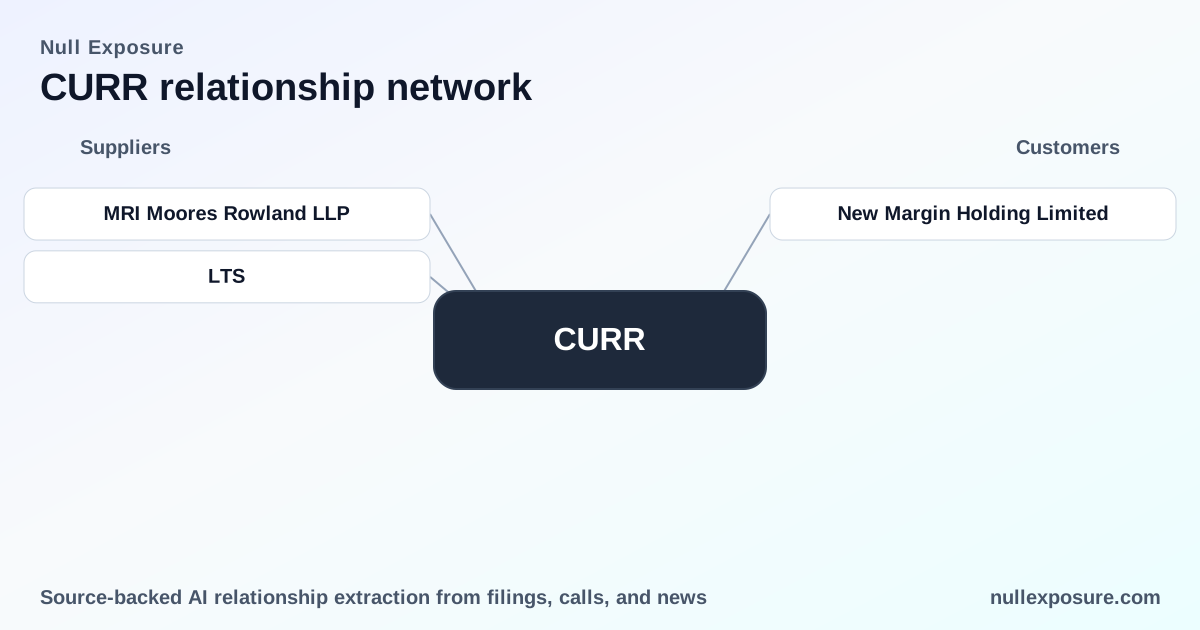
Currenc Group (CURR): What the customer relationships reveal about strategy, risk and optionality
Currenc Group operates as a B2B fintech that monetizes through remittance and airtime services, supporting licensed financial institutions, payment gateways and money service businesses with cross-border settlement, and is actively repositioning toward AI and Web3 product lines. The company generates revenue from transaction fees and airtime sales while treating certain crypto facilitation activities as agency arrangements, and it has recently executed a material corporate transaction that reshapes its customer footprint and balance sheet. For a concise tracker of these counterparties and implications, see NullExposure’s coverage at https://nullexposure.com/.
Quick investor thesis
Currenc is a capital-light service operator of global remittance rails and airtime distribution with concentrated enterprise counterparty exposure and significant retail reach through distribution partners. The US$400 million divestment of a controlling Tranglo stake accelerates a strategic pivot to higher-margin AI/Web3 offerings while materially changing the company’s cash position and revenue composition; investors should weight improved liquidity against reduced ownership of a global payments hub.
The headline relationship: New Margin Holding Limited — divestment of Tranglo
Currenc’s subsidiary Seamless Group executed a definitive agreement to sell its 60% controlling interest in Tranglo Sdn. Bhd. to New Margin Holding Limited for US$400 million. This is a cash transaction announced in FY2026 that transfers control of one of Currenc’s core cross-border payment assets to New Margin. (Source: company release reported by Yahoo Finance and contemporaneous coverage on March 9, 2026.)
Implication: this transaction converts a strategic payments asset into liquidity, enabling Currenc to accelerate investment in AI and Web3 while reducing direct exposure to remittance operational complexity and regulatory footprint. Multiple news outlets summarized the sale as part of a strategic realignment toward AI-driven solutions (see Quiver Quant and InvestingNews coverage, March 2026).
A secondary commercial tie: GLXG / Galaxy Payroll — product integration
A recent press mention links Currenc with Galaxy Payroll (ticker GLXG) in a partnership to integrate Currenc’s AI and stablecoin technology into HR payment solutions, positioning payroll as a distribution channel for digital-asset-enabled payouts. The reference appears in a March 2026 NewMediaWire item aggregated by Finviz. (Source: Finviz summary citing NewMediaWire, March 2026.)
Implication: this relationship signals commercialization of Currenc’s AI and tokenized-payments stack into enterprise HR/payroll workflows, which could open new recurring revenue avenues if adoption scales across GLXG’s client base.
How every disclosed relationship fits the business picture
- New Margin Holding Limited — Currenc divested its controlling 60% interest in Tranglo to New Margin for US$400 million; the transaction is documented in multiple press releases and news reports in March–May 2026. (Sources: Yahoo Finance, Quiver Quant, InvestingNews and ManilaTimes, March–May 2026.)
- GLXG (Galaxy Payroll) — Press coverage links Currenc to Galaxy Payroll for an integration of AI and stablecoin capabilities into HR solutions; coverage is summarized on Finviz from a NewMediaWire release in March 2026. (Source: Finviz / NewMediaWire, March 2026.)
Company-level constraints and operating signals investors need to price
Currenc’s disclosed counterparty footprints and public excerpts generate several durable signals about its operating model and business risks:
- Contracting posture — agent and service provider orientation. The company explicitly states it acts as an agent when facilitating cryptocurrency transactions, and it positions Tranglo as an upstream B2B remittance hub; this indicates Currenc typically operates in an intermediary/service-provider role rather than as a principal market-maker for many flows.
- Counterparty mix — both retail-facing and large-enterprise clients. Evidence shows end-user reach via retail distribution partners (for example WalletKu’s ~128,000 merchant/individual users) alongside enterprise relationships (Tranglo’s bank and eWallet partners). This dual posture requires different commercial contracts and compliance controls.
- Geographic footprint — global with APAC concentration. Tranglo’s network historically covered 100+ countries and 500 mobile operators, while revenue disclosures highlight significant Malaysia and Indonesia exposure, underscoring region-specific regulatory and FX risks.
- Segment maturity — remittance and airtime as established cash-generating lines; AI/Web3 as strategic growth initiatives. The remittance/airtime businesses are operationally mature, but Currenc is reallocating capital and management focus toward AI and tokenized payment products, a shift made explicit by the Tranglo divestiture.
- Spend and scale signals. Reported airtime distribution flows in the tens of millions (WalletKu distributed ~$14.5 million in airtime in FY2024) indicate customer spend bands that can reach mid-double-digit millions, validating enterprise-scale revenue potential from distribution partners.
- Concentration and criticality. The prior ownership of Tranglo represented concentration risk and operational criticality for cross-border payment volume; selling 60% transfers both control and related operational dependencies to a third party, lowering concentration but also reducing direct control over settlement rails.
Financial context to ground relationship impact
According to the company’s most recent quarter (LatestQuarter 2025-12-31), Revenue TTM was about $37.8 million with a negative EPS of -$0.29, and a market capitalization near $369 million. The US$400 million consideration for Tranglo is therefore a capital event large enough to materially change the balance sheet and funding capacity, and should be evaluated against working capital needs, potential shareholder returns, or reinvestment into AI/Web3 product development.
Investor takeaways and risks
- Positive: liquidity and strategic optionality. The Tranglo sale to New Margin delivers a significant cash infusion that funds Currenc’s pivot and reduces direct operational burdens tied to cross-border settlement.
- Negative: reduction of a core revenue-generating asset and residual counterparty risk. As ownership of a payments hub shrinks, near-term revenue and margin profiles could shift, and Currenc’s future growth will hinge on execution of its AI/Web3 commercialization plans.
- Execution risk on productization and partnerships. Early-stage partnerships (for example with GLXG) are promising but require scale and regulatory clarity to generate material recurring revenue.
- Operational complexity remains high. Despite the divestiture, the company still operates in regulated cross-border and crypto-adjacent spaces that demand strong compliance frameworks and contract discipline.
For a deeper read on how these relationships change Currenc’s risk/reward profile and to track subsequent counterparty developments, visit NullExposure’s research hub at https://nullexposure.com/.
Bold headline takeaway: the New Margin transaction materially de-risks operational concentration while funding Currenc’s strategic pivot; the investor case now rests on execution of AI/Web3 commercialization and the company’s ability to convert early partnerships into scalable revenue.